Ch. R - Algebra Review
Lial - Trigonometry 12th Edition
Lial12th EditionTrigonometryISBN: 9780136552161, 9780135440780, 9780136881117, 9780135440827, 9780135924891Non è quello che usi tu?Cambia libro di testo
Capitolo 1, Problema 52

Give (a) the additive inverse and (b) the absolute value of each number. 0.16

Guida verificata passo dopo passo
1
Identify the given number, which is 0.16.
To find the additive inverse of a number, change its sign. So, the additive inverse of 0.16 is \(-0.16\).
Recall that the absolute value of a number is its distance from zero on the number line, always non-negative.
Since 0.16 is already positive, its absolute value is simply \(0.16\).
Summarize: (a) Additive inverse is \(-0.16\), and (b) absolute value is \(0.16\).

Risposta video verificata per un problema simile:

Questa soluzione video è stata consigliata dai nostri tutor come utile per risolvere questo problema.
Durata del video:
1m

Concetti chiave

Ecco i concetti essenziali che devi comprendere per rispondere correttamente alla domanda.

Additive Inverse

The additive inverse of a number is the value that, when added to the original number, results in zero. For any real number x, its additive inverse is -x. This concept is fundamental in solving equations and understanding number properties.
Video consigliato:
Percorso guidato
4:49
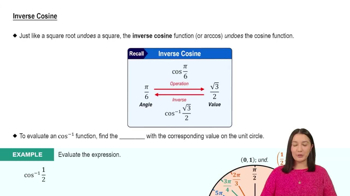
Inverse Cosine

Absolute Value

The absolute value of a number is its distance from zero on the number line, regardless of direction. It is always non-negative. For a number x, the absolute value is denoted |x| and equals x if x is positive or zero, and -x if x is negative.
Video consigliato:
Percorso guidato
7:28
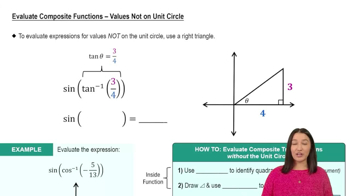
Evaluate Composite Functions - Values Not on Unit Circle

Real Numbers and Their Properties

Real numbers include all rational and irrational numbers and can be positive, negative, or zero. Understanding their properties, such as how additive inverses and absolute values apply, is essential for manipulating and interpreting numerical expressions.
Video consigliato:
Percorso guidato
3:31
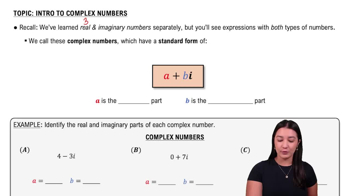
Introduction to Complex Numbers