Ch. R - Algebra Review
Lial - Trigonometry 12th Edition
Lial12th EditionTrigonometryISBN: 9780136552161, 9780135440780, 9780136881117, 9780135440827, 9780135924891Non è quello che usi tu?Cambia libro di testo
Capitolo 1, Problema 77

Graph each function. See Examples 6–8. _ ƒ(x) = 2√x + 1

Guida verificata passo dopo passo
1
Identify the function to be graphed: \(f(x) = 2\sqrt{x} + 1\). This is a transformation of the basic square root function \(y = \sqrt{x}\).
Recall the basic shape of \(y = \sqrt{x}\), which starts at the origin \((0,0)\) and increases slowly to the right, only defined for \(x \geq 0\).
Apply the vertical stretch by a factor of 2 to the function, changing it to \(y = 2\sqrt{x}\). This means every output value of \(\sqrt{x}\) is multiplied by 2, making the graph steeper.
Apply the vertical shift upward by 1 unit, resulting in \(f(x) = 2\sqrt{x} + 1\). This moves the entire graph of \(2\sqrt{x}\) up by 1 on the y-axis.
Plot key points by choosing values of \(x\) (such as 0, 1, 4, 9), calculate \(f(x)\) for each, and then sketch the curve starting at \((0,1)\) and increasing to the right, reflecting the transformations.

Risposta video verificata per un problema simile:

Questa soluzione video è stata consigliata dai nostri tutor come utile per risolvere questo problema.
Durata del video:
2m

Concetti chiave

Ecco i concetti essenziali che devi comprendere per rispondere correttamente alla domanda.

Understanding the Square Root Function

The square root function, √x, outputs the non-negative value whose square is x. It is defined only for x ≥ 0 in the real number system. Graphing this function involves plotting points where y = √x, resulting in a curve starting at the origin and increasing slowly.
Video consigliato:
Percorso guidato
2:20
Imaginary Roots with the Square Root Property

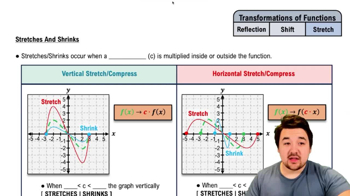
Function Transformations: Vertical Stretch and Shift

Multiplying a function by a constant greater than 1, like 2√x, vertically stretches the graph, making it steeper. Adding a constant, such as +1, shifts the entire graph upward by that amount. Understanding these transformations helps in accurately sketching the modified function.
Video consigliato:
Percorso guidato
6:02
Stretches and Shrinks of Functions

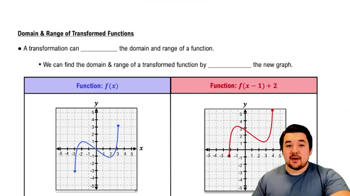
Domain and Range of the Function

The domain of ƒ(x) = 2√x + 1 is all x ≥ 0 because the square root is undefined for negative inputs. The range is y ≥ 1 since the smallest value of 2√x is 0, and adding 1 shifts the minimum output to 1. Recognizing domain and range is essential for correct graphing.
Video consigliato:
Percorso guidato
4:22
Domain and Range of Function Transformations