Ch. R - Algebra Review
Lial - Trigonometry 12th Edition
Lial12th EditionTrigonometryISBN: 9780136552161, 9780135440780, 9780136881117, 9780135440827, 9780135924891Non è quello che usi tu?Cambia libro di testo
Capitolo 1, Problema R.2.113

Identify the property illustrated in each statement. Assume all variables represent real numbers. (5x) • (1/5x) = 5 ( x • 1/x )

Guida verificata passo dopo passo
1
Observe the given expression: \((5x) \left( \frac{1}{x} \right) = 5 \left( x \cdot \frac{1}{x} \right)\).
Recognize that the expression shows how multiplication distributes over another operation, specifically how a product can be separated or grouped.
Recall the Distributive Property, which states that for all real numbers \(a\), \(b\), and \(c\), $a(b + c) = ab + ac$. However, here we are dealing with multiplication and division, so consider how multiplication interacts with division.
Notice that multiplying \$5x$ by \(\frac{1}{x}\) can be rewritten as \(5\) times the product of $x$ and \(\frac{1}{x}\), which is exactly what the right side shows: \(5 \left( x \cdot \frac{1}{x} \right)\).
Conclude that this illustrates the Associative Property of Multiplication, which allows us to regroup factors without changing the product, i.e., \((ab)c = a(bc)\).

Risposta video verificata per un problema simile:

Questa soluzione video è stata consigliata dai nostri tutor come utile per risolvere questo problema.
Durata del video:
2m

Concetti chiave

Ecco i concetti essenziali che devi comprendere per rispondere correttamente alla domanda.

Distributive Property of Multiplication over Division

This property states that multiplying a product by a fraction is equivalent to multiplying each factor by the fraction separately. In the given expression, (5x) * (1/x) = 5 * (x * 1/x), the multiplication distributes over the division, simplifying the expression.
Video consigliato:
Percorso guidato
7:48
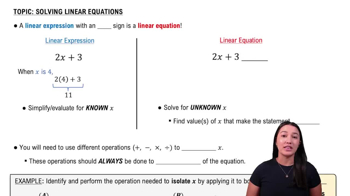
Solving Linear Equations

Simplification of Fractions

Simplifying fractions involves reducing expressions by canceling common factors in the numerator and denominator. Here, x in the numerator and denominator cancels out, which is essential to understand how the expression simplifies to 5.
Video consigliato:
Percorso guidato
4:02
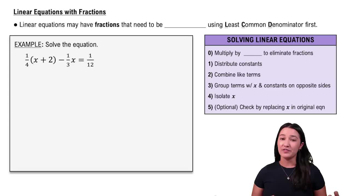
Solving Linear Equations with Fractions

Properties of Real Numbers

Real numbers follow specific algebraic rules such as commutativity, associativity, and distributivity. Recognizing these properties helps in manipulating and simplifying expressions involving variables and constants, as seen in the problem.
Video consigliato:
Percorso guidato
3:31
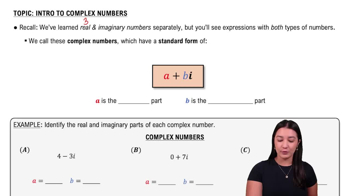
Introduction to Complex Numbers