Ch. R - Algebra Review
Lial - Trigonometry 12th Edition
Lial12th EditionTrigonometryISBN: 9780136552161, 9780135440780, 9780136881117, 9780135440827, 9780135924891Non è quello che usi tu?Cambia libro di testo
Capitolo 1, Problema R.2.115

Identify the property illustrated in each statement. Assume all variables represent real numbers. 5 + √3 is a real number.

Guida verificata passo dopo passo
1
Recognize that the problem asks to identify the property illustrated by the expression \(5 + \sqrt{3}\), where all variables represent real numbers.
Recall that the set of real numbers is closed under addition, meaning that the sum of any two real numbers is also a real number.
Note that \(5\) is a real number and \(\sqrt{3}\) is also a real number because the square root of a positive real number is real.
Apply the closure property of addition: since both \(5\) and \(\sqrt{3}\) are real numbers, their sum \(5 + \sqrt{3}\) must also be a real number.
Conclude that the property illustrated here is the Closure Property of Addition for real numbers.

Risposta video verificata per un problema simile:

Questa soluzione video è stata consigliata dai nostri tutor come utile per risolvere questo problema.
Durata del video:
2m

Concetti chiave

Ecco i concetti essenziali che devi comprendere per rispondere correttamente alla domanda.

Real Numbers

Real numbers include all rational and irrational numbers that can be found on the number line. They encompass integers, fractions, and roots like √3, representing quantities with magnitude but no imaginary component.
Video consigliato:
Percorso guidato
3:31
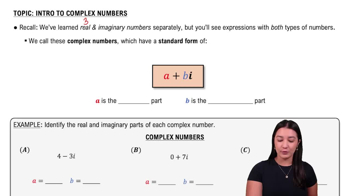
Introduction to Complex Numbers

Properties of Real Numbers

Real numbers are closed under addition, meaning the sum of any two real numbers is also a real number. This property ensures expressions like 5 + √3 remain within the set of real numbers.
Video consigliato:
Percorso guidato
3:31
Introduction to Complex Numbers

Irrational Numbers

Irrational numbers cannot be expressed as a simple fraction and have non-repeating, non-terminating decimal expansions. √3 is an example, and when added to a rational number like 5, the result is still a real number.
Video consigliato:
Percorso guidato
3:31
Introduction to Complex Numbers