Ch. R - Algebra Review
Lial - Trigonometry 12th Edition
Lial12th EditionTrigonometryISBN: 9780136552161, 9780135440780, 9780136881117, 9780135440827, 9780135924891Non è quello che usi tu?Cambia libro di testo
Capitolo 1, Problema 87

Use an inequality symbol to write each statement. 5 + 0 is not equal to 0.

Guida verificata passo dopo passo
1
Identify the two expressions being compared: the left side is \(5 + 0\) and the right side is \(0\).
Calculate the value of the left side: \(5 + 0 = 5\).
Recognize that the problem states "is not equal to," which corresponds to the inequality symbol \(\neq\).
Write the inequality using the expressions and the symbol: \(5 + 0 \neq 0\).
This inequality shows that the sum of 5 and 0 is not equal to 0, which matches the given statement.

Risposta video verificata per un problema simile:

Questa soluzione video è stata consigliata dai nostri tutor come utile per risolvere questo problema.
Durata del video:
44s

Concetti chiave

Ecco i concetti essenziali che devi comprendere per rispondere correttamente alla domanda.

Inequality Symbols

Inequality symbols are used to compare two values and show their relationship. Common symbols include < (less than), > (greater than), ≤ (less than or equal to), ≥ (greater than or equal to), and ≠ (not equal to). In this question, the symbol ≠ is used to indicate that two values are not equal.
Video consigliato:
Percorso guidato
5:10
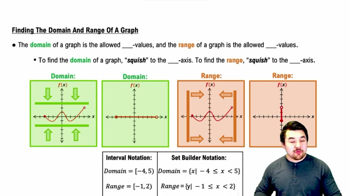
Finding the Domain and Range of a Graph

Evaluating Expressions

Evaluating expressions involves performing arithmetic operations to simplify or find the value of an expression. Here, 5 + 0 simplifies to 5, which helps in comparing it to 0 to determine the correct inequality symbol.
Video consigliato:
Percorso guidato
3:48
Evaluate Composite Functions - Special Cases

Writing Mathematical Statements

Writing mathematical statements requires translating verbal descriptions into symbolic form. The phrase 'is not equal to' corresponds to the inequality symbol ≠, which is used to express that two quantities differ.
Video consigliato:
Percorso guidato
06:03
Equations of Circles & Ellipses