Ch. R - Algebra Review
Lial - Trigonometry 12th Edition
Lial12th EditionTrigonometryISBN: 9780136552161, 9780135440780, 9780136881117, 9780135440827, 9780135924891Non è quello che usi tu?Cambia libro di testo
Capitolo 1, Problema 83

Use an inequality symbol to write each statement. 5 is greater than or equal to 5.

Guida verificata passo dopo passo
1
Identify the two quantities being compared: 5 and 5.
Recognize the phrase 'greater than or equal to' corresponds to the inequality symbol \(\geq\).
Write the inequality by placing the first number on the left, the inequality symbol in the middle, and the second number on the right.
Express the statement as \(5 \geq 5\).
This inequality means that 5 is either greater than or exactly equal to 5, which is true.

Risposta video verificata per un problema simile:

Questa soluzione video è stata consigliata dai nostri tutor come utile per risolvere questo problema.
Durata del video:
1m

Concetti chiave

Ecco i concetti essenziali che devi comprendere per rispondere correttamente alla domanda.

Inequality Symbols

Inequality symbols are used to compare two values or expressions. Common symbols include '<' (less than), '>' (greater than), '≤' (less than or equal to), and '≥' (greater than or equal to). They help express relationships where values are not necessarily equal.
Video consigliato:
Percorso guidato
5:10
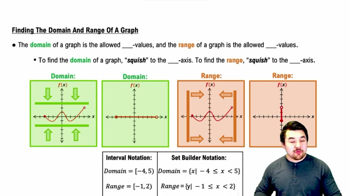
Finding the Domain and Range of a Graph

Greater Than or Equal To (≥) Symbol

The 'greater than or equal to' symbol (≥) indicates that the value on the left is either larger than or exactly equal to the value on the right. For example, '5 ≥ 5' means 5 is equal to or greater than 5, which is true.
Video consigliato:
Percorso guidato
3:47
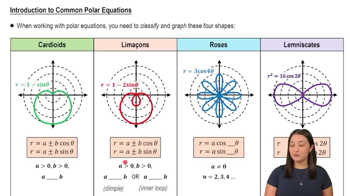
Introduction to Common Polar Equations

Translating Verbal Statements to Mathematical Expressions

This concept involves converting words into mathematical symbols or equations. Understanding key phrases like 'greater than or equal to' allows one to write precise mathematical inequalities, facilitating clearer communication and problem solving.
Video consigliato:
Percorso guidato
4:42
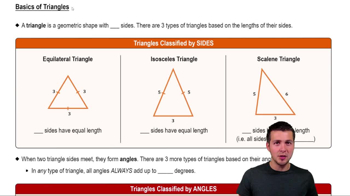
Review of Triangles