Skip to main content
Anatomy & Physiology
나의 코스
배우기
시험 준비
AI 튜터
학습 가이드
교과서적 해결책
플래시카드
탐험해 보세요
앱을 사용해 보세요
나의 코스
배우기
시험 준비
AI 튜터
학습 가이드
교과서적 해결책
플래시카드
탐험해 보세요
앱을 사용해 보세요
뒤로
8A-LE3-Anatomy & Physiology
카드를 뒤집기 위해 탭할 수 있습니다.
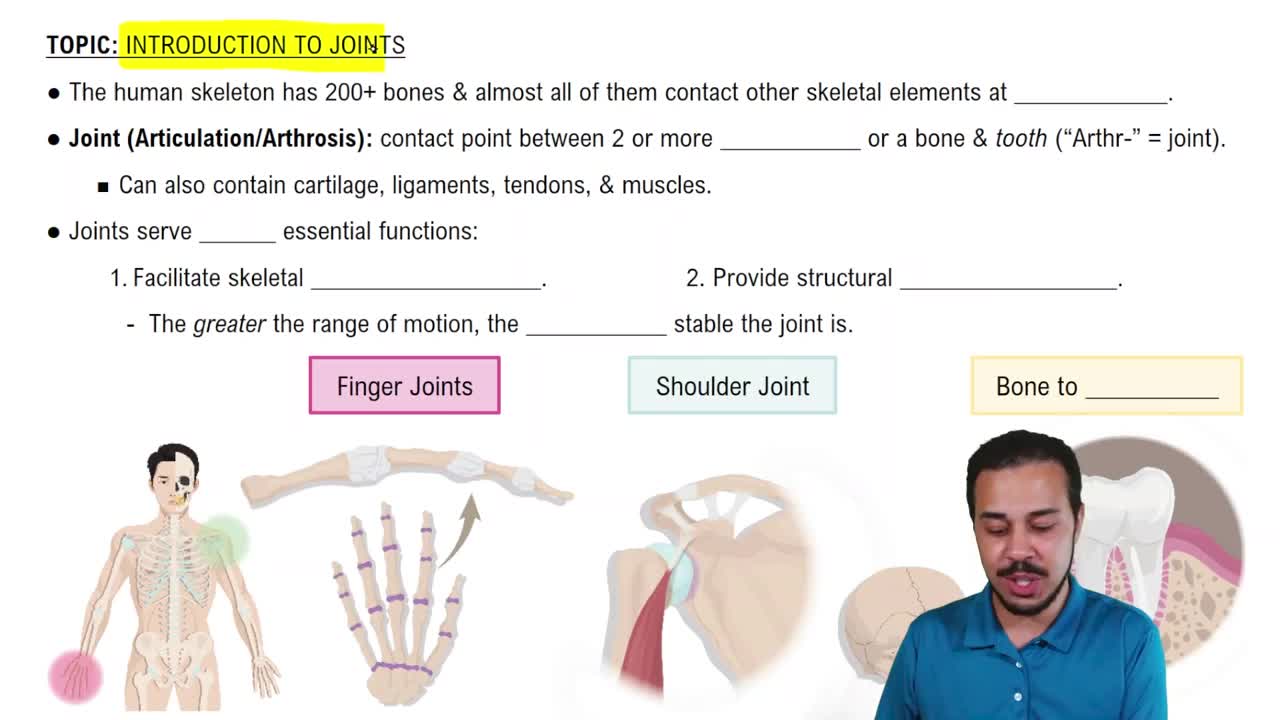
What are the two primary functions of joints (articulations)?
카드를 뒤집기 위해 탭할 수 있습니다.
👆
What are the two primary functions of joints (articulations)?
Mobility
to allow movement and
stability
to hold the skeleton together.
진행 상황 추적
컨트롤 버튼이 '내비게이션' 모드로 변경되었습니다.
1/23
추천 영상
VideoThumbView.guidedCourse
04:06
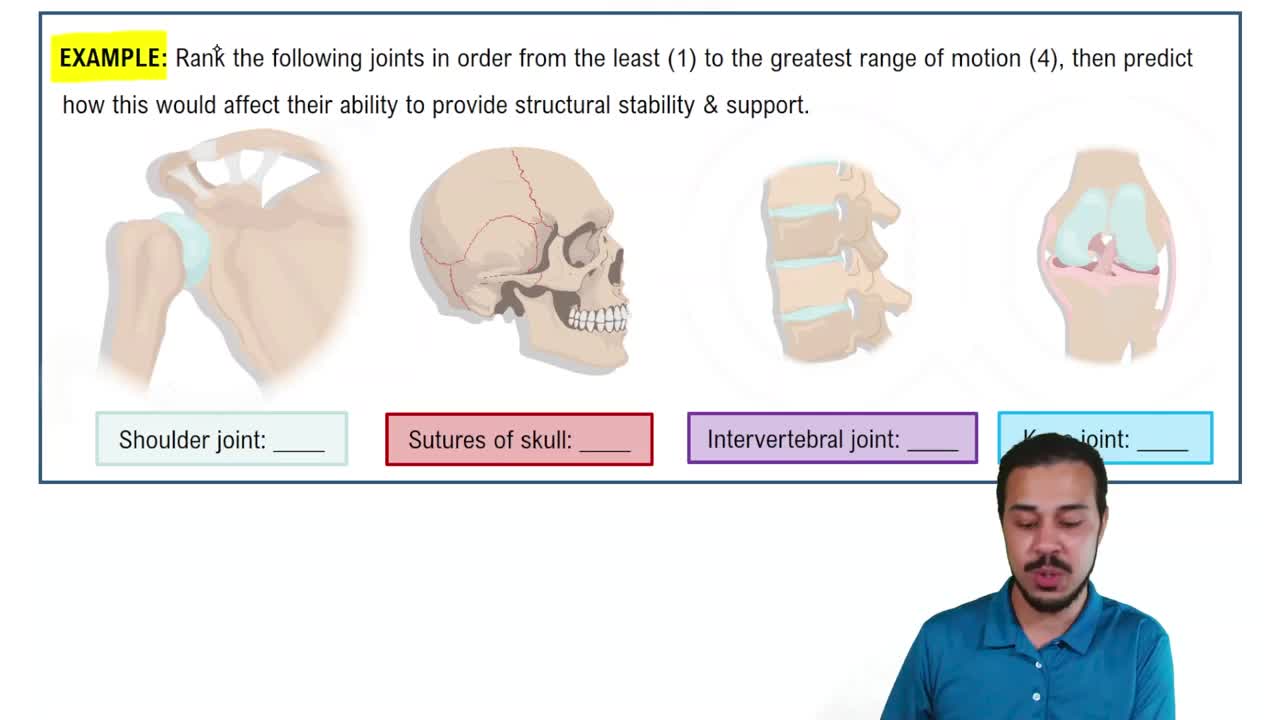
Introduction to Joints Example 1
11996
views
270
rank
VideoThumbView.guidedCourse
05:29
Map of the Lesson on Joints
12528
views
265
rank
1
comments
VideoThumbView.guidedCourse
05:39
Introduction to Joints
16804
views
432
rank
이 집합의 용어 (23)
하이드의 정의
What are the two primary functions of joints (articulations)?
Mobility
to allow movement and
stability
to hold the skeleton together.
How are joints structurally classified?
Based on the material binding bones and presence of a joint cavity:
Fibrous
,
Cartilaginous
, and
Synovial
joints.
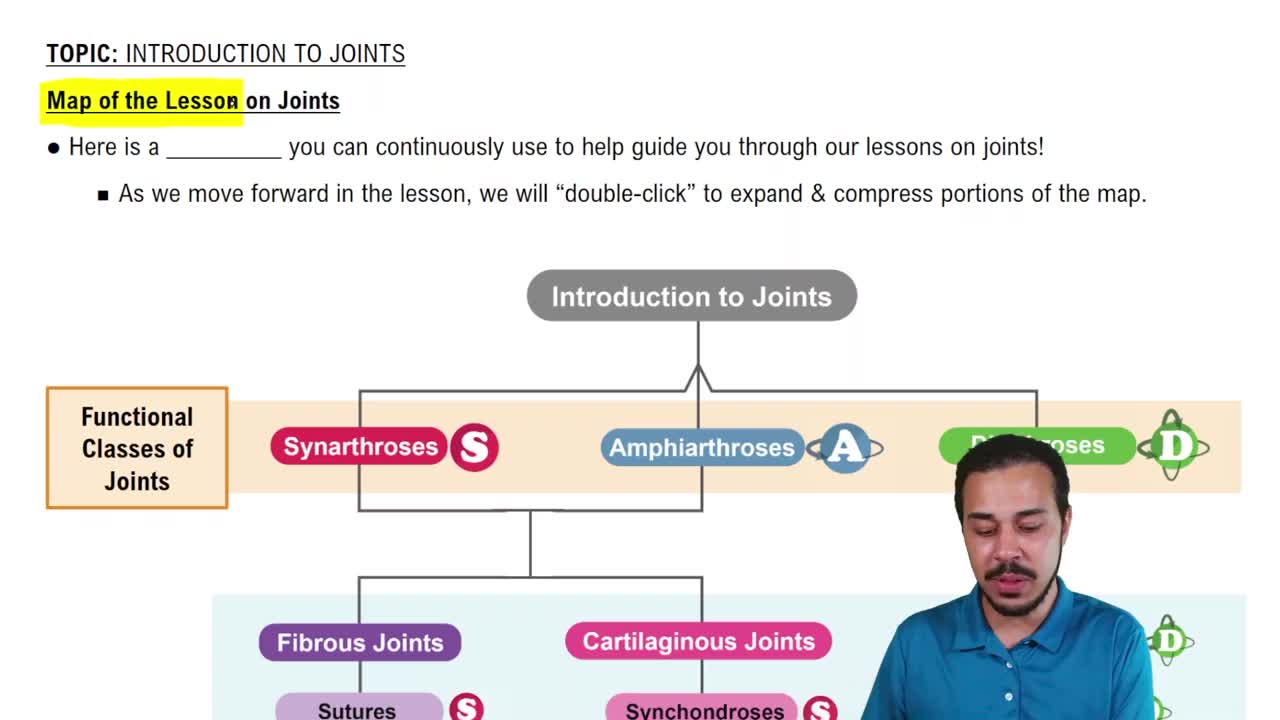
What are the functional classifications of joints?
Synarthroses
(immovable),
Amphiarthroses
(slightly movable), and
Diarthroses
(freely movable).
What characterizes fibrous joints?
Bones united by dense fibrous connective tissue with no joint cavity; mostly immovable.
Name the three types of fibrous joints.
Sutures
(skull),
Syndesmoses
(ligament connections), and
Gomphoses
(teeth in sockets).
What unites cartilaginous joints and how movable are they?
United by cartilage with no joint cavity; they are immovable or slightly movable.
What are the two types of cartilaginous joints?
Synchondroses
(hyaline cartilage, mostly immovable) and
Symphyses
(fibrocartilage, slightly movable).
What defines synovial joints?
Bones separated by a fluid-filled joint cavity; all are freely movable (diarthrotic).
List the six general features of synovial joints.
1. Articular cartilage, 2. Joint cavity, 3. Articular capsule, 4. Synovial fluid, 5. Reinforcing ligaments, 6. Nerves and blood vessels.
What is the function of synovial fluid?
Lubricates and nourishes articular cartilage and contains phagocytic cells.
What are bursae and tendon sheaths?
Bags of synovial fluid that reduce friction where tissues rub together; tendon sheaths wrap around tendons.
What is the difference between origin and insertion in muscle attachment?
Origin is the immovable bone; insertion is the movable bone that moves toward the origin during contraction.
Define flexion and extension.
Flexion
decreases the joint angle;
extension
increases the joint angle.
What is hyperextension?
Movement of a joint beyond its normal anatomical position.
Define abduction and adduction.
Abduction
moves a limb away from the midline;
adduction
moves it toward the midline.
What is circumduction?
A circular movement combining flexion, abduction, extension, and adduction, describing a cone in space.
Explain medial and lateral rotation.
Medial rotation
turns a bone toward the midline;
lateral rotation
turns it away from the midline.
What are supination and pronation of the forearm?
Supination
: palms face anteriorly with radius and ulna parallel;
pronation
: palms face posteriorly with radius crossing over ulna.
Define dorsiflexion and plantar flexion of the foot.
Dorsiflexion
bends the foot toward the shin;
plantar flexion
points the toes downward.
What are inversion and eversion of the foot?
Inversion
turns the sole medially;
eversion
turns the sole laterally.
Describe protraction and retraction.
Protraction
moves a body part forward;
retraction
moves it backward.
What do elevation and depression refer to in joint movement?
Elevation
lifts a body part superiorly;
depression
lowers a body part.
What is opposition in hand movement?
Movement of the thumb to touch the tips of other fingers, enabling grasping.
 뒤로뒤로
 04:06