Skip to main content
Anatomy & Physiology
나의 코스
배우기
시험 준비
AI 튜터
학습 가이드
교과서적 해결책
플래시카드
탐험해 보세요
앱을 사용해 보세요
나의 코스
배우기
시험 준비
AI 튜터
학습 가이드
교과서적 해결책
플래시카드
탐험해 보세요
앱을 사용해 보세요
뒤로
A & P Exam 4 primary
카드를 뒤집기 위해 탭할 수 있습니다.
Fascicle
카드를 뒤집기 위해 탭할 수 있습니다.
👆
Fascicle
A bundle of muscle fibers.
진행 상황 추적
컨트롤 버튼이 '내비게이션' 모드로 변경되었습니다.
1/71
추천 영상
VideoThumbView.guidedCourse
8:11
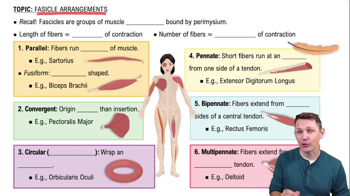
Fascicle Arrangements
8860
views
177
rank
VideoThumbView.guidedCourse
2:29
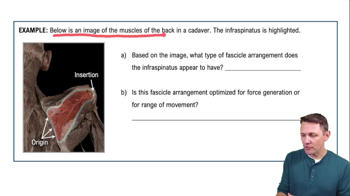
Fascicle Arrangements Example 1
6210
views
98
rank
이 집합의 용어 (71)
하이드의 정의
Fascicle
A bundle of muscle fibers.
Sarcolemma
Membrane surrounding a muscle fiber.
Epimysium
Connective tissue surrounding the entire muscle.
Perimysium
Connective tissue surrounding a fascicle.
Endomysium
Connective tissue surrounding one muscle fiber.
First-class lever
Fulcrum is between effort and resistance; example: seesaw.
Second-class lever
Resistance is between fulcrum and effort; example: standing on tiptoes.
Third-class lever
Effort is between fulcrum and resistance; example: biceps curl.
Prime mover (agonist)
Main muscle responsible for causing a movement.
Antagonist
Muscle that opposes the prime mover.
Synergist
Muscle that assists the prime mover.
Fixator
Muscle that stabilizes another muscle's origin.
Secondary mover
Muscle that helps produce movement but is not the main muscle.
Sarcomere
Basic contracting unit of a muscle.
Z disc
Marks the boundaries of a sarcomere.
A band
Contains the entire length of thick filaments.
I band
Contains only thin filaments.
H zone
Contains only thick filaments.
M line
Center of the sarcomere.
Actin
Thin protein filament.
Myosin
Thick protein filament that pulls actin.
Troponin
Protein that binds calcium.
Tropomyosin
Protein that blocks actin's binding sites when the muscle is relaxed.
Calcium
Ion that binds to troponin to allow contraction.
Sodium (Na⁺)
Ion that enters the muscle cell during depolarization.
Potassium (K⁺)
Ion that leaves the muscle cell during repolarization.
Depolarization
Process where sodium enters and the inside becomes less negative.
Repolarization
Process where the cell returns toward its resting electrical state.
Flexion
Decreases the angle of a joint.
Extension
Increases the angle of a joint.
Circumduction
Circular movement of a limb.
Abduction
Movement away from the body's midline.
Adduction
Movement toward the body's midline.
Rotation
Turning a bone around its axis.
Supination
Turning the palm upward.
Pronation
Turning the palm downward.
Dorsiflexion
Pulling the toes toward the shin.
Plantar flexion
Pointing the toes downward.
Inversion
Turning the sole of the foot inward.
Eversion
Turning the sole of the foot outward.
Elevation
Moving a body part upward.
Depression
Moving a body part downward.
Protraction
Moving a body part forward.
Retraction
Moving a body part backward.
Opposition
Moving the thumb to touch the fingertips.
Plane (gliding) joint
Flat surfaces slide past each other.
Hinge joint
Allows back-and-forth movement.
Pivot joint
Allows rotation around an axis.
Condyloid joint
Allows movement side to side and back and forth.
Saddle joint
Allows movement in two directions.
Ball-and-socket joint
Allows movement in almost every direction.
Muscle twitch
Muscle's response to one stimulus.
Wave summation
Repeated stimulation increases muscle tension.
Motor recruitment
Activating more motor units to increase muscle force.
Motor unit
One motor neuron and all the muscle fibers it controls.
Muscle tone
Low-level muscle activity while resting.
Isometric contraction
Muscle creates tension without changing length.
Isotonic contraction
Muscle changes length while producing movement.
Slow oxidative (Type I)
Slow, uses oxygen, and resists fatigue.
Fast oxidative-glycolytic (Type IIa)
Fast, uses oxygen and glycolysis, and has moderate fatigue resistance.
Fast glycolytic (Type IIx)
Fast and powerful but fatigues quickly.
Meniscus
Cartilage in the knee that cushions and stabilizes the joint.
Osteoarthritis
Joint disease involving the breakdown of cartilage.
Striated muscle
Muscle that has a striped appearance.
Voluntary muscle
Muscle under conscious control.
Involuntary muscle
Muscle not under conscious control.
Ligament
Connects bone to bone.
Tendon
Connects muscle to bone.
Synovial joint
Freely movable joint containing synovial fluid.
Articular cartilage
Covers bone ends and reduces friction.
Synovial fluid
Lubricates joints and reduces friction.
 뒤로뒤로
 8:11