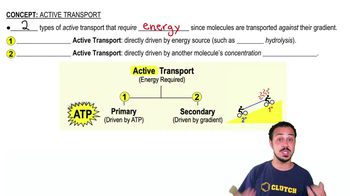
What are the two major active membrane transport processes?
Active transport (primary and secondary) and vesicular transport.
Why do active membrane transport processes require ATP?
To move solutes that are too large for channels, not lipid soluble, or cannot move down their concentration gradient.
What is the key feature of active transport?
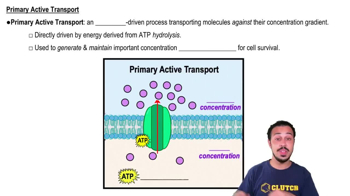
It requires carrier proteins (solute pumps) and moves solutes against their concentration gradient (low to high).
Difference between primary and secondary active transport?
Primary uses energy directly from ATP hydrolysis; secondary uses energy indirectly from ionic gradients created by primary active transport.
What does the Na+-K+ pump do?
Pumps Na+ and K+ against their gradients to maintain high intracellular K+ and high extracellular Na+, essential for muscle and nerve function.
How does secondary active transport use ionic gradients?
It uses the energy stored in ionic gradients (like Na+) created by primary active transport to drive the transport of other molecules against their gradient.
What are the three types of endocytosis?
Phagocytosis (cell eating), pinocytosis (cell drinking), and receptor-mediated endocytosis.
What is phagocytosis and its function?
A type of endocytosis where cells engulf large particles; used by immune cells like macrophages to remove pathogens.
What is pinocytosis?
Fluid-phase endocytosis where cells 'drink' extracellular fluid to sample the environment or absorb nutrients.
What is receptor-mediated endocytosis?
Endocytosis that involves specific molecules binding to receptors, often via clathrin-coated pits, for selective uptake.
What is exocytosis?
Process where materials enclosed in secretory vesicles are ejected from the cell, used for hormone secretion, neurotransmitter release, and waste removal.
What is transcytosis?
Transport of materials into, across, and then out of a cell.
What are Cell Adhesion Molecules (CAMs)?
Proteins on the cell surface that help cells recognize, attach to each other, move relative to each other, and organize into tissues.
What are the two major ways cells communicate?
Contact signaling (physical contact) and chemical signaling (ligand binding to receptors).
What happens during chemical signaling?
A ligand binds to a receptor, causing receptor structural change and alteration of intracellular proteins, changing cell activity.
Can the same ligand cause different responses in different cells?
Yes, the response depends on the receptor type and the intracellular signaling pathway.
What cellular responses can receptor activation cause?
Opening/closing ion channels, activating enzymes, triggering intracellular signaling pathways, and amplifying signals.
What are the four major jobs of a cell?
Make energy, make/process molecules, break down waste/pathogens, and maintain shape/move things.
What is cytoplasm composed of?
Cytosol (gel-like fluid), inclusions (insoluble molecules), and organelles (metabolic machinery).
Name membranous and nonmembranous organelles.
Membranous: mitochondria, ER, Golgi, peroxisomes, lysosomes. Nonmembranous: ribosomes, cytoskeleton, centrioles.
What is the function of mitochondria?
Produce most of the cell's ATP via aerobic cellular respiration.
What is the endomembrane system?
A group of membranous organelles (ER, Golgi, vesicles, lysosomes) plus nuclear and plasma membranes that produce, degrade, store, and export molecules.
What are the two types of endoplasmic reticulum and their functions?
Rough ER: protein synthesis for secretion. Smooth ER: lipid synthesis, detoxification, glycogen conversion, and calcium storage.
 뒤로
 06:57