Skip to main content
Anatomy & Physiology
나의 코스
배우기
시험 준비
AI 튜터
학습 가이드
교과서적 해결책
플래시카드
탐험해 보세요
앱을 사용해 보세요
나의 코스
배우기
시험 준비
AI 튜터
학습 가이드
교과서적 해결책
플래시카드
탐험해 보세요
앱을 사용해 보세요
뒤로
Anatomy & Physiology: Blood, Lymphatic, and Respiratory Systems
카드를 뒤집기 위해 탭할 수 있습니다.
Core functions of blood
카드를 뒤집기 위해 탭할 수 있습니다.
👆
Core functions of blood
Transportation
of gases, nutrients, wastes, and hormones;
Regulation
of temperature, pH, and fluid volume;
Protection
via clotting and immune defense.
진행 상황 추적
컨트롤 버튼이 '내비게이션' 모드로 변경되었습니다.
1/29
추천 영상
VideoThumbView.guidedCourse
2:36
Introduction to Blood Example 1
11374
views
334
rank
VideoThumbView.guidedCourse
7:49
Composition of Blood
11919
views
337
rank
VideoThumbView.guidedCourse
1:55
Introduction to Blood Example 2
9390
views
225
rank
이 집합의 용어 (29)
하이드의 정의
Core functions of blood
Transportation
of gases, nutrients, wastes, and hormones;
Regulation
of temperature, pH, and fluid volume;
Protection
via clotting and immune defense.
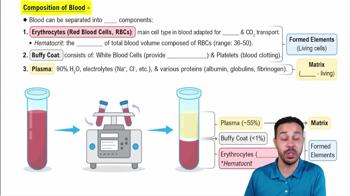
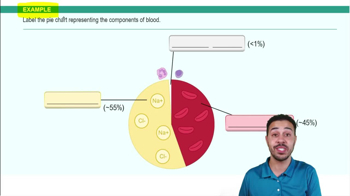
Composition of whole blood
Plasma
(~55%),
buffy coat
(<1%) with leukocytes and platelets, and
erythrocytes
(~45%, hematocrit).
Major plasma proteins and functions
Albumin
: carrier, buffer, osmotic pressure;
Globulins
: transport and antibodies;
Fibrinogen
: clotting precursor.
Erythrocyte structural adaptations
Biconcave shape for surface area, anucleate with no mitochondria to avoid oxygen use, contains hemoglobin for oxygen transport.
Hemoglobin structure and function
Four polypeptide chains each with an iron-containing heme group; binds up to four oxygen molecules reversibly.
Erythropoiesis regulation
Produced in red bone marrow; stimulated by erythropoietin from kidneys in response to low oxygen (hypoxia).
Leukocyte classification
Granulocytes
: neutrophils, eosinophils, basophils;
Agranulocytes
: lymphocytes and monocytes.
Functions of neutrophils
Most abundant WBC; phagocytize bacteria using respiratory bursts and enzymes.
Role of eosinophils
Attack parasitic worms and modulate allergic reactions and asthma.
Basophil function
Release histamine (vasodilator) and heparin (anticoagulant) during inflammation.
Lymphocyte types and roles
T cells: cell-mediated immunity; B cells: produce antibodies for humoral immunity.
Platelets origin and function
Cell fragments from megakaryocytes; contain clotting factors; lifespan 8–10 days; essential for hemostasis.
Three steps of hemostasis
1. Vascular spasm; 2. Platelet plug formation; 3. Coagulation forming fibrin mesh.
Clot retraction and fibrinolysis
Platelets contract to close vessel edges; plasmin enzymatically dissolves clots after repair.
ABO blood group antigens and antibodies
Type A: A antigen, anti-B antibody; B: B antigen, anti-A antibody; AB: both antigens, no antibodies; O: no antigens, anti-A and anti-B antibodies.
Rh blood group significance
Rh+ carry Rh antigen; Rh- develop anti-Rh antibodies if exposed; important in pregnancy for hemolytic disease.
Lymphatic system core functions
Fluid recovery, absorption of dietary lipids, and immune defense.
Primary lymphoid organs
Red bone marrow (B cell maturation) and thymus (T cell maturation).
Secondary lymphoid organs
Lymph nodes, spleen, and MALT (tonsils, Peyer’s patches, appendix).
Innate immune defenses
Surface barriers (skin, mucous membranes), phagocytes, natural killer cells, inflammation, fever, antimicrobial proteins.
Adaptive immunity characteristics
Specificity, systemic action, and memory; includes cell-mediated (T cells) and humoral (B cells/antibodies) immunity.
T cell types and functions
Helper T cells (CD4): activate immune cells; Cytotoxic T cells (CD8): kill infected/tumor cells; Regulatory T cells: suppress immune response.
B cell activation and clonal selection
Antigen binds receptor, B cell proliferates, differentiates into plasma cells (antibody producers) and memory B cells.
Five major antibody classes (GAMED)
IgG: most abundant; IgA: mucosal secretions; IgM: first responder; IgE: allergic responses; IgD: B cell receptor.
Primary function of the respiratory system
Pulmonary ventilation and gas exchange; also olfaction, speech, and acid-base balance.
Conducting vs respiratory zones
Conducting zone: air passage without gas exchange; Respiratory zone: site of gas exchange (alveoli and respiratory bronchioles).
Mechanics of pulmonary ventilation
Inspiration: diaphragm and external intercostals contract, increasing thoracic volume and lowering pressure; expiration: muscles relax, volume decreases, pressure rises.
Gas transport in blood
Oxygen mostly bound to hemoglobin (~98.5%); CO2 transported dissolved, bound to hemoglobin, or as bicarbonate ions.
Neural control of respiration
Medullary respiratory centers (VRG and DRG) generate rhythm and integrate input; pontine centers smooth breathing transitions.
 뒤로뒤로
 2:36