Skip to main content
Anatomy & Physiology
나의 코스
배우기
시험 준비
AI 튜터
학습 가이드
교과서적 해결책
플래시카드
탐험해 보세요
앱을 사용해 보세요
나의 코스
배우기
시험 준비
AI 튜터
학습 가이드
교과서적 해결책
플래시카드
탐험해 보세요
앱을 사용해 보세요
뒤로
Anatomy & Physiology: Blood Structure and Functions
카드를 뒤집기 위해 탭할 수 있습니다.
What is blood classified as in connective tissue?
카드를 뒤집기 위해 탭할 수 있습니다.
👆
What is blood classified as in connective tissue?
Blood
is the only fluid tissue in the human body and is classified as a
special connective tissue
.
진행 상황 추적
컨트롤 버튼이 '내비게이션' 모드로 변경되었습니다.
1/22
추천 영상
VideoThumbView.guidedCourse
2:36
Introduction to Blood Example 1
11364
views
334
rank
VideoThumbView.guidedCourse
7:49
Composition of Blood
11909
views
337
rank
VideoThumbView.guidedCourse
1:55
Introduction to Blood Example 2
9382
views
225
rank
이 집합의 용어 (22)
하이드의 정의
What is blood classified as in connective tissue?
Blood
is the only fluid tissue in the human body and is classified as a
special connective tissue
.
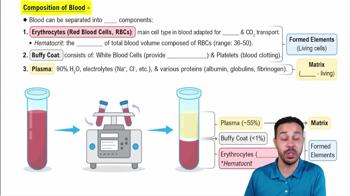
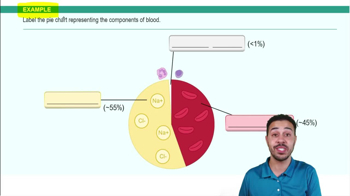
What are the formed elements of blood?
Formed elements include
red blood cells (RBCs)
,
white blood cells (WBCs)
, and
platelets
.
What is the liquid matrix of blood called?
The liquid matrix of blood is called
plasma
, which contains dissolved proteins, nutrients, and waste products.
List the three main functions of blood.
Transport
of gases and nutrients,
regulation
of temperature, pH, and fluid volume, and
protection
via clotting and immune defense.
How does blood transport oxygen?
Oxygen binds to iron in hemoglobin in the lungs forming
oxyhemoglobin
, then is delivered to tissues where it unbinds.
How is carbon dioxide transported in blood?
CO2 binds to amino acids in hemoglobin forming
carbaminohemoglobin
and is transported to the lungs for exhalation.
What is hematopoiesis?
Hematopoiesis is the process of forming all blood cells from hematopoietic stem cells in red bone marrow.
Describe the stages of erythropoiesis.
Stages include hematopoietic stem cell → myeloid stem cell → proerythroblast → basophilic erythroblast → polychromatic erythroblast → orthochromatic erythroblast → reticulocyte → mature RBC.
What regulates the rate of erythropoiesis?
The oxygen-carrying capacity of blood regulates erythropoiesis, not the number of RBCs.
How is iron transported and stored for RBC production?
Iron is stored as ferritin or hemosiderin and transported bound to transferrin to the bone marrow.
What is leukopoiesis?
Leukopoiesis is the production of white blood cells, maintaining a normal WBC count of 4,800–10,800 cells/μL.
How are platelets produced?
Platelets are produced from megakaryocytes in bone marrow through stages from hematopoietic stem cell to megakaryocyte, then released as platelets.
What triggers the intrinsic pathway of blood clotting?
The intrinsic pathway is triggered by factors within blood such as activated platelets and collagen; it is slower with many steps.
What triggers the extrinsic pathway of blood clotting?
The extrinsic pathway is triggered by tissue factor from damaged tissue outside the blood; it is faster and bypasses several steps.
What happens during clot retraction and repair?
Platelet-derived growth factor (PDGF) stimulates fibroblasts to rebuild tissue, and vascular endothelial growth factor (VEGF) promotes endothelial cell proliferation.
Describe fibrinolysis.
Fibrinolysis is clot breakdown where tissue plasminogen activator (tPA) converts plasminogen into plasmin, which digests fibrin to dissolve the clot.
What determines ABO blood groups?
ABO groups are based on the presence of A and/or B antigens on RBCs; plasma contains antibodies against absent antigens.
What determines Rh blood group status?
Presence of the D antigen (Rh factor) on RBCs determines Rh+ or Rh– status.
What causes hemolytic disease of the newborn?
An Rh– mother sensitized by an Rh+ fetus produces anti-Rh antibodies that attack RBCs of an Rh+ fetus in subsequent pregnancies.
How do incompatible blood transfusions cause reactions?
Recipient antibodies attack donor RBC antigens causing agglutination and hemolysis, which can lead to acute renal failure.
Why are donor plasma antibodies usually not serious in transfusions?
Donor antibodies are diluted in recipient plasma and typically do not cause significant reactions.
Who is the universal blood donor and recipient?
Group O negative is the universal donor; Group AB positive is the universal recipient.
 뒤로뒤로
 2:36