The abdominal cavity is the space within the abdomen that contains organs such as the stomach, intestines, liver, and kidneys.
Name the abdominopelvic cavity.
The abdominopelvic cavity includes both the abdominal and pelvic cavities, housing digestive organs and reproductive organs.
What does the cranial cavity contain?
The cranial cavity contains the brain and is protected by the skull.
Define the dorsal cavity.
The dorsal cavity includes the cranial cavity and spinal cavity, protecting the brain and spinal cord.
What is the thoracic cavity?
The thoracic cavity houses the heart and lungs, enclosed by the rib cage.
What organs are found in the pelvic cavity?
The pelvic cavity contains reproductive organs, the urinary bladder, and the rectum.
What is the pleural cavity?
The pleural cavity is the space surrounding each lung, filled with pleural fluid.
Where is the pericardial cavity located and what does it contain?
The pericardial cavity surrounds the heart and contains pericardial fluid to reduce friction.
What is the mediastinum?
The mediastinum is the central compartment of the thoracic cavity containing the heart, trachea, esophagus, and major vessels.
Define the ventral cavity.
The ventral cavity includes the thoracic and abdominopelvic cavities on the front of the body.
What is the peritoneum?
The peritoneum is the serous membrane lining the abdominal cavity and covering abdominal organs.
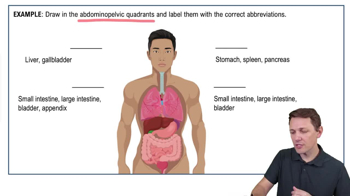
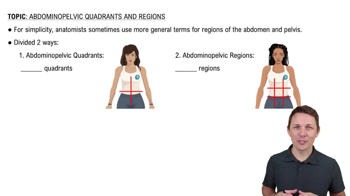
Name the four abdominal quadrants.
The four abdominal quadrants are: right upper, right lower, left upper, and left lower quadrants.
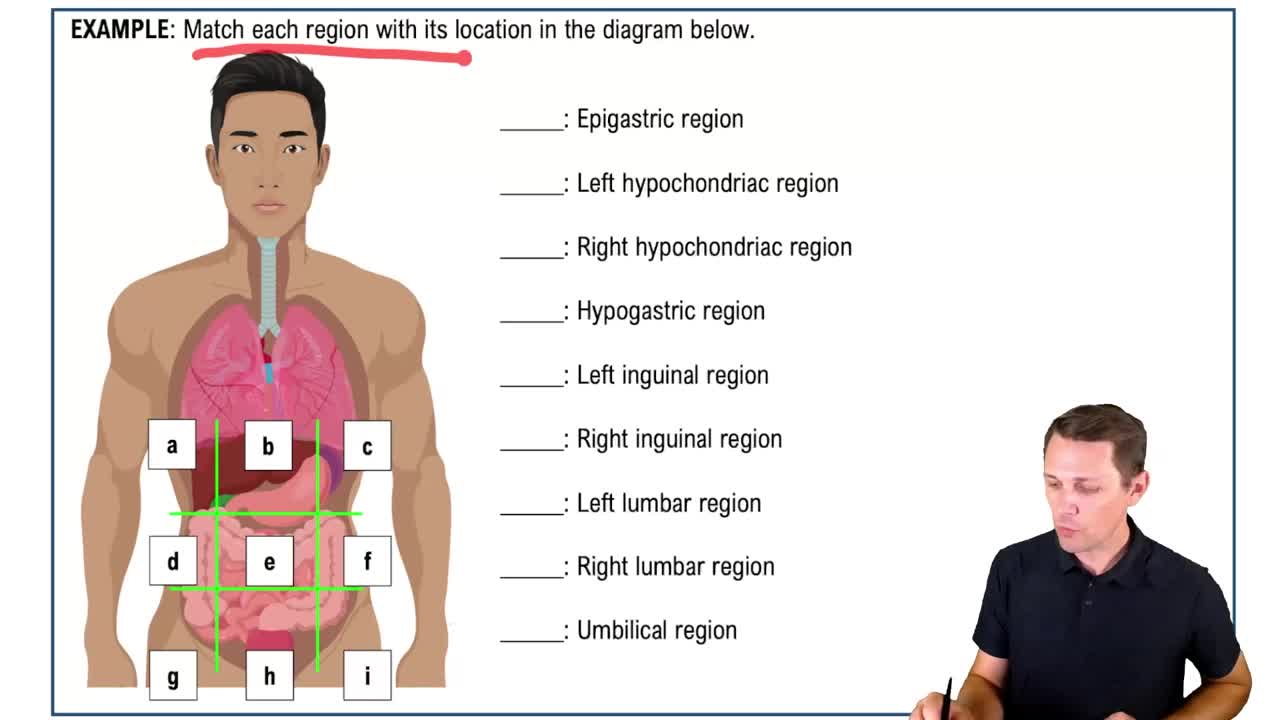
What are the nine abdominal regions?
The nine regions are: right and left hypochondriac, epigastric, right and left lumbar, umbilical, right and left iliac (inguinal), and hypogastric (pubic).
What is the sagittal plane?
The sagittal plane divides the body into left and right parts.
Define the parasagittal plane.
A parasagittal plane is any sagittal plane offset from the midline, dividing the body into unequal left and right parts.
What is the frontal plane?
The frontal plane divides the body into anterior (front) and posterior (back) sections.
Describe the transverse plane.
The transverse plane divides the body into superior (upper) and inferior (lower) parts.
Where is the epigastric region located?
The epigastric region is the upper central region of the abdomen, above the umbilical region.
What organs are in the right upper quadrant?
The right upper quadrant contains the liver, gallbladder, right kidney, and parts of the intestines.
What is the umbilical region?
The umbilical region is the central area of the abdomen around the navel.
Where is the hypogastric (pubic) region?
The hypogastric region is the lower central region of the abdomen below the umbilical region.
What is the olecranal region?
The olecranal region refers to the posterior aspect of the elbow.
Define the patellar region.
The patellar region is the anterior surface of the knee.
What is the mammary region?
The mammary region refers to the breast area.
Where is the inguinal region?
The inguinal region is the lower lateral parts of the abdomen near the groin.
What is the sternal region?
The sternal region is the area over the breastbone (sternum).
What does the spinal cavity contain?
The spinal cavity contains the spinal cord within the vertebral column.
 뒤로
 02:59