뒤로

Anatomy & Physiology: Bones and Skeletal Tissues

컨트롤 버튼이 '내비게이션' 모드로 변경되었습니다.
1/23
  • What are the three types of skeletal cartilage?

    Hyaline cartilage (most abundant, collagen fibers), Elastic cartilage (contains elastic fibers, found in external ear and epiglottis), and Fibrocartilage (thick collagen fibers, found in menisci and vertebral discs).
  • What is the function of the perichondrium in cartilage?

    The perichondrium is a dense connective tissue girdle that surrounds cartilage, contains blood vessels for nutrient delivery, and resists outward expansion.
  • Describe appositional and interstitial growth in cartilage.

    Appositional growth is when cells secrete matrix on the external face of existing cartilage. Interstitial growth is when chondrocytes divide and secrete new matrix from within, expanding cartilage internally.
  • How are bones classified by shape?

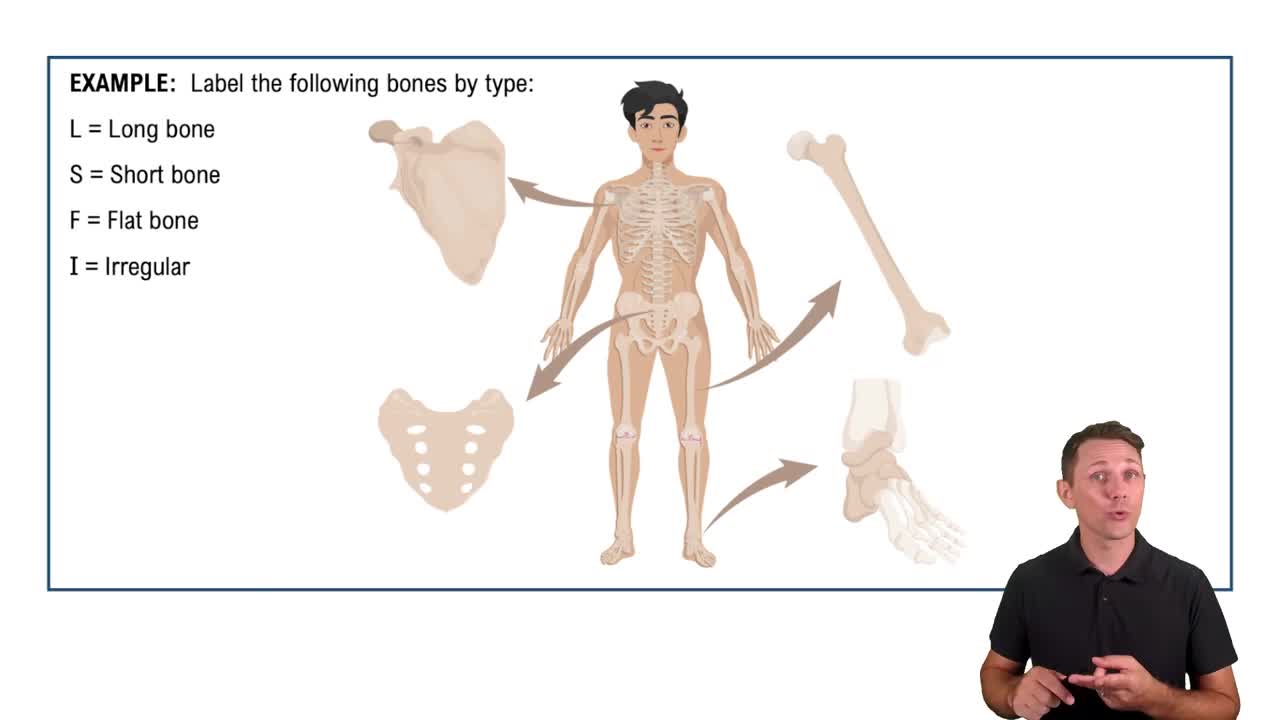
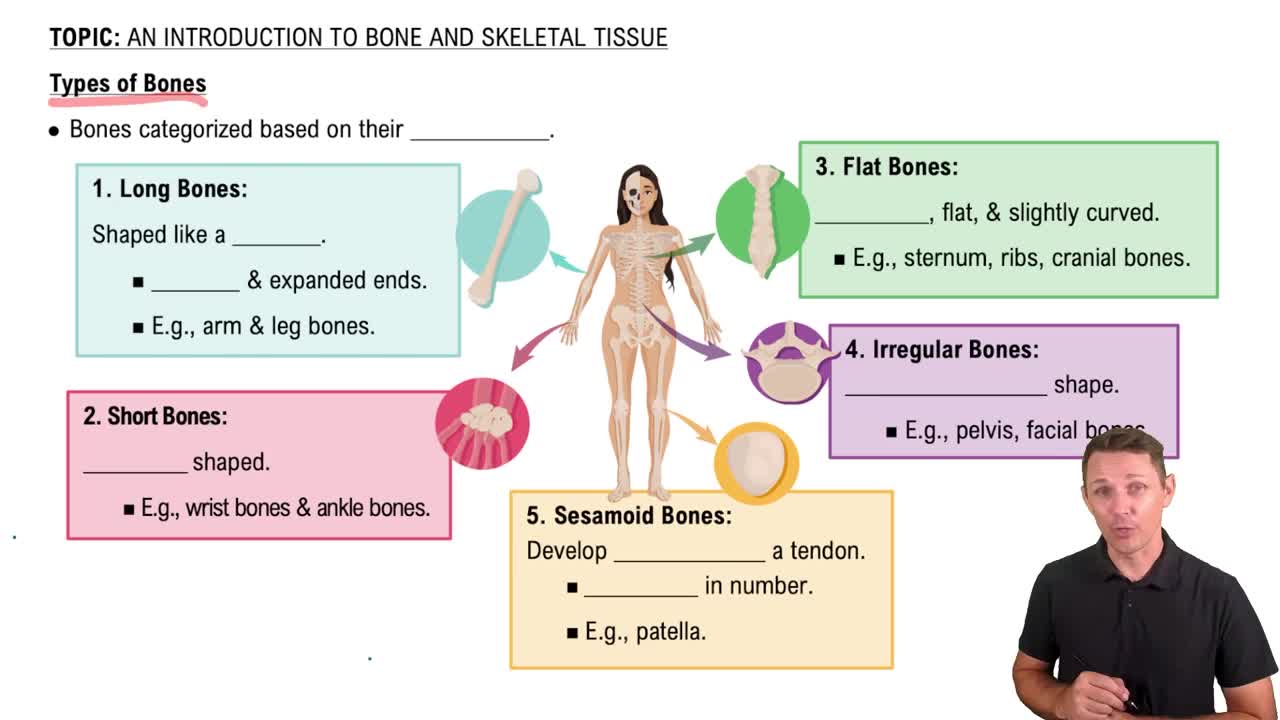
    Bones are classified as long (longer than wide), short (cube-shaped or sesamoid), flat (thin, flat, slightly curved), and irregular (complicated shapes).
  • List seven important functions of bones.

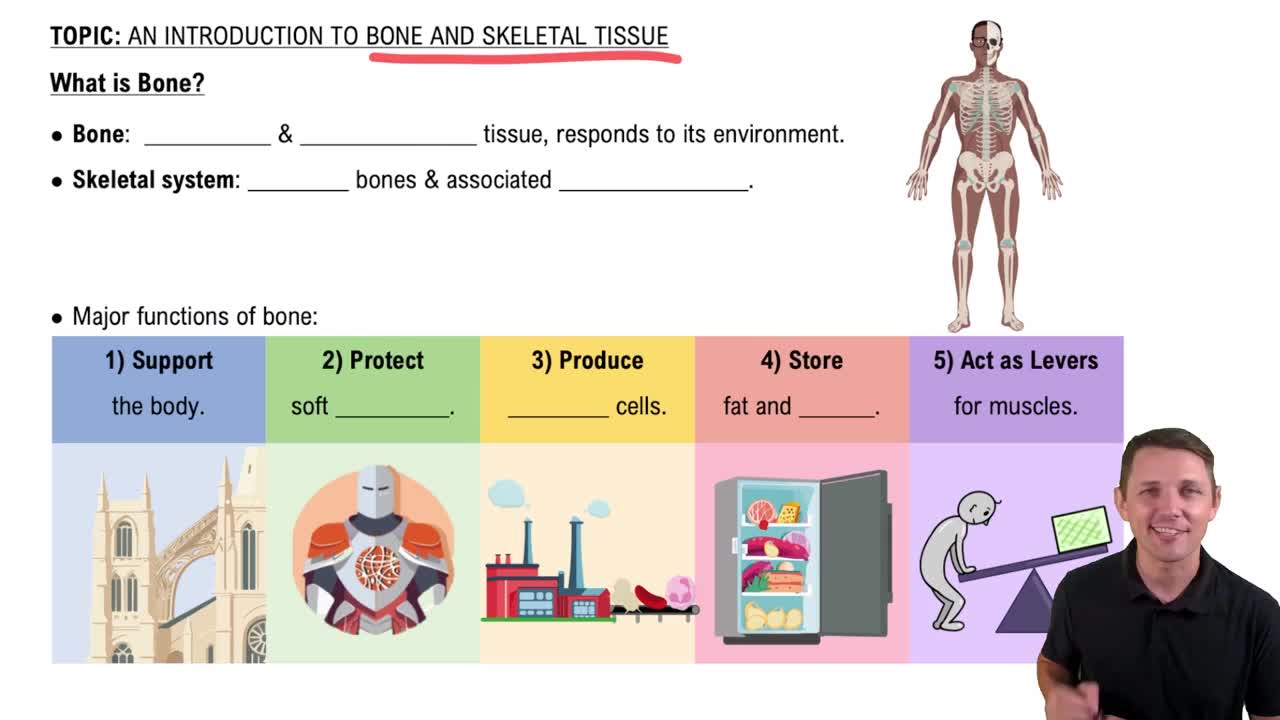
    Support, protection, movement, mineral and growth factor storage, blood cell formation, triglyceride (fat) storage, and hormone production.
  • What tissues are contained in bones as organs?

    Bones contain osseous tissue, nervous tissue, cartilage, fibrous connective tissue, muscle, and epithelial cells in blood vessels.
  • What are the two main types of bone texture?

    Compact bone is dense and smooth forming the outer layer, while spongy bone is a honeycomb of trabeculae found deep to compact bone.
  • Describe the structure of a typical long bone.

    A long bone has a diaphysis (shaft of compact bone surrounding medullary cavity), epiphyses (ends with compact bone outside and spongy bone inside), and an epiphyseal line marking childhood growth.
  • What is the periosteum and its function?

    The periosteum is a white, double-layered membrane covering bone surfaces except joints, containing osteogenic cells, blood vessels, nerves, and anchoring points for tendons and ligaments.
  • What is the endosteum?

    The endosteum is a delicate connective tissue membrane covering internal bone surfaces, trabeculae of spongy bone, and lining canals in compact bone.
  • Where is red marrow found and what is its function?

    Red marrow is found in trabecular cavities of spongy bone and diploë of flat bones, and is the site of blood cell formation (hematopoiesis).
  • What are bone markings and their categories?

    Bone markings are sites for muscle, ligament, tendon attachment, joint surfaces, and conduits for blood vessels and nerves. Categories include projections, depressions, and openings.
  • Name the five major cell types in bone tissue.

    Osteogenic cells, osteoblasts, osteocytes, bone lining cells, and osteoclasts.
  • What are osteogenic cells?

    Mitotically active stem cells in periosteum and endosteum that differentiate into osteoblasts or bone lining cells.
  • What is the role of osteoblasts?

    Bone-forming cells that secrete unmineralized bone matrix (osteoid), including collagen and calcium-binding proteins.
  • Describe osteocytes and their function.

    Mature bone cells in lacunae that monitor and maintain bone matrix and act as stress sensors to regulate remodeling.
  • What are osteoclasts and their function?

    Large multinucleate cells derived from hematopoietic stem cells responsible for bone resorption.
  • What is an osteon (Haversian system)?

    The structural unit of compact bone, an elongated cylinder with concentric lamellae and a central canal containing blood vessels and nerves.
  • What are perforating (Volkmann's) canals?

    Canals perpendicular to central canals that connect blood vessels and nerves of periosteum, medullary cavity, and central canal.
  • How does spongy bone differ microscopically from compact bone?

    Spongy bone lacks osteons, has trabeculae aligned along stress lines, irregular lamellae, and osteocytes connected by canaliculi with capillaries in endosteum.
  • What are the organic components of bone matrix?

    Cells and osteoid, which includes ground substance (proteoglycans and glycoproteins) and collagen fibers providing tensile strength and flexibility.
  • What are the inorganic components of bone?

    Hydroxyapatites (mineral salts), mainly calcium phosphate crystals, responsible for bone hardness and resistance to compression.
  • How strong is bone compared to steel?

    Bone is half as strong as steel in resisting compression but as strong as steel in resisting tension.