뒤로

Anatomy & Physiology: Bones and Skeletal Tissues

컨트롤 버튼이 '내비게이션' 모드로 변경되었습니다.
1/23
  • What is the primary composition of skeletal cartilage?

    Skeletal cartilage is made of resilient cartilage tissue consisting primarily of water, contains no blood vessels or nerves, and is surrounded by a dense connective tissue layer called the perichondrium.
  • Name the three types of cartilage and a key feature of each.

    Hyaline cartilage: most abundant, provides support and flexibility.
    Elastic cartilage: contains elastic fibers, found in external ear and epiglottis.
    Fibrocartilage: thick collagen fibers, great tensile strength, found in menisci and vertebral discs.
  • How does cartilage grow?

    Cartilage grows by appositional growth (matrix secreted on cartilage surface) and interstitial growth (chondrocytes divide and secrete matrix from within).
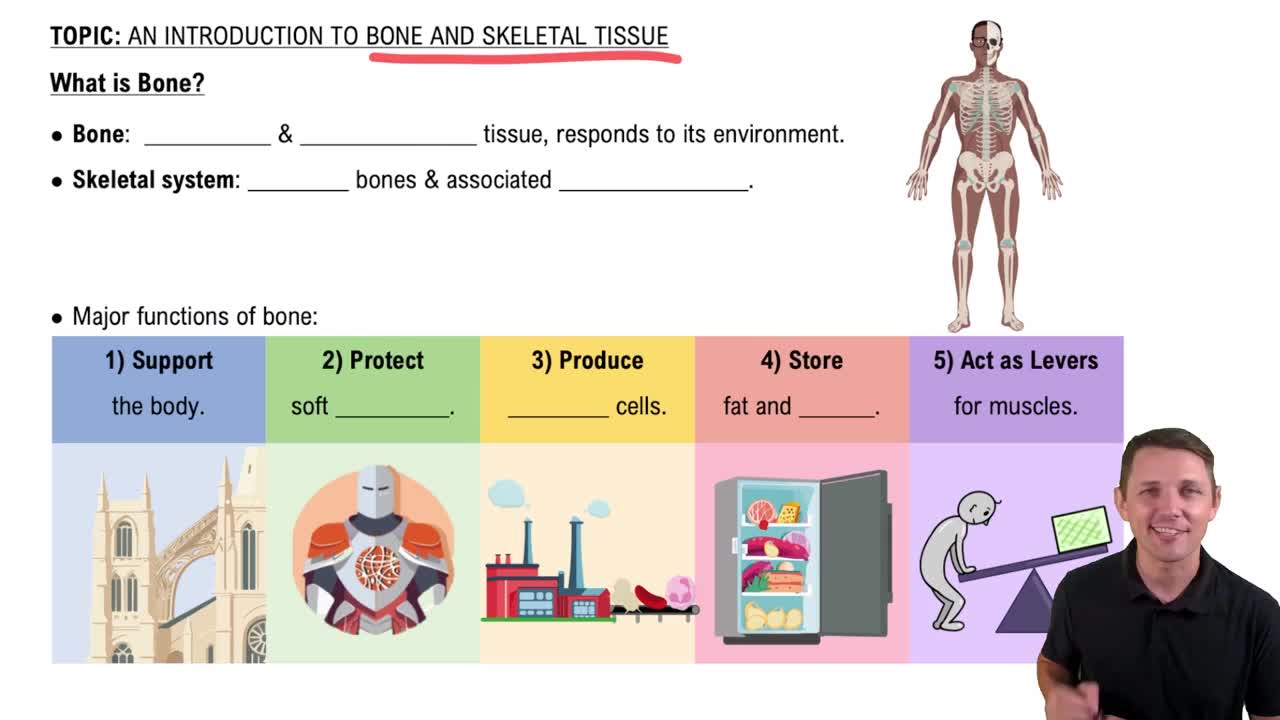
  • List four major functions of bones.

    Support for body and organs, protection of vital organs, anchorage for muscles, and mineral & growth factor storage (calcium and phosphorus).
  • What is hematopoiesis and where does it occur?

    Hematopoiesis is blood cell formation and occurs in the red marrow cavities of certain bones.
  • How are bones classified by location?

    Axial skeleton: bones along the body's long axis (skull, vertebrae, rib cage).
    Appendicular skeleton: bones of limbs and girdles attaching limbs to axial skeleton.
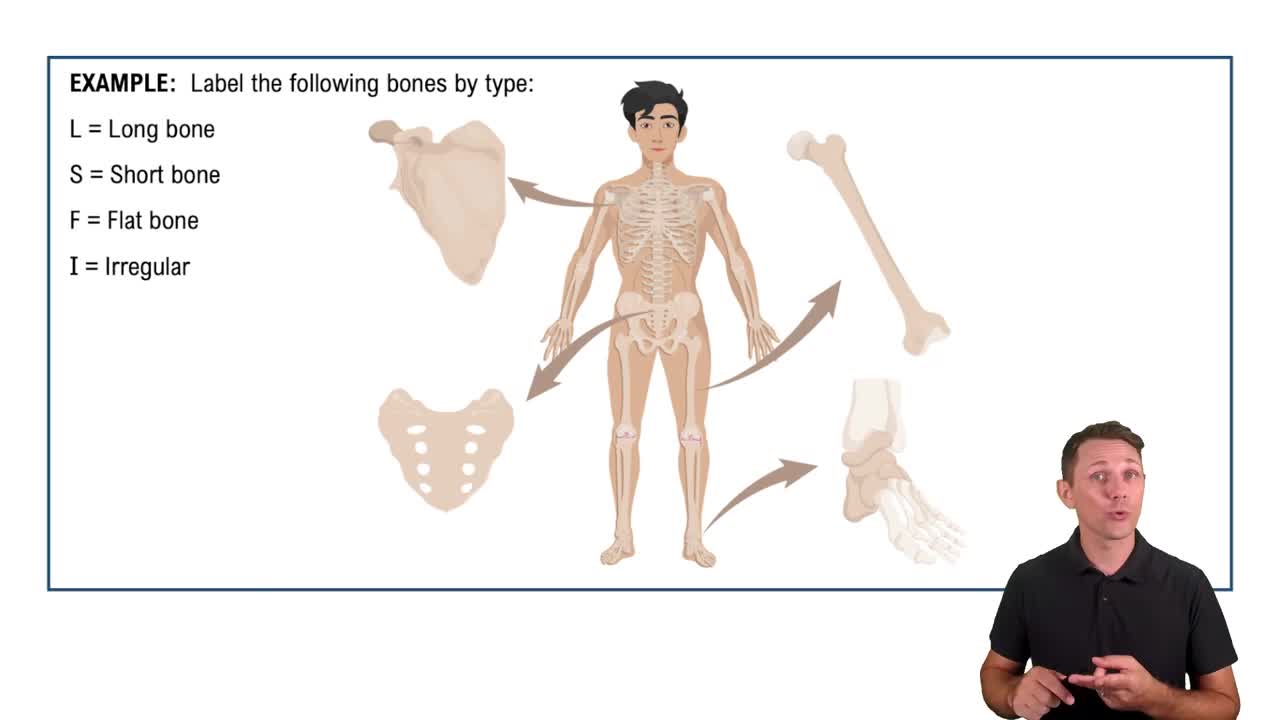
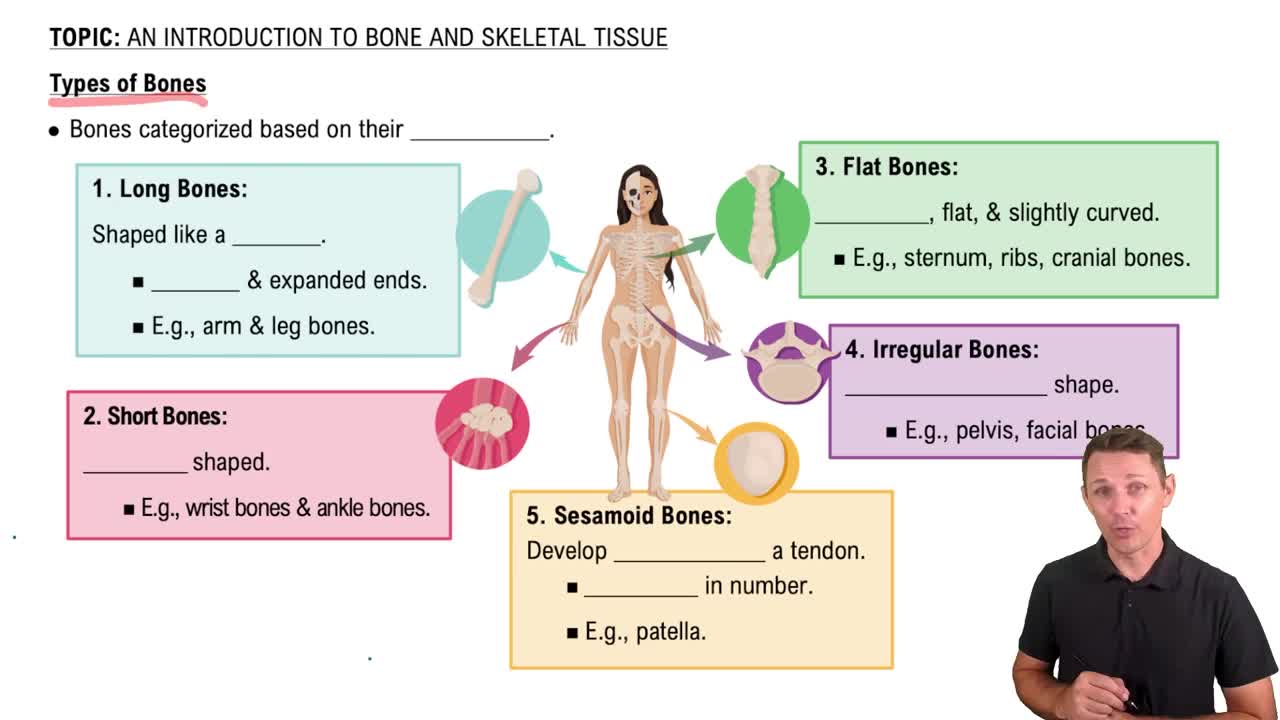
  • What are the four bone shapes and an example of each?

    Long bones (femur), short bones (wrist bones), flat bones (sternum), irregular bones (vertebrae).
  • Describe the structure of a typical long bone.

    Has a diaphysis (shaft) of compact bone surrounding a medullary cavity with yellow marrow, epiphyses (ends) with compact bone outside and spongy bone inside, and articular cartilage covering joint surfaces.
  • What are the two bone membranes and their functions?

    Periosteum: outer double-layered membrane with osteogenic cells, nerves, and blood vessels.
    Endosteum: delicate membrane lining internal bone surfaces, also contains osteogenic cells.
  • How do nutrient arteries supply bone?

    Nutrient arteries enter the diaphysis through nutrient foramina, supplying bone marrow, spongy bone, and compact bone via branching vessels.
  • Where is red marrow found in adults and newborns?

    In newborns, red marrow is in medullary cavities and spongy bone. In adults, red marrow is mainly in flat bones and some irregular bones like the hip, and in the heads of femur and humerus.
  • What are bone markings and their categories?

    Bone markings are surface features for muscle/ligament attachment, joint formation, or passageways for vessels and nerves. Categories: projections, surfaces, depressions/openings.
  • Name the five major bone cell types.

    Osteoprogenitor cells, osteoblasts, osteocytes, bone-lining cells, and osteoclasts.
  • What is the role of osteoprogenitor cells?

    Mitotically active stem cells in periosteum and endosteum that differentiate into osteoblasts or bone-lining cells.
  • What do osteoblasts do?

    Bone-forming cells that secrete unmineralized bone matrix called osteoid, responsible for bone growth.
  • Describe the function of osteocytes.

    Mature bone cells in lacunae that maintain bone matrix and act as stress sensors to regulate remodeling.
  • What are bone-lining cells?

    Flat cells on bone surfaces that help maintain the bone matrix alongside osteocytes.
  • What is the function of osteoclasts?

    Large multinucleate cells derived from hematopoietic stem cells that resorb (break down) bone during remodeling.
  • What is an osteon and its components?

    The osteon is the structural unit of compact bone, consisting of concentric lamellae around a central (Haversian) canal containing blood vessels and nerves.
  • What are canaliculi and their function?

    Hairlike canals connecting lacunae and the central canal, allowing osteocytes to communicate and exchange nutrients and wastes.
  • What is the chemical composition of bone?

    Bone is composed of organic components (cells and osteoid) that resist tension and inorganic mineral salts (hydroxyapatites) that resist compression.
  • What gives bone its tensile strength and flexibility?

    The organic matrix, especially collagen fibers in osteoid, provides tensile strength and flexibility.
  • What mineral makes up 65% of bone mass and what is its role?

    Hydroxyapatites (calcium phosphate crystals) make up 65% of bone mass and provide hardness and resistance to compression.