뒤로

Anatomy & Physiology: Bones Study Guide

컨트롤 버튼이 '내비게이션' 모드로 변경되었습니다.
1/29
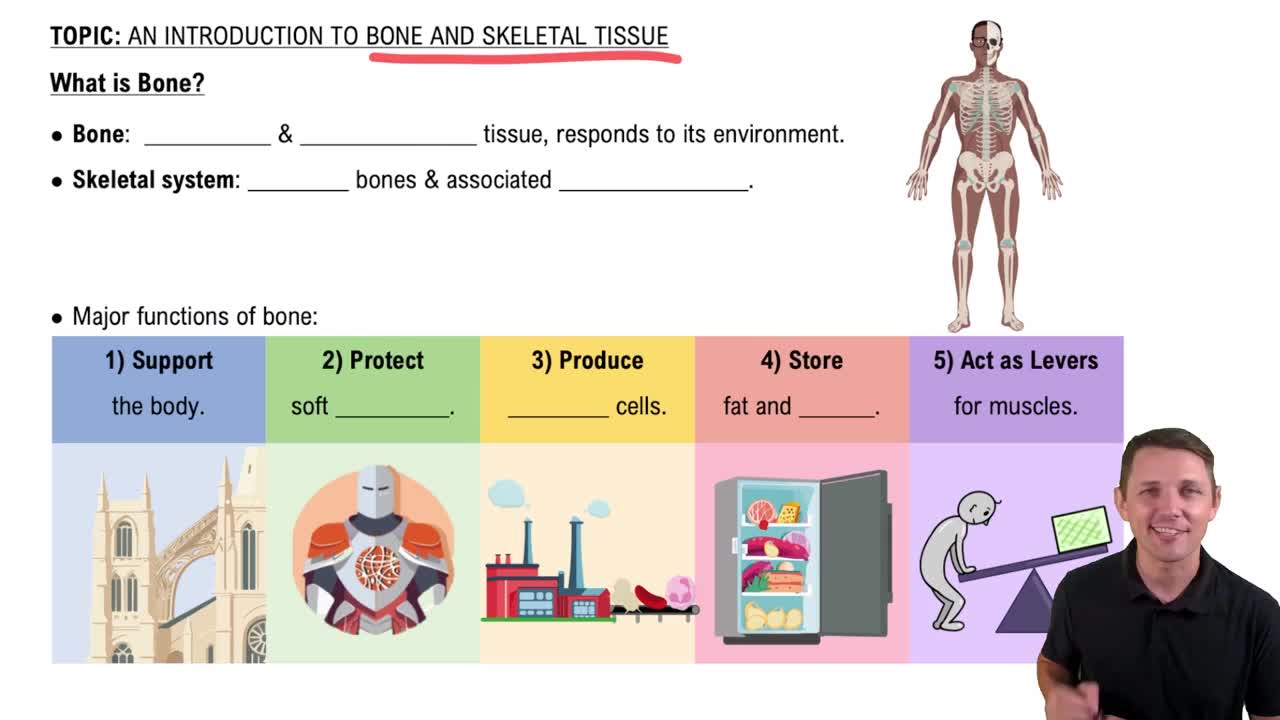
  • What is the skeletal system?

    The body's framework including bones, cartilage, ligaments, and joints. Most adults have 206 bones.
  • What are the five main functions of bones?

    Support, Protection, Movement, Blood cell production, and Mineral storage.
  • Give an example of the support function of bones.

    The spine supports the body and helps keep you upright.
  • Which bones protect important organs?

    The skull protects the brain; ribs protect the heart and lungs.
  • How do bones assist in movement?

    Bones work with muscles to move the body, such as leg bones helping you walk.
  • What is produced in red bone marrow?

    Red bone marrow produces red blood cells, white blood cells, and platelets.
  • What minerals are stored in bones?

    Bones store minerals, especially calcium and phosphorus, which help keep bones strong.
  • What are the two divisions of the skeleton?

    Axial skeleton (80 bones) and Appendicular skeleton (126 bones).
  • What does the axial skeleton include?

    The center of the body: skull, spine, ribs, sternum, ear bones, and hyoid bone.
  • What does the appendicular skeleton include?

    Limbs and their attachments: arms, hands, legs, feet, shoulder girdle, and pelvic girdle.
  • Name the main part of the skull that protects the brain.

    The cranium.
  • What is the function of the mandible?

    The lower jaw; helps with chewing and speaking.
  • Where is the clavicle located and what is its function?

    The collarbone; connects the shoulder area to the sternum.
  • What bones form the rib cage?

    The ribs form the rib cage and protect the heart and lungs.
  • How many vertebrae are in the cervical region of the spine?

    7 vertebrae in the neck region.
  • What is the sacrum?

    A triangular bone at the base of the spine; part of the pelvis.
  • Which bone supports the skull and helps you nod 'yes'?

    The atlas (C1).
  • Which bone helps you turn your head 'no'?

    The axis (C2).
  • Name the forearm bone on the thumb side.

    The radius.
  • What is the longest and strongest bone in the body?

    The femur (thigh bone).
  • What is the kneecap called?

    The patella.
  • Which lower leg bone bears more weight?

    The tibia, the larger shin bone on the inner side.
  • How many bones are in a typical adult skeleton?

    206 bones.
  • What are the three regions of the spine above the sacrum?

    Cervical, thoracic, and lumbar regions.
  • How many carpals are in each wrist?

    8 wrist bones (carpals) in each wrist.
  • How many phalanges are in each hand?

    14 finger bones (phalanges) in each hand.
  • How many tarsals are in each foot?

    7 ankle and back-of-foot bones (tarsals) in each foot.
  • How many metatarsals are in each foot?

    5 middle foot bones (metatarsals) in each foot.
  • How many phalanges are in each foot?

    14 toe bones (phalanges) in each foot.