뒤로

Anatomy & Physiology: Cardiovascular and Endocrine Systems

컨트롤 버튼이 '내비게이션' 모드로 변경되었습니다.
1/29
  • What hormones are produced by the adrenal gland and their primary functions?

    Cortisol: Regulates metabolism and stress response.
    Aldosterone: Controls sodium and potassium balance.
    Epinephrine & Norepinephrine: Mediate 'fight or flight' response.
  • What is the role of the hypothalamus in endocrine regulation?

    Produces releasing and inhibiting hormones that control pituitary gland activity.
  • How is the pituitary gland anatomically divided and what is its function?

    Divided into anterior (adenohypophysis) and posterior (neurohypophysis) lobes, each releasing specific hormones.
  • What are the main chemical classifications of hormones?

    Peptide Hormones: Amino acid-based, act via cell surface receptors.
    Steroid Hormones: Derived from cholesterol, act via intracellular receptors.
    Amino Acid Derivatives: Include catecholamines and thyroid hormones.
  • Which hormones regulate calcium homeostasis?

    Parathyroid Hormone (PTH): Increases blood calcium.
    Calcitonin: Lowers blood calcium.
    Vitamin D (Calcitriol): Enhances calcium absorption.
  • What hormone does the thymus gland produce and its function?

    Thymosin: Promotes T-cell development and differentiation.
  • How is blood glucose homeostasis maintained hormonally?

    Insulin: Lowers blood glucose by promoting cellular uptake.
    Glucagon: Raises blood glucose by stimulating glycogen breakdown.
  • Name the four chambers of the heart.

    Right atrium, right ventricle, left atrium, left ventricle.
  • What structures make up the heart's conduction system?

    Sinoatrial (SA) node, atrioventricular (AV) node, bundle of His, bundle branches, Purkinje fibers.
  • Describe the flow of blood through the heart chambers.

    Deoxygenated blood enters right atrium → right ventricle → lungs.
    Oxygenated blood returns to left atrium → left ventricle → body.
  • What are the three layers of the heart wall and their functions?

    Epicardium: Outer protective layer.
    Myocardium: Muscular middle layer for contraction.
    Endocardium: Inner lining of chambers and valves.
  • What is the role of coronary arteries and veins?

    Coronary arteries supply oxygen and nutrients to myocardium; coronary veins drain deoxygenated blood into right atrium.
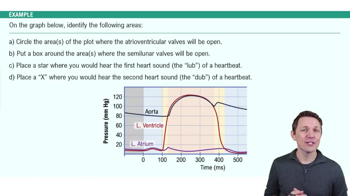
  • List the four phases of the cardiac cycle.

    Atrial systole, ventricular systole (first phase), ventricular systole (second phase), ventricular diastole.
  • What happens during atrial systole?

    Atria contract, forcing blood into ventricles.
  • What occurs during the first phase of ventricular systole?

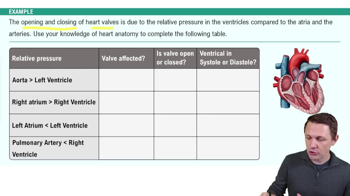
    Ventricles contract, atrioventricular (AV) valves close.
  • Describe the second phase of ventricular systole.

    Semilunar valves open and blood is ejected from ventricles.
  • What occurs during ventricular diastole?

    Ventricles relax, semilunar valves close, and blood flows passively into atria and ventricles.
  • Explain the pulmonary and systemic circuits of blood circulation.

    Pulmonary: Right ventricle → lungs → left atrium.
    Systemic: Left ventricle → body → right atrium.
  • What is the formula for cardiac output?

    Cardiac Output = Stroke Volume × Heart Rate, with normal values 4-8 L/min in adults.
  • What factors influence stroke volume?

    Preload: Degree of stretch before contraction.
    Afterload: Resistance to ejection.
    Contractility: Strength of contraction.
  • Identify the main waves and intervals on an ECG and their meanings.

    P Wave: Atrial depolarization.
    QRS Complex: Ventricular depolarization.
    T Wave: Ventricular repolarization.
    PR Interval: Time from atrial to ventricular depolarization.
    ST Segment: Time between ventricular depolarization and repolarization.
  • What characterizes sinus rhythm on an ECG?

    Regular P waves preceding each QRS complex, initiated by the SA node.
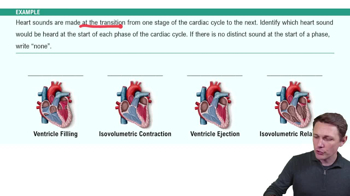
  • What causes the heart sounds S1 and S2?

    S1: Closure of atrioventricular (AV) valves.
    S2: Closure of semilunar valves.
  • Define end-diastolic volume (EDV) and end-systolic volume (ESV).

    EDV: Volume of blood in ventricle at end of diastole.
    ESV: Volume of blood in ventricle at end of systole.
  • How do athletes' EDV and ESV typically differ from non-athletes?

    Athletes have higher EDV and lower ESV due to increased cardiac efficiency.
  • What are the main types of blood vessels and their functions?

    Arteries: Carry blood away from heart, thick muscular walls.
    Veins: Carry blood to heart, thinner walls with valves.
    Capillaries: Site of exchange between blood and tissues.
  • What factors determine blood pressure?

    Cardiac output, blood volume, and vascular resistance.
  • How do the sympathetic and parasympathetic nervous systems affect blood pressure?

    SNS increases heart rate and vasoconstriction, raising BP.
    PSNS decreases heart rate, lowering BP.
  • What is mean arterial pressure (MAP) and its formula?

    Average arterial pressure during one cardiac cycle.
    MAP = Diastolic Pressure + (Systolic Pressure − Diastolic Pressure) / 3.