What is the basic unit of life in anatomy and physiology?
The cell is the basic structural and functional unit of life.
Name the four main types of tissue in the human body.
Epithelial, connective, muscle, and nervous tissues.
What is the primary function of epithelial tissue?
To cover body surfaces and line cavities, providing protection and absorption.
Define homeostasis in physiology.
The body's ability to maintain a stable internal environment despite external changes.
What organelle is known as the 'powerhouse of the cell'?
The mitochondrion, which produces ATP through cellular respiration.
Describe the structure of the plasma membrane.
A phospholipid bilayer with embedded proteins that controls substance movement in and out of the cell.
What is the function of connective tissue?
To support, bind, and protect other tissues and organs.
Name the three types of muscle tissue.
Skeletal, cardiac, and smooth muscle tissues.
What is the role of the nucleus in a cell?
It contains DNA and controls cell activities.
Explain the difference between passive and active transport.
Passive transport requires no energy and moves substances down their concentration gradient; active transport requires energy to move substances against the gradient.
What is osmosis?
The diffusion of water molecules across a selectively permeable membrane.
Define the term 'organ system'.
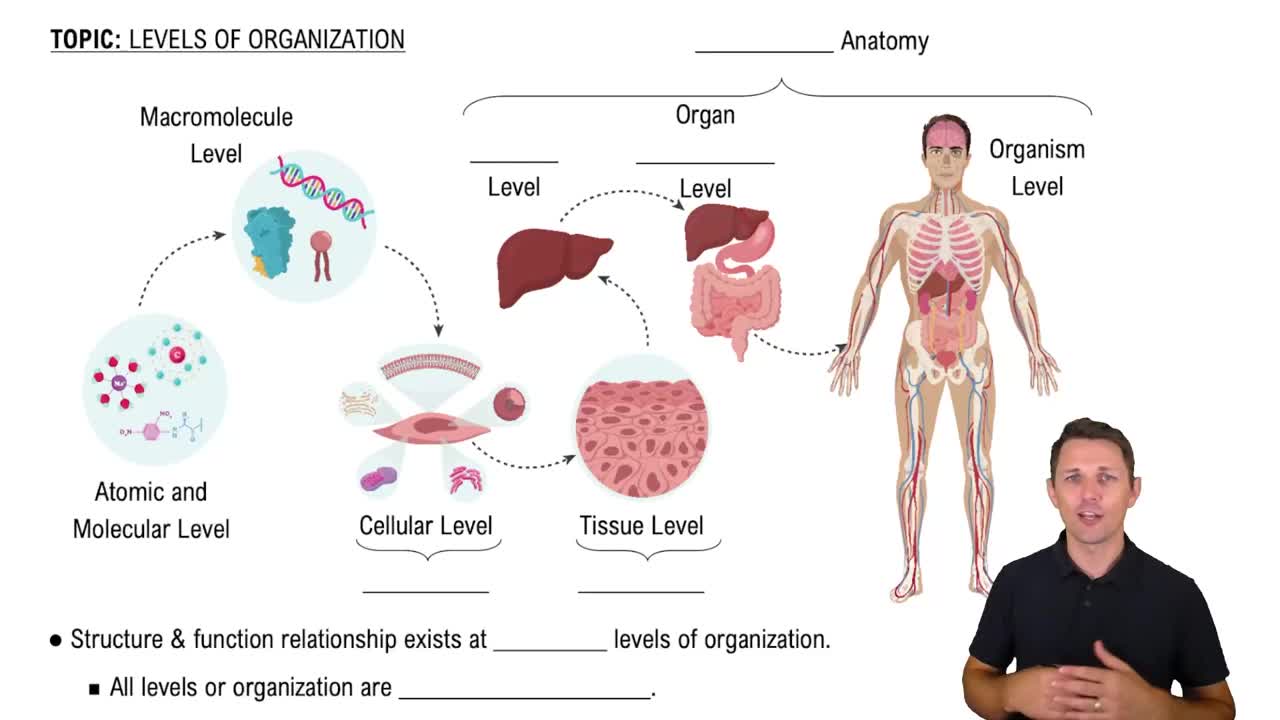
A group of organs that work together to perform a specific function.
What is the function of the ribosome?
To synthesize proteins by translating mRNA.
Describe the role of the endoplasmic reticulum (ER).
The rough ER synthesizes proteins; the smooth ER synthesizes lipids and detoxifies substances.
What is the extracellular matrix?
A network of proteins and carbohydrates outside cells that provides structural and biochemical support.
Name the phases of the cell cycle.
Interphase (G1, S, G2 phases) and mitotic phase (mitosis and cytokinesis).
What is the function of lysosomes?
To digest and remove waste materials and cellular debris.
Explain the difference between mitosis and meiosis.
Mitosis produces two identical diploid cells; meiosis produces four genetically diverse haploid cells.
What is the role of collagen in connective tissue?
To provide strength and structural support.
Define anatomical position.
Body standing upright, facing forward, arms at sides with palms facing forward.
 뒤로
 05:04