Skip to main content
Anatomy & Physiology
나의 코스
배우기
시험 준비
AI 튜터
학습 가이드
교과서적 해결책
플래시카드
탐험해 보세요
앱을 사용해 보세요
나의 코스
배우기
시험 준비
AI 튜터
학습 가이드
교과서적 해결책
플래시카드
탐험해 보세요
앱을 사용해 보세요
뒤로
Anatomy & Physiology: Chemistry of Life
카드를 뒤집기 위해 탭할 수 있습니다.
What are the three main subatomic particles in an atom?
카드를 뒤집기 위해 탭할 수 있습니다.
👆
What are the three main subatomic particles in an atom?
Protons
(positive charge),
neutrons
(neutral), and
electrons
(negative charge).
진행 상황 추적
컨트롤 버튼이 '내비게이션' 모드로 변경되었습니다.
1/25
추천 영상
VideoThumbView.guidedCourse
02:13
Atoms- Smallest Unit of Matter Example 1
30868
views
796
rank
VideoThumbView.guidedCourse
03:51
Atoms- Smallest Unit of Matter Example 3
20093
views
427
rank
VideoThumbView.guidedCourse
09:44
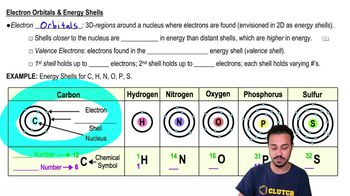
Electron Orbitals & Energy Shells
27924
views
591
rank
5
comments
이 집합의 용어 (25)
하이드의 정의
What are the three main subatomic particles in an atom?
Protons
(positive charge),
neutrons
(neutral), and
electrons
(negative charge).
What determines the atomic number of an element?
The number of
protons
in the nucleus of an atom.
What is an ionic bond?
A chemical bond formed by the
transfer of electrons
from a metal to a nonmetal, resulting in attraction between positive and negative ions.
How is a covalent bond formed?
By
sharing electrons
between atoms, allowing each to obey the octet or duet rule.
What is the difference between nonpolar and polar covalent bonds?
Nonpolar covalent bonds
share electrons equally;
polar covalent bonds
share electrons unequally due to differences in electronegativity.
What are hydrogen bonds?
Weak attractions between polar covalent molecules where partial positive hydrogen atoms attract partial negative atoms like oxygen.
Name the three types of mixtures in chemistry.
Suspensions
,
colloids
, and
solutions
differ by particle size and whether particles settle out.
What is the difference between potential and kinetic energy?
Potential energy
is stored energy;
kinetic energy
is energy of motion.
List the three forms of energy in the human body.
Chemical energy
,
electrical energy
, and
mechanical energy
.
What are the three types of chemical reactions?
Catabolic
(breakdown),
exchange
(oxidation-reduction), and
anabolic
(building) reactions.
What is activation energy in a chemical reaction?
The minimum energy required to start a chemical reaction.
How do enzymes affect activation energy?
Enzymes
lower activation energy
, speeding up reactions without being consumed.
What are the key properties of water important for life?
High heat capacity, heat transport, cushioning, and lubrication.
Why is water considered a universal solvent?
Because it dissolves many substances due to its
polar nature
.
What defines an acid and a base in water?
Acids release
H+
ions; bases release
OH-
ions or bind H+.
What is the pH scale?
A scale from 0 to 14 measuring
H+
ion concentration; below 7 is acidic, 7 is neutral, above 7 is basic.
What are the four major classes of organic compounds?
Carbohydrates
,
lipids
,
proteins
, and
nucleic acids
.
What is the basic structure of carbohydrates?
Composed of
carbon, hydrogen, and oxygen
in a 1:2:1 ratio, serving as energy sources.
What is dehydration synthesis?
An anabolic process that
joins monomers
by removing water.
What is hydrolysis?
A catabolic process that
breaks down polymers
by adding water.
What are triglycerides composed of?
One glycerol molecule and three fatty acid chains.
What is the function of proteins in the body?
Proteins serve as enzymes, structural components, defense molecules, communication signals, muscle contraction agents, and energy sources.
What is a peptide bond?
A bond formed between amino acids by dehydration synthesis.
What is ATP and its role?
Adenosine triphosphate
is the main chemical energy source for cellular processes.
What are nucleotides?
Monomers of nucleic acids composed of a sugar, phosphate group, and nitrogenous base.
 뒤로뒤로
 02:13