What are the main components of the circulatory system?
The circulatory system consists of the heart, blood vessels, and blood. The cardiovascular system refers only to the heart and blood vessels.
What are the primary functions of blood circulation?
Transport of gases, nutrients, wastes, hormones, and stem cells; protection via inflammation, infection control, and clotting; and regulation of fluid balance, pH, and temperature.
What are the components of blood?
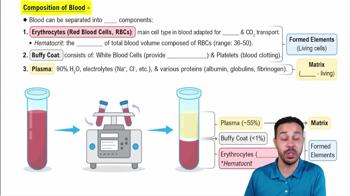
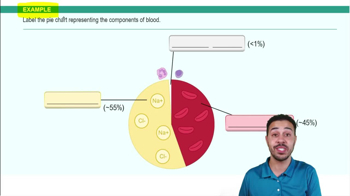
Blood is a liquid connective tissue composed of plasma (extracellular matrix) and formed elements (erythrocytes, leukocytes, and platelets).
What are the types of leukocytes and their classification?
Leukocytes are classified as granulocytes (neutrophils, eosinophils, basophils) and agranulocytes (lymphocytes, monocytes).
What is hematocrit and its typical range in adults?
Hematocrit is the percentage of blood volume composed of RBCs, typically 37% to 52% in adults.
What are the major plasma proteins and their functions?
Albumins transport solutes and buffer pH; globulins aid in transport, clotting, and immunity; fibrinogen is the precursor to fibrin for clot formation.
What is blood viscosity and what affects it?
Blood viscosity is the resistance to flow, about 4.5 to 5.5 times that of water, mainly affected by RBCs and albumin.
What is hematopoiesis?
Hematopoiesis is the production of blood cells, originating from multipotent hematopoietic stem cells in bone marrow.
Describe the structure of erythrocytes.
Erythrocytes are biconcave, discoid cells about 7.5 μm in diameter, lacking nucleus and mitochondria, and contain 33% hemoglobin.
What is the structure and function of hemoglobin?
Hemoglobin has four globin protein chains each with a heme group that binds one oxygen molecule; it transports oxygen and some CO2.
What is erythropoiesis and its rate?
Erythropoiesis is RBC production, producing about 1 million RBCs per second with a lifespan of ~120 days.
What causes anemia and its consequences?
Anemia is a deficiency of RBCs or hemoglobin causing tissue hypoxia, lethargy, shortness of breath, edema, and possible cardiac failure.
What is sickle-cell disease?
A hereditary hemoglobin defect causing rigid, sticky, sickle-shaped RBCs that block vessels and cause organ damage.
How are blood types determined?
Blood types are based on the presence or absence of antigens A and B on RBCs and corresponding antibodies in plasma.
What are the ABO blood groups and their antibody profiles?
Type A has antigen A and anti-B antibodies; B has antigen B and anti-A antibodies; AB has both antigens and no antibodies; O has no antigens and both anti-A and anti-B antibodies.
What is agglutination in blood transfusion?
Agglutination is the clumping of RBCs caused by antibodies binding to foreign antigens, which can block vessels and cause hemolysis.
What is the Rh blood group system?
Rh system includes antigens like D; Rh-positive individuals have D antigen, Rh-negative lack it and form anti-D antibodies only after exposure.
What is hemolytic disease of the newborn (HDN)?
HDN occurs when an Rh-negative mother forms anti-D antibodies after exposure to Rh-positive fetal blood, attacking RBCs in subsequent Rh-positive pregnancies.
What are the main types of leukocytes and their functions?
Neutrophils phagocytize bacteria; eosinophils attack parasites and allergens; basophils secrete histamine and heparin; lymphocytes coordinate immunity; monocytes become macrophages.
What is hemostasis and its three mechanisms?
Hemostasis stops bleeding via vascular spasm, platelet plug formation, and coagulation (blood clotting).
Describe the platelet plug formation process.
Platelets stick to exposed collagen, release granules like serotonin and ADP, which attract more platelets, forming a plug via positive feedback.
What are the intrinsic and extrinsic pathways of coagulation?
Intrinsic pathway uses clotting factors in blood; extrinsic pathway uses factors from damaged tissue; both converge to activate factor X and form fibrin clot.
How is clot dissolution (fibrinolysis) achieved?
Plasminogen is activated to plasmin, which digests fibrin and dissolves the clot after tissue repair.
What controls prevent inappropriate clotting?
Platelet repulsion by prostacyclin, dilution of thrombin by blood flow, and anticoagulants like antithrombin and heparin prevent unwanted clotting.
What is thrombosis and its risks?
Thrombosis is abnormal clot formation in unbroken vessels, risking embolism and infarction in vital organs.
What is the role of platelets in hemostasis?
Platelets secrete vasoconstrictors, form plugs, release clotting factors, attract immune cells, phagocytize bacteria, and secrete growth factors for vessel repair.
What is thrombopoiesis?
Thrombopoiesis is platelet production from megakaryocytes in bone marrow, which release proplatelets that fragment into platelets.
What is the clinical use of platelet-rich plasma (PRP)?
PRP therapy uses concentrated platelets from centrifuged blood to promote healing in conditions like osteoarthritis and tendinopathies.
What is the Wells Criteria used for?
Wells Criteria is a clinical tool to assess the risk of deep vein thrombosis (DVT) based on patient symptoms and history.
What are common phlebotomy procedures?
Venipuncture collects blood from veins for testing; fingerstick collects small blood drops for point-of-care tests; arterial puncture collects arterial blood for gas analysis.
 뒤로
 2:36