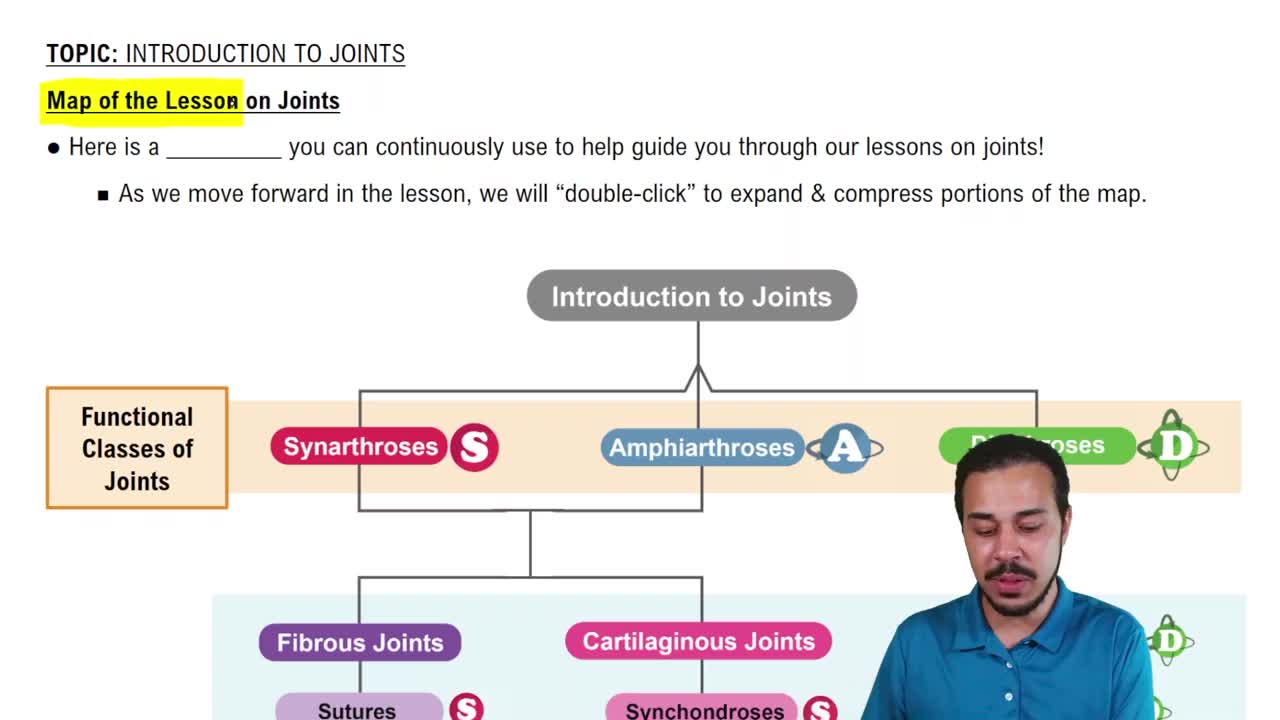
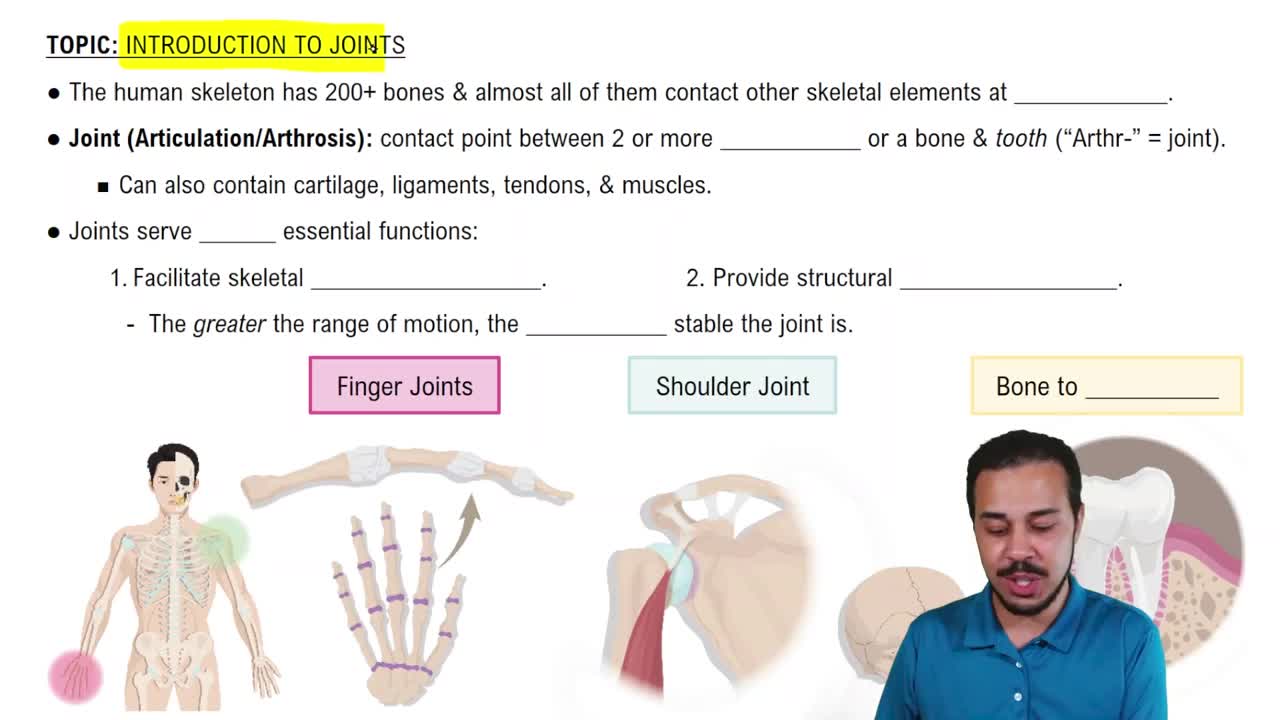
What are the two main methods of joint classification?
Functional classification is based on the range of motion, and structural classification is based on the anatomical organization of the joint.
Name the three functional classifications of joints.
Synarthrosis (immovable), Amphiarthrosis (slightly movable), and Diarthrosis (freely movable).
What are the four structural classifications of joints?
Bony, Fibrous, Cartilaginous, and Synovial.
What defines a synovial joint?
A movable joint found at the ends of long bones, enclosed within an articular capsule lined with a synovial membrane.
What is the function of articular cartilage in synovial joints?
Pads articulating surfaces, prevents bones from touching, and provides smooth surfaces lubricated by synovial fluid to reduce friction.
What are the main functions of synovial fluid?
Lubrication, nutrient distribution, and shock absorption within the joint.
List some accessory structures found in synovial joints.
Cartilages, fat pads, ligaments, and tendons.
What is a suture joint and its functional classification?
A suture is a bony joint where bones are interlocked and bound by dense fibrous connective tissue; functionally classified as synarthrosis (immovable).
Define a gomphosis joint.
A gomphosis is a fibrous joint where a cone-shaped peg fits into a socket, such as a tooth in its alveolus; functionally a synarthrosis.
What is a synchondrosis joint?
A cartilaginous joint where bones are joined by hyaline cartilage, such as the epiphyseal plate; functionally a synarthrosis.
Describe a synostosis joint.
A bony joint formed when two bones fuse, eliminating the joint, such as the fusion of the frontal bone; functionally a synarthrosis.
What is a syndesmosis joint and its functional classification?
A fibrous joint where bones are connected by ligaments, allowing slight movement; functionally an amphiarthrosis.
Define a symphysis joint.
A cartilaginous joint where bones are connected by a wedge or pad of fibrocartilage, allowing slight movement; functionally an amphiarthrosis.
What are the three planes of movement in synovial joints?
Monaxial (one plane), Biaxial (two planes), and Triaxial (three planes).
What is the difference between abduction and adduction?
Abduction moves a limb away from the body's longitudinal axis; adduction moves it toward the axis.
Describe flexion and extension movements.
Flexion decreases the angle between bones; extension increases the angle, returning to anatomical position.
What is hyperextension?
Extension beyond the anatomical position, increasing the angle between bones past normal range.
What is circumduction?
A circular movement combining flexion, extension, abduction, and adduction, creating a cone-shaped motion.
Define rotation in joint movement.
A bone pivots around its own longitudinal axis, such as turning the head side to side.
What are pronation and supination?
Pronation rotates the forearm so the palm faces down; supination rotates it so the palm faces up.
Explain inversion and eversion of the foot.
Inversion twists the sole medially; eversion twists the sole laterally.
What are dorsiflexion and plantar flexion?
Dorsiflexion is flexion at the ankle lifting the toes; plantar flexion is extension at the ankle pointing the toes.
 뒤로
 04:06