뒤로

Anatomy & Physiology: Connective Tissue, Membranes, Muscle, and Nervous Tissue

컨트롤 버튼이 '내비게이션' 모드로 변경되었습니다.
1/35
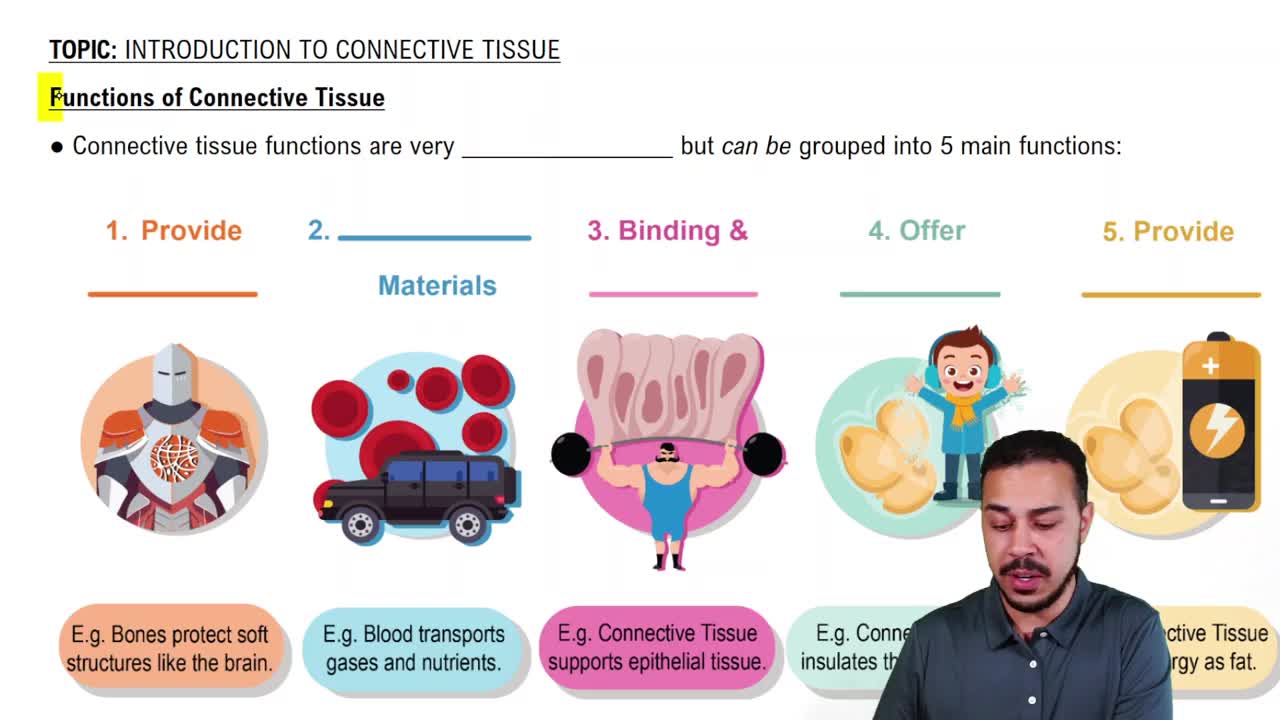
  • Three basic components shared by connective tissues

    Specialized cells, extracellular protein fibers, and a fluid called the ground substance.
  • What is the cell matrix in connective tissue?

    The extracellular fibers and ground substance surrounding cells, accounting for most connective tissue volume.
  • Three subdivisions of connective tissue

    Connective tissue proper, fluid connective tissue, and supportive connective tissue.
  • Types of connective tissue proper

    Loose connective tissue (areolar, adipose, reticular) and dense connective tissue (dense regular, dense irregular, elastic).
  • Types of fluid connective tissue

    Blood (within cardiovascular system) and lymph (within lymphatic system).
  • Types of supportive connective tissue

    Cartilage (hyaline, elastic, fibrocartilage) and bone.
  • Three types of extracellular protein fibers in connective tissue proper

    Reticular fibers (strong, branching), collagen fibers (thick, resist stretching), and elastic fibers (stretchy).
  • Two classes of cells in connective tissue proper

    Fixed cells (maintenance, repair, energy storage) and wandering cells (defense and repair).
  • Functions of fixed cells in connective tissue

    Include melanocytes (pigment synthesis), fibroblasts (fiber synthesis), mast cells (inflammation), fixed macrophages (debris removal), and adipocytes (lipid storage).
  • Functions of wandering cells in connective tissue

    Include plasma cells (antibody production), free macrophages (phagocytosis), mesenchymal cells (stem cells for repair), and neutrophils, eosinophils, lymphocytes (immune defense).
  • Characteristics of areolar tissue

    Most common connective tissue proper, acts as packing material, contains all connective tissue proper cell types.
  • Characteristics of adipose tissue

    Found deep to skin, stores energy as fat in adipocytes, provides padding around eyes and kidneys.
  • Characteristics of reticular tissue

    Found in liver, kidney, spleen, lymph nodes, bone marrow; provides support with a network of reticular fibers called the stroma.
  • Three types of dense connective tissue

    Dense regular (parallel collagen bundles), dense irregular (meshwork fibers), and elastic tissue (more elastic fibers).
  • Functions of blood as a fluid connective tissue

    Transports oxygen (red blood cells), defends body (white blood cells), and aids clotting (platelets) in a watery matrix called plasma.
  • Functions of lymph

    Watery matrix collected from interstitial fluid, contains mostly lymphocytes, returns fluid to blood, and alerts immune system.
  • Three types of cartilage

    Hyaline (flexible support), elastic (distorts and returns to shape), and fibrocartilage (durable, resists compression).
  • Cartilage growth types

    Appositional growth (new matrix at surface by chondroblasts) and interstitial growth (division within cartilage by chondrocytes).
  • Two types of bone tissue

    Compact bone (dense outer layer, weight bearing) and spongy bone (internal cavity lining, fine network).
  • Structure of compact bone

    Organized in osteons with concentric layers, central canal with blood vessels and nerves, osteocytes in lacunae connected by canaliculi.
  • Four types of membranes in the body

    Mucous, serous, cutaneous, and synovial membranes.
  • Function of mucous membranes

    Line passageways open to exterior, kept moist for movement, absorption, or secretion, supported by areolar connective tissue.
  • Function of serous membranes

    Line ventral body cavity subdivisions, produce watery serous fluid to reduce friction, composed of mesothelium and areolar tissue.
  • Characteristics of cutaneous membrane

    Covers body surface (skin), composed of stratified squamous epithelium, areolar tissue, and dense irregular connective tissue; thick and waterproof.
  • Characteristics of synovial membrane

    Lines freely movable joint cavities, lubricates with synovial fluid, lacks basement membrane, contains gaps for fluid exchange.
  • Three layers of fascia

    Superficial fascia (areolar and adipose tissue), deep fascia (dense irregular connective tissue), and subserous fascia (areolar tissue).
  • Three types of muscle tissue

    Skelatal (moves body), cardiac (moves blood in heart), and smooth (moves fluids and solids in organs).
  • Characteristics of skeletal muscle tissue

    Elongated, cylindrical, striated cells with multiple nuclei; functions include movement, heat generation, and organ protection.
  • Characteristics of cardiac muscle tissue

    Short, branched cells with one nucleus, interconnected by intercalated disks; functions to move blood and maintain blood pressure.
  • Characteristics of smooth muscle tissue

    Short, spindle-shaped, non-striated cells with one nucleus; controls movement of food, urine, secretions, and vessel diameter.
  • Functions of nervous tissue

    Specialized for electrical impulse conduction; consists of neurons (information transfer) and neuroglia (support and repair).
  • Main parts of a neuron

    Dendrites receive information, axon conducts impulses, and cell body processes information and controls the cell.
  • Primary functions of neuroglia

    Maintain nervous tissue structure, repair tissue, perform phagocytosis, and regulate interstitial fluid composition.
  • Four signs of inflammation

    Swelling, redness, warmth, and pain caused by increased blood flow and vessel permeability.
  • Purpose of regeneration in tissue repair

    Fibroblasts produce collagen fibers to stabilize injury, forming scar tissue that is remodeled to restore normal tissue.