Why is the digestive tract considered 'outside' the body?
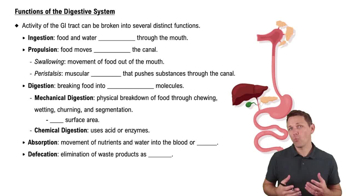
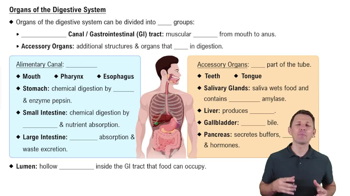
The digestive tract is a continuous tube from mouth to anus; material in the lumen has not crossed a cell layer, so it is outside the body until absorbed across the epithelium into the blood.
What are the four main functions of the digestive tract?
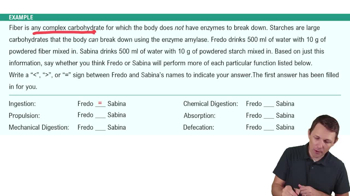
Digestion: mechanical and chemical breakdown of food; Absorption: movement of small molecules into blood; Secretion: release of enzymes, acid, mucus; Motility: moving contents at proper speed and direction.
What are the absorbable products of carbohydrates, proteins, and fats?
Describe the layers of the GI tract wall and their functions.
Mucosa: epithelium controls absorption and secretes hormones/enzymes/mucus; Submucosa: blood/lymph vessels and submucosal plexus; Muscularis externa: circular and longitudinal muscle with myenteric plexus for motility; Serosa: outer covering.
What digestive functions occur in the mouth?
Mechanical digestion by chewing; chemical digestion by salivary amylase (carbohydrates) and some lipase (fat); secretion of saliva; some absorption of sugars and drugs; motility by tongue forming and pushing bolus.
How does the stomach contribute to digestion?
Mechanical digestion by churning; chemical digestion mainly of proteins by pepsin (activated from pepsinogen by HCl) and some fat by lipase; secretion of acid, enzymes, mucus, and gastrin; some absorption.
How do parietal cells produce hydrochloric acid (HCl)?
CO2 + H2O → H2CO3 → H+ + HCO3−; HCO3− exchanged into blood for Cl−; H+ pumped into lumen by H+/K+-ATPase; Cl− follows passively; H+ + Cl− form HCl in stomach lumen.
What regulates HCl secretion in the stomach?
Gastrin (↑ acid), histamine (↑ acid), acetylcholine (↑ acid), and somatostatin (↓ acid). Cephalic phase (brain stimuli) and gastric phase (stomach stretch and peptides) increase acid; negative feedback by somatostatin reduces acid.
What increases the surface area of the small intestine?
Length (~20 ft), circular folds, villi (finger-like projections with capillaries and lacteals), and microvilli (brush border on epithelial cells).
What is celiac disease and how does it affect absorption?
An autoimmune reaction to gluten that flattens villi, reducing surface area and causing poor nutrient absorption, leading to malnutrition and digestive symptoms.
What are the main digestive secretions of the pancreas and their roles?
Pancreatic enzymes (trypsin, chymotrypsin, lipase, amylase) digest proteins, fats, and carbohydrates; duct cells secrete bicarbonate to neutralize stomach acid in the small intestine.
Describe the hepatic portal system and its functions.
Blood from digestive organs flows via the hepatic portal vein to liver capillaries before returning to the heart. Functions: process/store nutrients, filter toxins, recycle bile salts.
How does the large intestine contribute to digestion?
Reabsorbs water by pumping Na+ out of lumen, with water following osmotically; secretes mucus; bacteria ferment undigested polysaccharides producing gas.
What is the difference between absorptive and postabsorptive states?
Absorptive: nutrients enter blood; body uses energy and stores excess as glycogen/triglycerides. Postabsorptive: GI tract empty; body uses stored glycogen, fat, and protein to maintain blood glucose.
How does the body regulate blood glucose when levels are high?
Pancreatic beta cells release insulin, increasing glucose uptake in muscle and adipose (via GLUT4), promoting glycogen and triglyceride synthesis, and reducing liver glucose output.
How does the body respond to low blood glucose?
Pancreatic alpha cells release glucagon, stimulating liver glycogen breakdown, gluconeogenesis, and ketone synthesis to raise plasma glucose and provide alternative fuels.
What are the main energy sources during rest and high-intensity exercise?
At rest and low intensity: mainly fat oxidation. As intensity rises, carbohydrate use increases, becoming the sole fuel at maximal effort.
What are the ATP sources at the onset of muscle activity?
1) Stored ATP (seconds), 2) Phosphocreatine donating phosphate to ADP, 3) Anaerobic glycolysis, 4) Aerobic oxidative phosphorylation (steady state after ~90 s).
Explain oxygen deficit and oxygen debt in exercise.
O2 deficit: initial lag in oxygen supply at exercise start, covered anaerobically. O2 debt: elevated oxygen use after exercise to restore ATP, phosphocreatine, and clear lactate.
How does the preoptic-anterior hypothalamus (POAH) regulate body temperature?
POAH senses temperature via thermoreceptors and triggers sympathetic responses: vasodilation and sweating to lose heat when hot; vasoconstriction and shivering to conserve/generate heat when cold.
What are the four modes of heat exchange and their effects?
Radiation: infrared heat transfer; Convection: heat transfer by moving air/water; Conduction: direct contact heat transfer; Evaporation: heat loss via sweat evaporation, primary during exercise.
How do humidity and wind affect heat loss?
High humidity reduces evaporation, impairing cooling; wind increases convection, enhancing heat loss but can increase heat loss in cold conditions (wind chill).
What is the role of bile in digestion?
Bile salts emulsify fat droplets, increasing surface area for pancreatic lipase to digest triglycerides into absorbable monoglycerides and fatty acids.
How are pepsin and trypsin kept from digesting the cells that produce them?
They are secreted as inactive precursors (pepsinogen, trypsinogen) and activated only in the lumen to prevent self-digestion.
What is the function of the enteric nervous system in the GI tract?
Coordinates local motility and secretion via the submucosal and myenteric plexuses, receiving input from the autonomic nervous system.
What happens in untreated type 1 diabetes leading to coma?
No insulin → high plasma glucose → osmotic diuresis → dehydration and low blood volume → impaired brain blood flow; plus ketoacidosis from fat breakdown → coma and death if untreated.
 뒤로
 4:06