Skip to main content
Anatomy & Physiology
나의 코스
배우기
시험 준비
AI 튜터
학습 가이드
교과서적 해결책
플래시카드
탐험해 보세요
앱을 사용해 보세요
나의 코스
배우기
시험 준비
AI 튜터
학습 가이드
교과서적 해결책
플래시카드
탐험해 보세요
앱을 사용해 보세요
뒤로
Anatomy & Physiology Exam 2 Review Flashcards
카드를 뒤집기 위해 탭할 수 있습니다.
Functions of astrocytes include all of the following except
카드를 뒤집기 위해 탭할 수 있습니다.
👆
Functions of astrocytes include all of the following except
C) conducting action potentials.
진행 상황 추적
컨트롤 버튼이 '내비게이션' 모드로 변경되었습니다.
1/64
추천 영상
VideoThumbView.guidedCourse
04:36
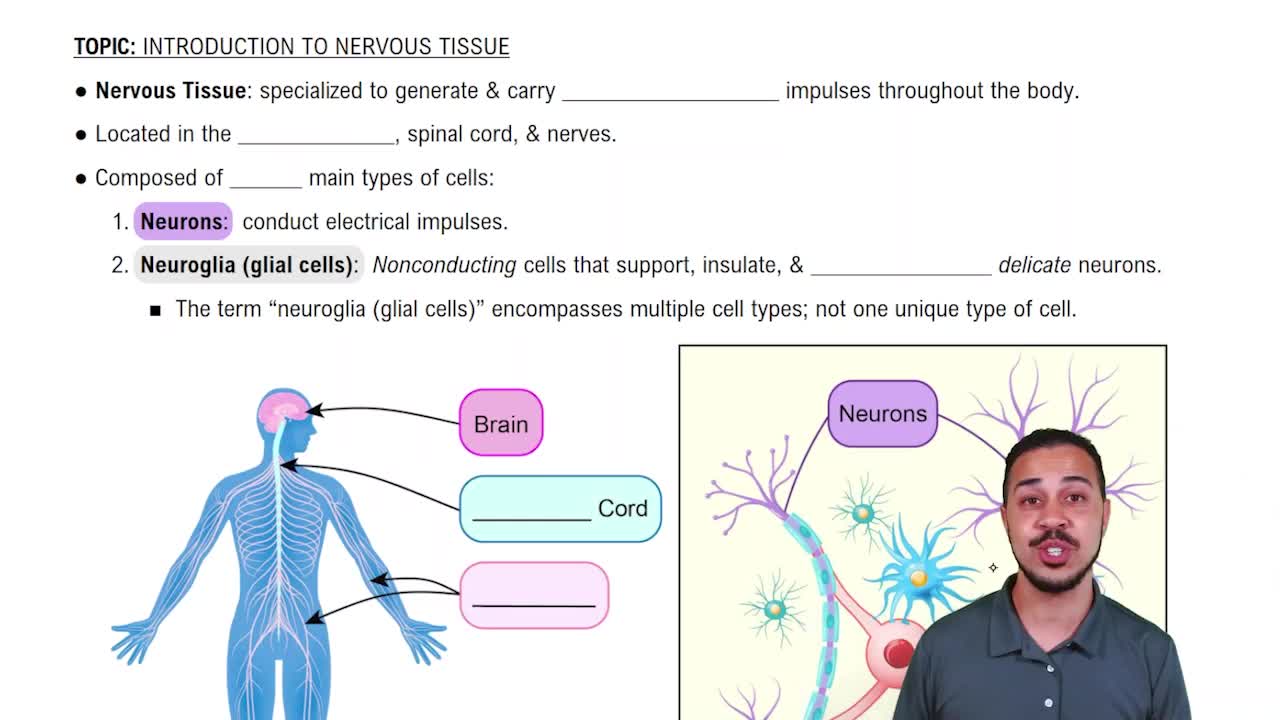
Intro to Nervous Tissue
8261
views
157
rank
이 집합의 용어 (64)
하이드의 정의
Functions of astrocytes include all of the following except
C) conducting action potentials.
Neurons that have one axon and one dendrite, with the soma in between, are called
C) bipolar.
Synaptic delay is caused by
E) neurotransmitter diffusion.
The effect that a neurotransmitter has on the postsynaptic membrane depends on the
A) characteristics of the receptors.
The ________ principle states that the size and speed of the action potential are independent of the stimulus strength.
E) all-or-none
When a second EPSP arrives at a single synapse before the effects of the first have disappeared, what occurs?
A) temporal summation
The plasma membrane of an axon is called the
E) axolemma.
Regions of the CNS with an abundance of myelinated axons constitute the ________ matter.
D) white
Which of the following neurotransmitters is a dissolved gas?
D) nitric oxide
________ carry motor information to peripheral effectors.
B) Efferent neurons
The axoplasm of the axon contains which of the following?
E) All of the answers are correct.
In which of the following would the rate of impulse conduction be the greatest?
D) a myelinated fiber of 10-µm diameter
The ________ nervous system controls the skeletal muscles.
B) somatic
Select the correct order of events during continuous propagation of action potential.
A) 4,2,3,1
If the sodium-potassium pumps in the plasma membrane fail to function, all of the following occur except
D) the intracellular concentration of potassium ions will increase.
Which of the following is a type of glial cell found in the peripheral nervous system?
D) satellite cells
The site in the neuron where EPSPs and IPSPs are integrated is the
D) axon hillock.
What is the correct sequence of events at a cholinergic synapse?
B) 4, 2, 6, 7, 1, 8, 3, 5
________ account for roughly half of the volume of the nervous system.
E) Neuroglia
Type ________ fibers have the largest diameter axons.
B) A
Sensory neurons of the PNS are
D) unipolar.
In the condition ________, a virus infects posterior root ganglia causing a painful rash.
D) shingles
Sensory information from the abdomen is carried to the spinal cord over a(n) ________ ramus.
B) posterior
Recognized neuronal circuit patterns include all of the following except
D) multipolar.
________ reflexes activate skeletal muscles.
C) Somatic
Which of the following is not a way that reflexes are classified?
C) sympathetic/parasympathetic
Axons cross from one side of the spinal cord to the other through the
E) anterior white commissure.
The largest peripheral nerve is the ________ nerve.
C) sciatic
The reflex that prevents a muscle from exerting too much tension is the ________ reflex.
E) tendon
Which of the following associations is incorrect?
C) 11 thoracic spinal nerves
Spinal nerves from the sacral region of the cord innervate the ________ muscles.
E) leg
The posterior root of a spinal nerve contains
A) axons of sensory neurons.
The white matter of the spinal cord is mainly
C) myelinated axons.
A complex, interwoven network of nerves is called a
E) plexus.
Large bundles of axons from several spinal nerves in the brachial plexus are termed
A) cords.
Sensory innervation of the lower teeth and gums is by the ________ nerve.
A) mandibular branch of the trigeminal
The control of heart rate and blood pressure is based in the
C) medulla oblongata.
The wall between the lateral ventricles is called the
D) septum pellucidum.
Sensory information is processed and relayed to the cerebrum by the
E) thalamus.
At the optic chiasm,
A) axons from the medial halves of each retina cross.
The lateral ventricles are found
B) in the cerebral hemispheres.
Symptoms of change in vocal tone, problems swallowing, erratic heart rate, and gastric problems indicate damage to the
E) vagus nerve.
The brain requires a substantial blood supply. The vessels that deliver blood to the brain are the
D) internal carotid and vertebral arteries.
The medulla oblongata relays auditory stimuli to the
C) inferior colliculi.
Which of the following nerves is purely sensory?
C) optic
What is the proper sequence of events in the generation of an action potential?
D) 4, 6, 7, 1, 2, 3, 5
The efferent division of the peripheral nervous system innervates ________ cells.
E) All of the answers are correct.
Which of the following is the primary second messenger in G-protein coupled post-synaptic cells?
A) cAMP
Summation from multiple synapses at multiple places on the neuron is called
B) spatial summation.
The molecule responsible for making cyclic AMP is called
B) adenylate cyclase.
Raising the potassium ion concentration in the extracellular fluid surrounding a nerve cell will
B) depolarize it
A threshold stimulus is the
C) depolarization necessary to cause an action potential.
A posterior and anterior root of each spinal segment unite to form a
C) spinal nerve.
The scenario of touching a hot plate and withdrawing your hand represents a ________ neuronal circuit.
C) divergent
Each of the following nerves originates in the lumbar plexus except the ________ nerve.
C) sciatic
The white structure that connects the cerebral hemispheres is the
A) corpus callosum.
The passageway between the lateral ventricles and the third ventricle is the
B) interventricular foramen.
The ________ division of the nervous system carries motor commands to muscles and glands.
C) efferent
Neurons that have several dendrites and a single axon are called
E) multipolar.
If the posterior root of a spinal nerve is severed,
A) sensory input would be blocked.
What is the area between the arachnoid mater and the pia mater?
D) subarachnoid space
Which sensation(s) does the vestibulocochlear nerve carry?
C) hearing and balance
The axon hillock is a region between what two general regions of a neuron?
A) cell body and axon
Masses of gray matter within the central nervous system are
C) nuclei.
 뒤로뒤로
 04:36
