뒤로

Anatomy & Physiology Exam 2 Study Guide

1 학생이 이 점이 도움이 되었다고 느꼈습니다
컨트롤 버튼이 '내비게이션' 모드로 변경되었습니다.
1/20
  • What is the focus of Chapter 7 in Anatomy & Physiology?

    Chapter 7 covers the skeleton, including bone functions, classification, structure, and the axial and appendicular skeleton.
  • Name the four types of bone cells.

    Osteogenic cells, osteoblasts, osteocytes, and osteoclasts.
  • What are the two main types of bone tissue?

    Compact bone and spongy bone.
  • What is the difference between the axial and appendicular skeleton?

    The axial skeleton includes the skull, vertebral column, and thoracic cage; the appendicular skeleton includes limbs and girdles.
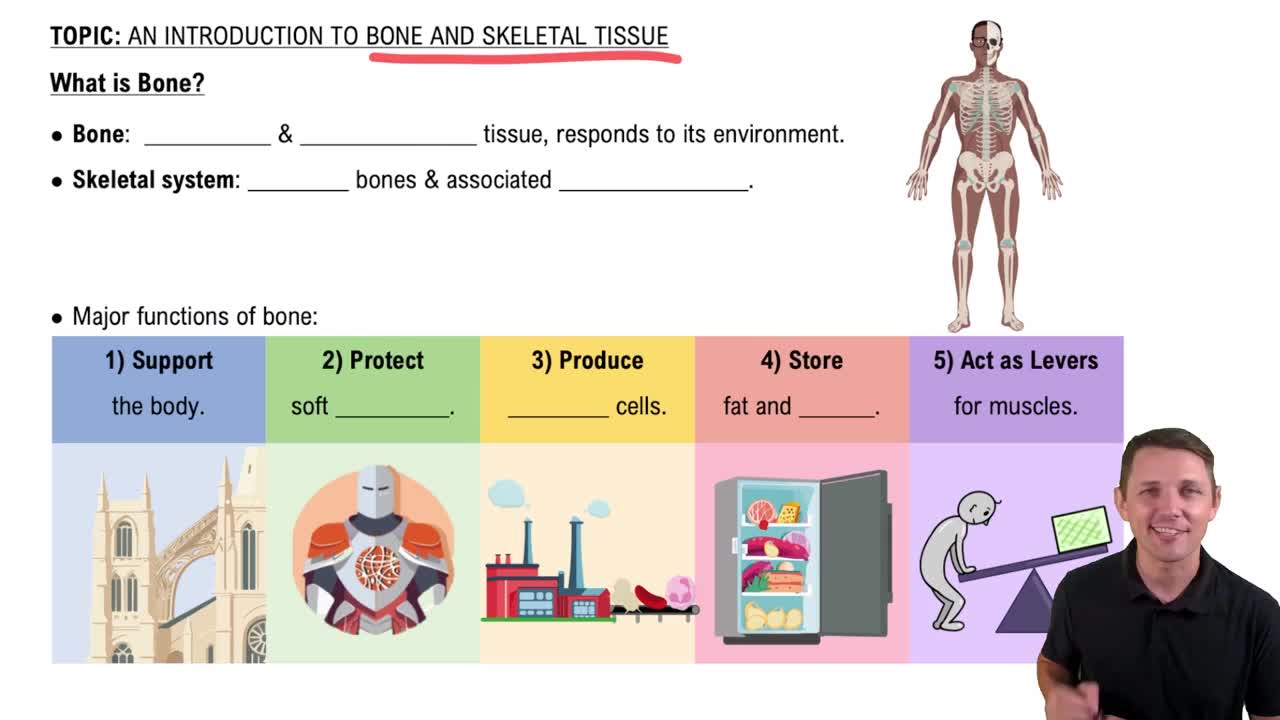
  • What are the major functions of the skeletal system?

    Support, protection, movement, mineral storage, blood cell production, and energy storage.
  • What is the periosteum?

    A dense layer of vascular connective tissue enveloping bones except at the surfaces of the joints.
  • What is the role of osteoblasts?

    Bone-forming cells that secrete the bone matrix.
  • What is the role of osteoclasts?

    Bone-resorbing cells that break down bone tissue.
  • What is the epiphyseal plate?

    A hyaline cartilage plate in the metaphysis at each end of a long bone where growth occurs.
  • What is the difference between compact and spongy bone structure?

    Compact bone is dense and solid; spongy bone has a porous, lattice-like structure.
  • What is the function of red bone marrow?

    Site of hematopoiesis, the production of blood cells.
  • What is the function of yellow bone marrow?

    Stores fat and serves as an energy reserve.
  • What is the role of the endosteum?

    A thin vascular membrane lining the inner surface of the bony tissue that forms the medullary cavity.
  • What are the major parts of a long bone?

    Diaphysis, epiphyses, metaphysis, medullary cavity, periosteum, and endosteum.
  • What is ossification?

    The process of bone tissue formation.
  • What are the two types of ossification?

    Intramembranous and endochondral ossification.
  • What is the function of the axial skeleton?

    Supports and protects the brain, spinal cord, and thoracic organs.
  • What bones make up the thoracic cage?

    The sternum and ribs.
  • What is the function of the appendicular skeleton?

    Facilitates movement and supports the limbs.
  • What is the role of cartilage in the skeletal system?

    Provides flexible support and reduces friction at joints.