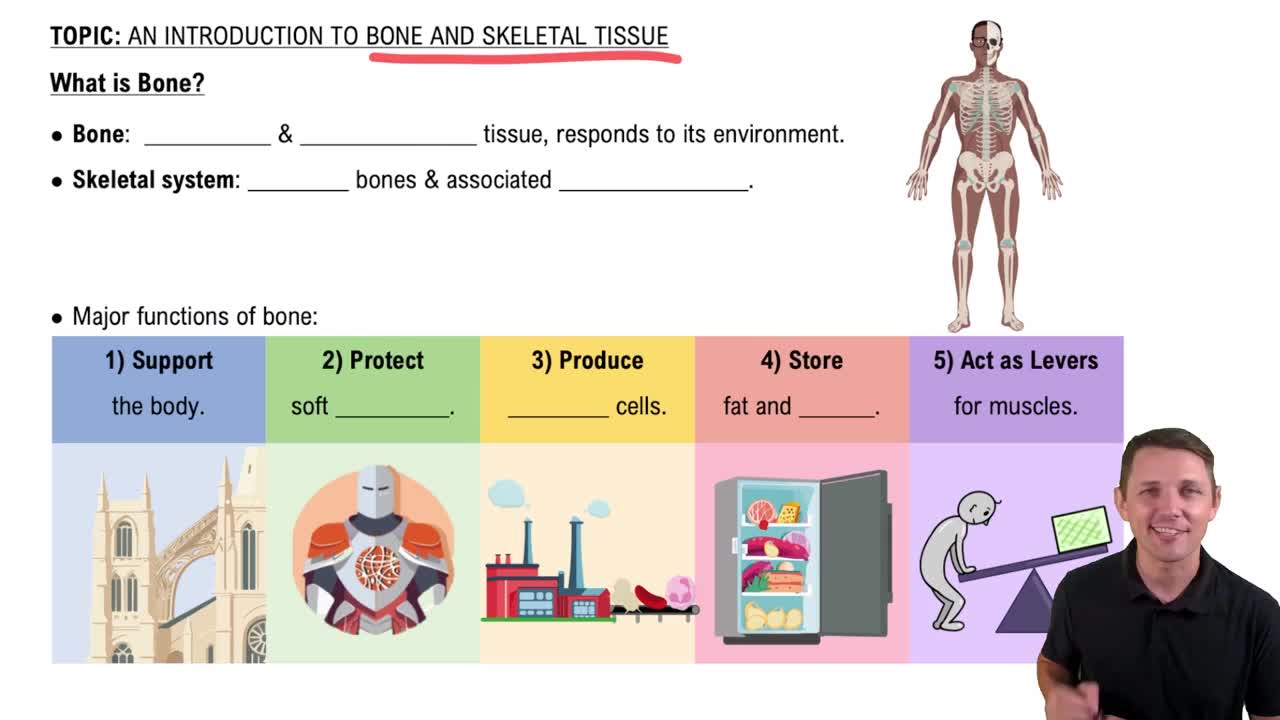
Support, Protection, Movement, Mineral storage, Blood cell formation, Fat storage, and Endocrine role (osteocalcin release).
Types of bone cells and their roles
Osteogenic cells: stem cells that become osteoblasts. Osteoblasts: build bone and secrete osteoid. Osteocytes: mature cells maintaining matrix and sensing stress. Osteoclasts: break down bone.
Compact vs spongy bone
Compact bone is dense, organized into osteons with central canals, forming the outer shell. Spongy bone is a honeycomb of trabeculae, found in epiphyses and inside flat bones, holding red marrow.
Organic vs inorganic bone matrix
Organic matrix (collagen and ground substance) provides flexibility and tensile strength. Inorganic matrix (hydroxyapatite crystals) provides hardness and compression strength.
Osteon structure
Osteon is the structural unit of compact bone, a cylinder with concentric lamellae around a central (Haversian) canal containing blood vessels and nerves.
Bone remodeling cycle
Cycle includes activation, resorption by osteoclasts, reversal, and formation by osteoblasts. It maintains calcium balance, repairs damage, and adapts bone strength to stress.
Hormones regulating bone
PTH raises blood calcium by increasing osteoclast activity. Calcitonin lowers calcium by inhibiting osteoclasts. Calcitriol increases intestinal calcium absorption. Growth and thyroid hormones promote growth.
Endochondral ossification steps
0: Cartilage model forms. 1: Bone collar forms. 2: Cartilage calcifies and chondrocytes die. 3: Periosteal bud invades, primary ossification center forms. 4: Secondary ossification centers form. 5: Cartilage remains as articular cartilage and epiphyseal plate.
Intramembranous ossification steps
1: Ossification center forms. 2: Osteoid secreted and calcifies. 3: Woven bone and periosteum form. 4: Lamellar bone replaces woven bone with red marrow inside.
Epiphyseal plate zones
1: Resting cartilage anchors plate. 2: Proliferation zone where chondrocytes divide. 3: Hypertrophy zone where chondrocytes enlarge. 4: Calcification zone where matrix calcifies and cells die. 5: Ossification zone where bone replaces cartilage.
Types of bone fractures
Closed (skin intact) vs open (bone breaks skin). Complete vs incomplete (greenstick). Other types: transverse, oblique, spiral, comminuted, impacted, compression, depressed, avulsion, stress, pathological.
Stages of fracture repair
1: Hematoma formation. 2: Fibrocartilaginous (soft) callus forms. 3: Bony (hard) callus forms. 4: Bone remodeling restores shape and strength.
Bone growth in length and width
Length grows by interstitial growth at epiphyseal plates. Width grows by appositional growth with osteoblasts adding bone outside and osteoclasts enlarging medullary cavity inside.
Bone classification by shape
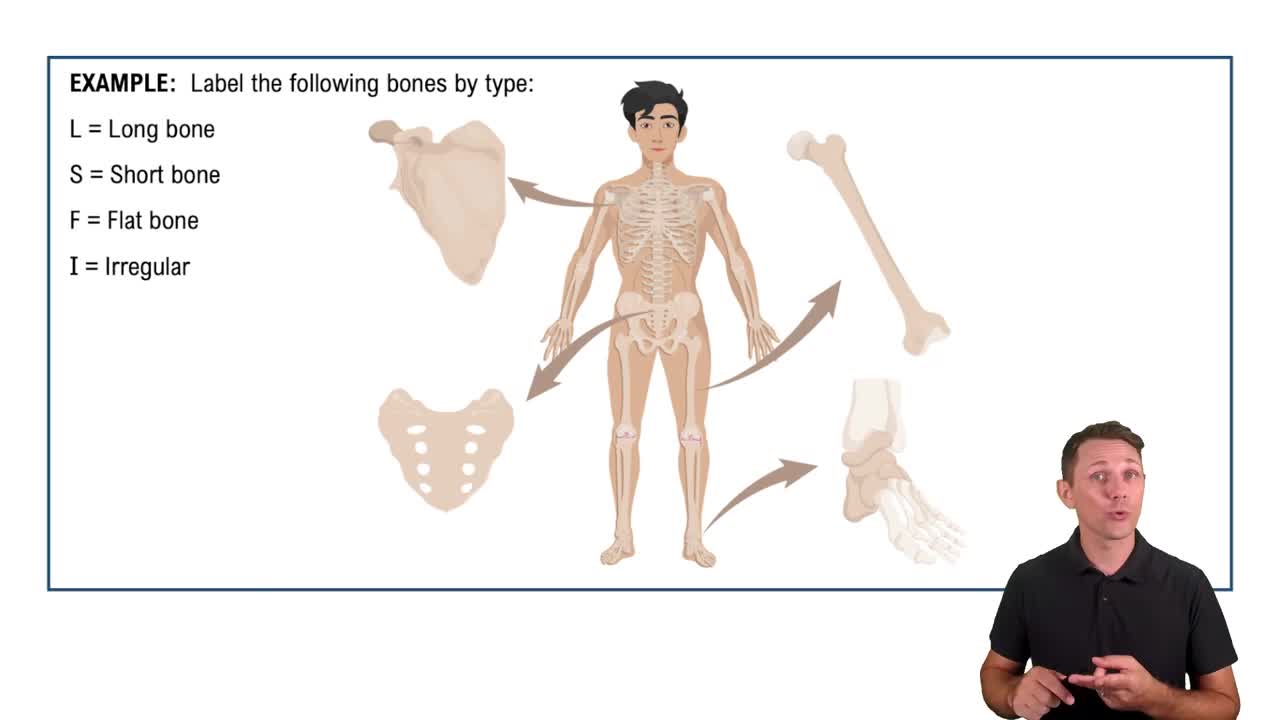
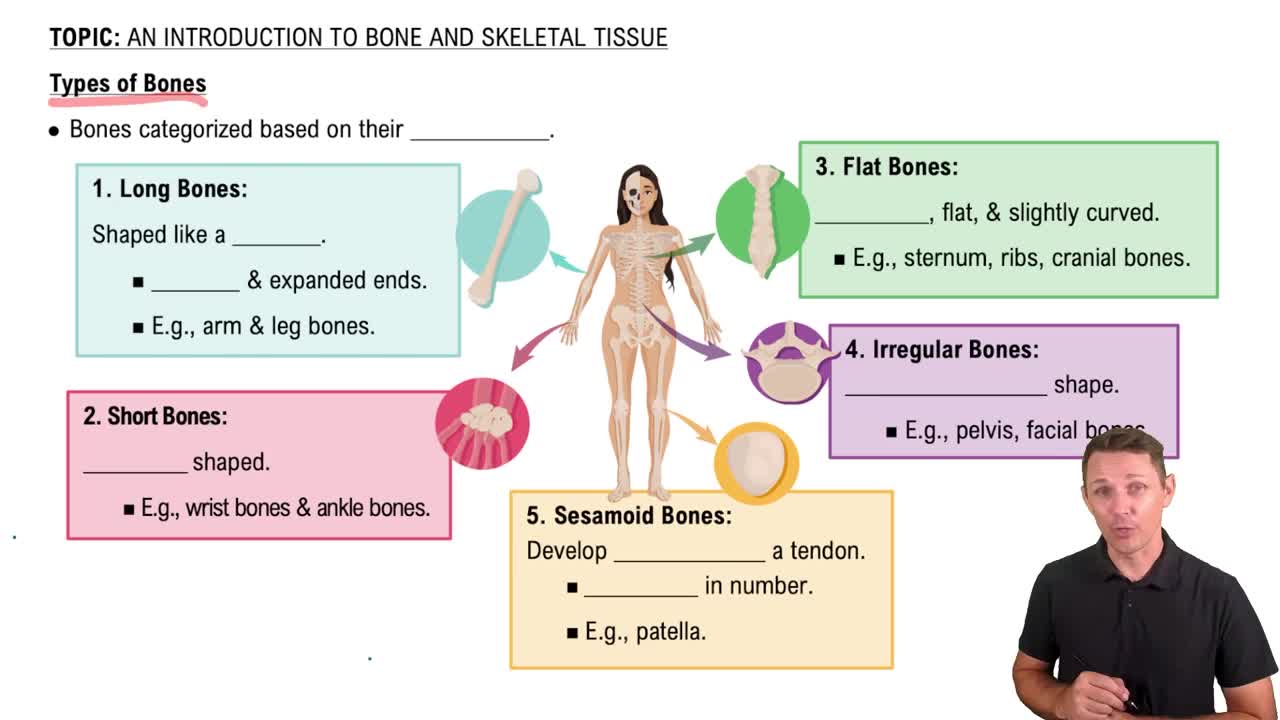
Long (levers), short (stability), flat (protection and muscle attachment), irregular (special shapes), sesamoid (inside tendons), sutural (extra skull bones).
Axial vs appendicular skeleton
Axial skeleton (80 bones) includes skull, vertebrae, ribs, sternum. Appendicular skeleton (126 bones) includes limbs and girdles.
Synovial joint features
Joint cavity with synovial fluid, articular cartilage, articular capsule with fibrous layer and synovial membrane, reinforcing ligaments, and rich nerve and blood supply.
Factors affecting joint stability
1: Shape and fit of articular surfaces. 2: Number and strength of ligaments. 3: Muscle tone and tendons crossing the joint.
Osteoarthritis: wear and tear, cartilage breakdown. Rheumatoid arthritis: autoimmune attack on synovial membrane. Gout: uric acid crystal buildup causing pain.
Why is the shoulder prone to dislocation?
Shallow glenoid cavity, loose capsule, weak ligaments, and reliance on rotator cuff muscles make it mobile but unstable.
How do ligaments and tendons support joints?
Ligaments connect bone to bone and limit motion. Tendons connect muscle to bone and stabilize joints dynamically through muscle tone.
Role of bursae and menisci
Bursae cushion and reduce friction where tissues rub over bone. Menisci absorb shock and improve fit between bones.
Wolff's law
Bone remodels and grows stronger in response to mechanical stress placed on it.
Why is calcium regulation important for bone health?
Calcium is vital for muscle contraction, nerve signaling, and blood clotting. Bone stores 99% of body calcium and releases it to maintain blood levels.
Differences between compact and spongy bone
Compact bone is dense, forms outer shell, resists bending. Spongy bone is porous, found in epiphyses, supports marrow, and remodels faster.
How does bone repair differ with age?
Children heal fractures faster due to active growth and thick periosteum. Older adults have slower healing and decreased bone mass.
How do joint injuries affect mobility?
Injuries cause pain, swelling, instability, and reduced range of motion, limiting daily activities and increasing arthritis risk.
 뒤로
 3:56