뒤로

Anatomy & Physiology Exam 2 Study Guide Flashcards

컨트롤 버튼이 '내비게이션' 모드로 변경되었습니다.
1/31
  • Major function of the respiratory system

    To bring oxygen (O₂) into the body and remove carbon dioxide (CO₂), which is a waste product of cellular respiration.
  • Respiratory mucosa epithelium type

    Most of the nasal cavity is lined with pseudostratified ciliated columnar epithelium containing goblet cells that produce mucus and cilia that move mucus toward the pharynx.
  • Functions of the nose

    Filters, warms, and moistens incoming air; detects odors (olfaction); and acts as a resonating chamber to help shape the voice.
  • Common function of respiratory-zone structures

    Gas exchange between air and blood occurs in respiratory bronchioles, alveolar ducts, and alveoli.
  • Common function of conducting-zone structures

    Conduct air to and from the respiratory zone; they also filter, warm, and humidify air but do not perform gas exchange.
  • Three functions of the larynx

    Keeps an open airway; routes air and food into proper pathways and protects the lower airway during swallowing; produces voice.
  • Why are tracheal cartilage rings incomplete posteriorly?

    The open side faces the esophagus, allowing it to bulge forward when swallowing food, while still keeping the airway open.
  • Pleural fluid function

    Lubricates pleural surfaces to reduce friction and helps lungs move smoothly with the chest wall during breathing.
  • Why must intrapleural pressure remain negative?

    Negative pressure keeps lungs expanded against the chest wall; loss of this pressure can cause lung collapse (pneumothorax).
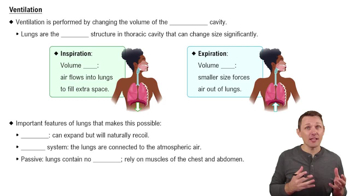
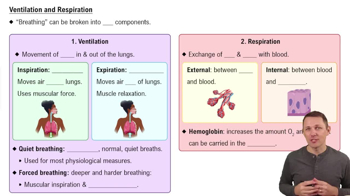
  • Sequence of inspiration

    1) Inspiratory muscles contract → 2) thoracic cavity volume increases → 3) lungs stretch and intrapulmonary volume increases → 4) intrapulmonary pressure drops below atmospheric pressure → 5) air flows into lungs.
  • Difference between inspiration and quiet expiration

    Inspiration is active, requiring muscle contraction; quiet expiration is passive, relying on elastic recoil of lungs.
  • Lung volumes: Vital capacity (VC)

    Maximum exchangeable air: tidal volume + inspiratory reserve volume + expiratory reserve volume.
  • Lung volumes: Residual volume (RV)

    Air remaining in the lungs after a maximal forced expiration.
  • How is most oxygen transported in blood?

    Bound to the heme group of hemoglobin in red blood cells.
  • Effect of CO₂ accumulation on blood pH

    Increases H⁺ concentration, lowering pH (making blood more acidic).
  • Three long-term high-altitude adjustments

    Increased ventilation; increased red blood cell/hemoglobin production; increased tissue capillary supply to improve oxygen delivery.
  • Six major digestive processes

    Ingestion, propulsion, mechanical breakdown, digestion, absorption, and defecation.
  • Four layers of the alimentary canal wall (lumen outward)

    Mucosa → submucosa → muscularis externa → serosa (or adventitia where serosa is absent).
  • Function of muscularis externa

    Smooth muscle layer responsible for segmentation and peristalsis to mix and propel contents.
  • Epithelium lining the esophagus

    Nonkeratinized stratified squamous epithelium protects against abrasion from swallowed food.
  • Stomach muscularis externa modification

    Has three smooth muscle layers: longitudinal, circular, and an inner oblique layer for strong mixing and churning.
  • Typical stomach pH and importance

    Very acidic (pH 1.5–3.5) to activate pepsinogen, denature proteins, and kill microbes.
  • Role of cholecystokinin (CCK)

    Released in response to fats and proteins; stimulates gallbladder contraction, bile release, pancreatic enzyme secretion, and slows gastric emptying.
  • Small intestine segments (proximal to distal)

    Duodenum → jejunum → ileum.
  • Structure creating brush-border appearance

    Microvilli on the apical surface of intestinal epithelial cells increase surface area for absorption.
  • Processes in the small intestine

    Propulsion, mechanical breakdown/mixing, digestion, and absorption; major site of chemical digestion and nutrient absorption.
  • Beneficial role of large-intestine bacteria

    Produce vitamins (K and some B), ferment undigested material, and help resist harmful microbes.
  • Three macronutrient categories

    Carbohydrates, lipids (fats), and proteins.
  • Definitions: Catabolism and Anabolism

    Catabolism breaks down molecules, releasing energy; Anabolism builds molecules, requiring energy.
  • Where does the citric acid cycle occur?

    In the mitochondrial matrix.
  • Typical ATP yield per glucose molecule

    About 30 ATP molecules are produced per glucose during cellular respiration.