 뒤로
Anatomy & Physiology Exam 2 Study Guide: Skeleton and Joints
 3:56

이 집합의 용어 (29)
Axial skeleton has 80 bones forming the body's vertical axis (skull, vertebral column, sternum). Appendicular skeleton has 126 bones attached to axial (pectoral/pelvic girdles, limbs).
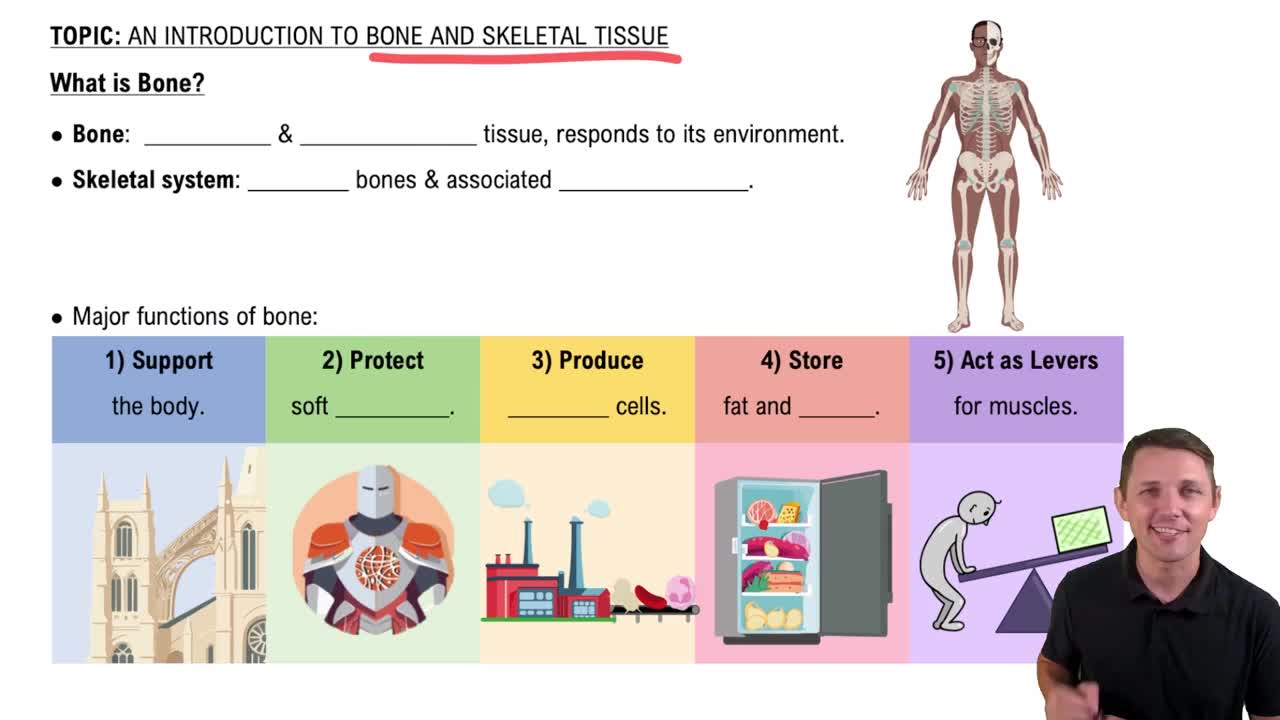
Supports/protects organs in body cavities, contains special sense organs, provides muscle attachment for posture, moves thoracic cage during respiration, stabilizes appendicular skeleton.
22 total: 8 cranial bones (Occipital, Parietal, Frontal, Temporal, Ethmoid, Sphenoid) and 14 facial bones (Mandible, Maxillae, Nasal, Zygomatic, etc.).
Coronal (frontal-parietal), Sagittal (between parietals), Lambdoid (parietal-occipital), Squamous (temporal-parietal).
Only bone not articulating with another bone; anchors muscles of larynx and swallowing.
26 bones: 7 cervical, 12 thoracic, 5 lumbar vertebrae, 1 sacrum (5 fused), 1 coccyx (3–5 fused).
7 total; small body, large vertebral foramen, transverse foramina, bifid spinous process; C1 (Atlas) has no body; C2 (Axis) has dens.
12 total; articulate with ribs via costal facets; heart-shaped body; long, downward spinous process.
5 total; largest vertebrae; large kidney-shaped body; small vertebral foramen; blunt, robust spinous process.
Primary (thoracic, sacral) develop before birth; Secondary (cervical, lumbar) develop after birth for upright posture.
12 pairs: True ribs (1–7) attach directly to sternum; False ribs (8–10) attach indirectly; Floating ribs (11–12) no sternal attachment.
Manubrium, body, xiphoid process; landmarks include jugular notch, clavicular notches, sternal angle.
Clavicle (only direct axial connection) and scapula with landmarks like acromion, coracoid process, glenoid fossa.
Brachium = humerus; Antebrachium = radius and ulna; Wrist = carpals; Hand = metacarpals and phalanges.
Radius is lateral (thumb side); Ulna is medial (pinky side) in anatomical position.
Two ossa coxae, each formed by ilium, ischium, and pubis fused at acetabulum.
Femur → patella → tibia/fibula → tarsals → metatarsals → phalanges.
Fibula is lateral and non-weight-bearing; tibia is medial and weight-bearing.
Bony (synostoses), fibrous, cartilaginous, and synovial joints.
Most movable; joint capsule with fibrous outer layer and synovial membrane; synovial fluid lubricates joint.
Plane, hinge, pivot, condylar, saddle, ball-and-socket joints.
Flexion/Extension, Abduction/Adduction, Supination/Pronation, Rotation, Circumduction.
Only diarthrotic skull joint; synovial hinge; has fibrocartilage articular disc; ligaments strengthen it.
Glenoid labrum, rotator cuff muscles, bursae, ligaments, and joint capsule.
Humeroulnar (hinge) and humeroradial (rotation) joints; radial and ulnar collateral ligaments; annular ligament around radius.
Largest joint; hinge with limited lateral movement; includes MCL, LCL, ACL, PCL, medial and lateral menisci.
First-class: fulcrum between effort and resistance; Second-class: resistance between fulcrum and effort; Third-class: effort between fulcrum and resistance (most common).
Breakfast at 7 = cervical; Lunch at 12 = thoracic; Dinner at 5 = lumbar vertebrae counts.
1st = Fulcrum middle; 2nd = Resistance middle; 3rd = Effort middle.