 뒤로
Anatomy & Physiology: Framework, Language, and Tissue Types
 05:04

이 집합의 용어 (20)
The person stands with feet flat on the ground, arms at the sides, and palms facing forward. All anatomical descriptions are based on this position.
A vertical plane dividing the body into left and right parts. The midsagittal plane divides the body into equal halves.
A vertical plane dividing the body into front (anterior) and back (posterior) portions.
A plane perpendicular to the long axis of the body or organ, dividing it into superior (upper) and inferior (lower) parts.
Proximal means closer to the point of attachment or origin; distal means farther from the point of attachment or origin.
Medial means toward the median plane; lateral means away from the median plane.
Axial region includes head, neck, and trunk; appendicular region includes upper and lower limbs.
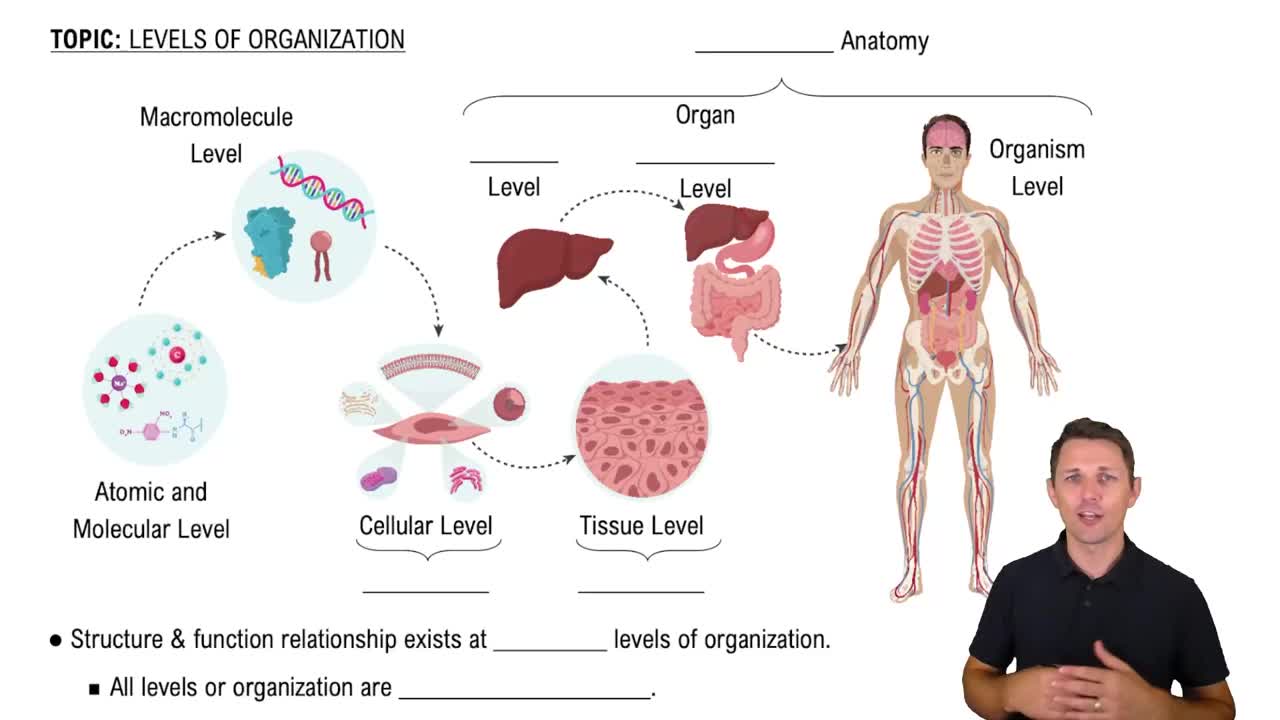
Epithelial, connective, nervous, and muscular tissues.
Protection, secretion, excretion, absorption, filtration, and sensation.
Simple epithelium has every cell touching the basement membrane; stratified epithelium has multiple layers with only the bottom layer touching the basement membrane.
Cells occupy less space than the extracellular matrix they secrete; functions include support, connection, protection, immune defense, movement, storage, heat production, and transport.
Loose connective tissue has more ground substance; dense connective tissue has more fibers, which can be regular or irregular in orientation.
Energy storage, thermal insulation, and cushioning of organs.
Hyaline cartilage, elastic cartilage, and fibrocartilage.
Compact bone is dense and strong, arranged in osteons; spongy bone is porous, contains red marrow, and is arranged in trabeculae.
Water (95%), dissolved proteins, clotting factors, electrolytes, hormones, and gases like oxygen and carbon dioxide.
Neurons, which transmit signals, and neuroglia, which protect and assist neurons.
Skeletal: voluntary, striated, multinucleated; cardiac: involuntary, striated, branched with intercalated discs; smooth: involuntary, non-striated, found in hollow organs.
It anchors the epithelium to the underlying connective tissue and acts as a selective barrier.
Keratinized epithelium has a surface layer of dead cells with keratin for abrasion resistance; nonkeratinized lacks this layer and remains moist.