뒤로

Anatomy & Physiology I - Key Concepts and Course Overview

컨트롤 버튼이 '내비게이션' 모드로 변경되었습니다.
1/20
  • What is the focus of Biology 121: Anatomy & Physiology I?

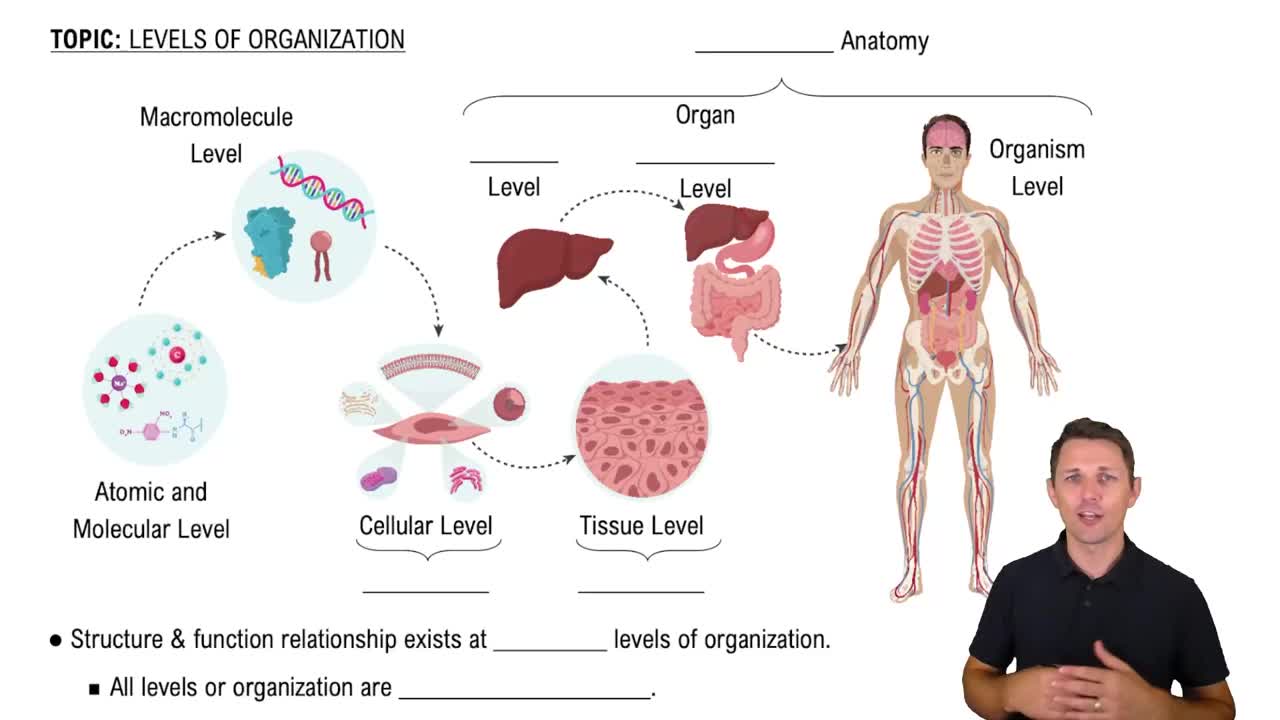
    It examines the structure, function, support, and regulation of the human body, starting from cellular level to organ systems, including integumentary, skeletal, muscular, and nervous systems.
  • What are the main body systems studied in Anatomy & Physiology I?

    The integumentary, skeletal, muscular, and nervous systems at both microscopic and macroscopic levels.
  • What is the course format for Anatomy & Physiology I?

    In-person meetings with some flipped classes requiring students to review materials online for active learning and group activities.
  • What are the course learning objectives for Anatomy & Physiology I?

    Use correct terminology, understand anatomy and physiology of organs and tissues, relate structure to function, understand homeostasis, disease disruption, organ interrelationships, and research presentation skills.
  • What textbook is required for Anatomy & Physiology I?

    Visual Anatomy & Physiology 3rd ed. by Frederic Martini et al., with Modified Mastering A&P and Pearson eText.
  • What is the role of MasteringA&P in this course?

    It provides interactive assignments for each chapter to reinforce learning at the student's own pace.
  • How is lab attendance handled in Anatomy & Physiology I?

    Lab attendance is mandatory; missing sessions results in loss of lab points and assignments unless excused with prior arrangements.
  • What is the grading breakdown for the course?

    Lecture assignments 15.5%, lecture exams 30%, lab exams 20%, lab participation/assignments 5.5%, lab quizzes 5%, lab presentation 2.5%, comprehensive final 20%.
  • What is the policy on late assignments?

    Late assignments accepted with 10% grade deduction per day, up to 50%, and not accepted after five days past due.
  • What topics are covered in Unit 1 of the course?

    Introduction to Anatomy & Physiology, Chemical Level of Organization, Cellular Level of Organization, Tissue Level of Organization.
  • What topics are covered in Unit 2 of the course?

    The Integumentary System, Bones and Bone Structure, The Skeleton, and Joints.
  • What topics are covered in Unit 3 of the course?

    Skeletal Muscle Tissue and The Muscular Tissue.
  • What topics are covered in Unit 4 of the course?

    Nervous Tissue, The Spinal Cord, Spinal Nerves and Spinal Reflexes, The Brain, Cranial Nerves, and Sensory and Motor Pathways.
  • What topics are covered in Unit 5 of the course?

    The Autonomic Nervous System and The Special Senses.
  • What is the policy on academic dishonesty in this course?

    Plagiarism and cheating result in penalties from failing the assignment to failing the course, with offenses reported to the Office of the Provost.
  • What accommodations are available for students with disabilities?

    Students can contact Student Accessibility Services for reasonable accommodations based on documentation, with services not retroactive.
  • What is the Title IX compliance statement for the course?

    The university prohibits gender-based and sexual misconduct and provides resources and reporting options to maintain a respectful environment.
  • What is the importance of lecture attendance?

    Attendance allows participation in active learning, asking questions, and hearing explanations not found in textbooks.
  • What is the role of lab presentations in the course?

    Students present current research on lab topics, including background, experiments, conclusions, and must cite primary research articles.
  • How are exams and quizzes delivered in this course?

    They may be multiple choice, matching, true/false, labeling, fill-in-the-blank, or short answer, delivered on paper or electronically via Canvas.