Skip to main content
Anatomy & Physiology
나의 코스
배우기
시험 준비
AI 튜터
학습 가이드
교과서적 해결책
플래시카드
탐험해 보세요
앱을 사용해 보세요
나의 코스
배우기
시험 준비
AI 튜터
학습 가이드
교과서적 해결책
플래시카드
탐험해 보세요
앱을 사용해 보세요
뒤로
Anatomy & Physiology: Joint Articulations
카드를 뒤집기 위해 탭할 수 있습니다.
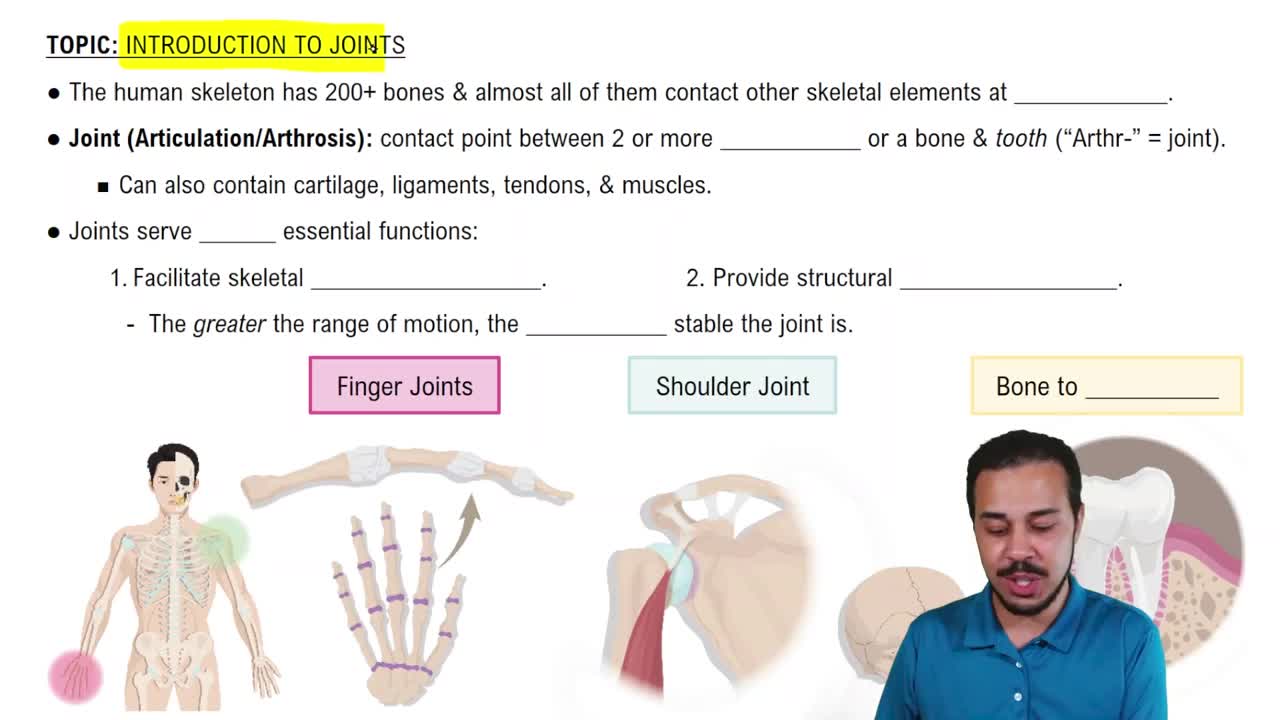
What is a joint articulation?
카드를 뒤집기 위해 탭할 수 있습니다.
👆
What is a joint articulation?
A
joint articulation
is the connection between two or more bones that allows movement and provides mechanical support.
진행 상황 추적
컨트롤 버튼이 '내비게이션' 모드로 변경되었습니다.
1/20
추천 영상
VideoThumbView.guidedCourse
04:06
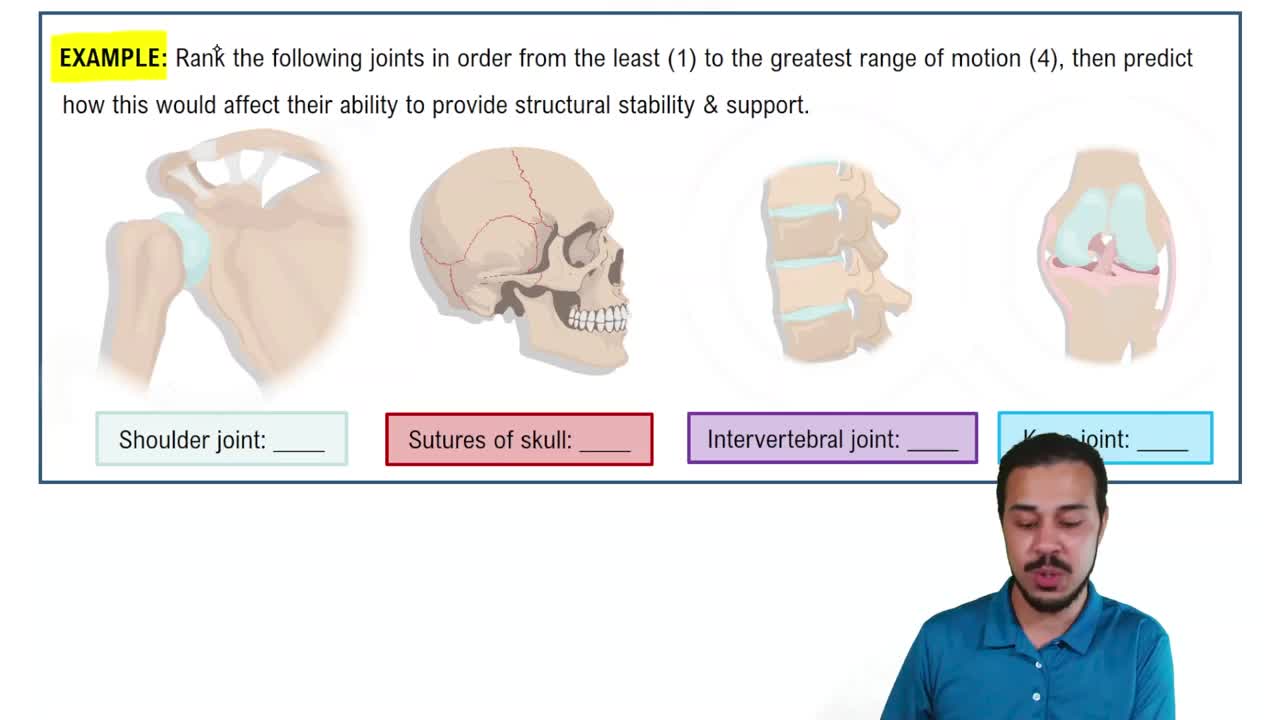
Introduction to Joints Example 1
11999
views
270
rank
VideoThumbView.guidedCourse
05:29
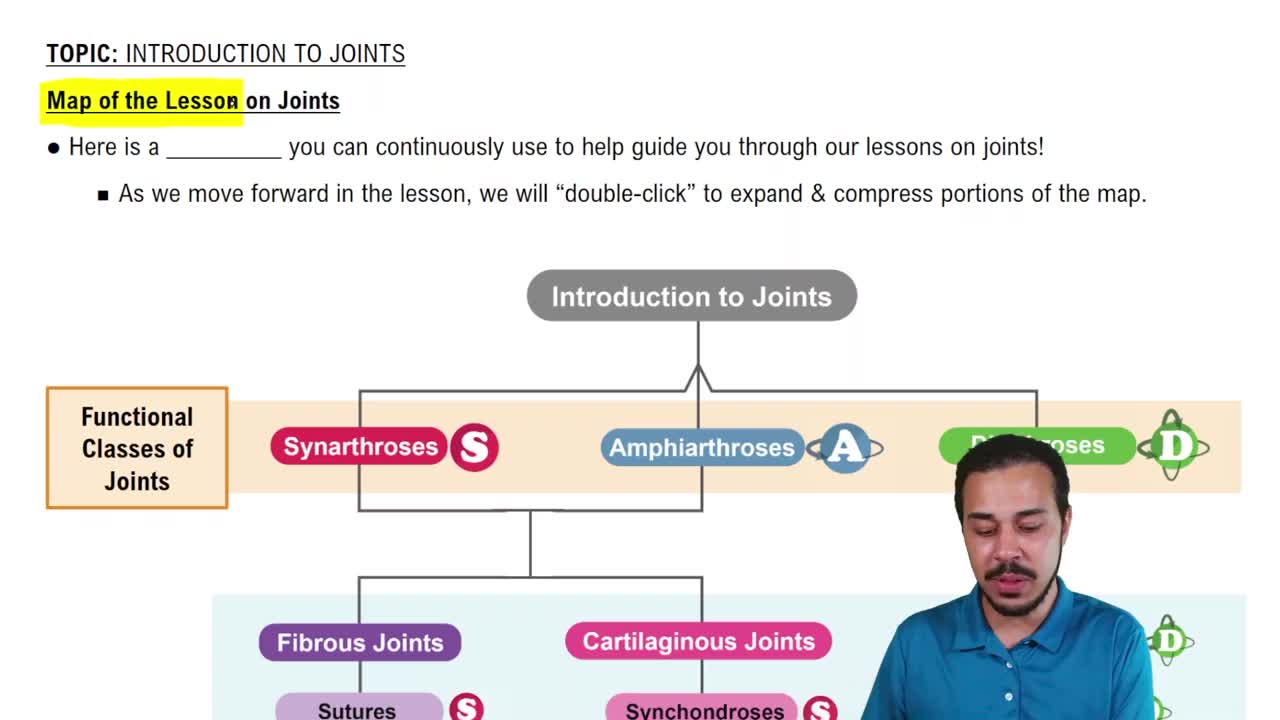
Map of the Lesson on Joints
12531
views
265
rank
1
comments
VideoThumbView.guidedCourse
05:39
Introduction to Joints
16810
views
433
rank
이 집합의 용어 (20)
하이드의 정의
What is a joint articulation?
A
joint articulation
is the connection between two or more bones that allows movement and provides mechanical support.
Name the three functional classifications of joints.
Synarthrosis
(immovable),
Amphiarthrosis
(slightly movable), and
Diarthrosis
(freely movable).
What are the structural classifications of joints?
Joints are classified structurally as
fibrous
,
cartilaginous
, or
synovial
based on the type of connective tissue binding the bones.
Describe fibrous joints.
Fibrous joints are connected by dense connective tissue and generally allow little or no movement.
Give an example of a fibrous joint.
The
sutures
between skull bones are fibrous joints.
What characterizes cartilaginous joints?
Cartilaginous joints are connected by cartilage and allow limited movement.
Name two types of cartilaginous joints.
Synchondroses
(hyaline cartilage) and
symphyses
(fibrocartilage).
What is a synovial joint?
A synovial joint has a fluid-filled cavity between articulating bones, allowing free movement.
List the main components of a synovial joint.
Articular cartilage, synovial membrane, joint cavity, synovial fluid, ligaments, and sometimes bursae.
What is the function of synovial fluid?
Synovial fluid lubricates the joint, reduces friction, and nourishes the articular cartilage.
Define ligament in the context of joints.
A ligament is a band of dense connective tissue that connects bone to bone, stabilizing the joint.
What type of movement do hinge joints allow?
Hinge joints allow movement in one plane, such as flexion and extension.
Give an example of a hinge joint.
The elbow joint is a hinge joint.
What movement is permitted by ball-and-socket joints?
Ball-and-socket joints allow movement in multiple planes including rotation, flexion, extension, abduction, and adduction.
Name two ball-and-socket joints in the human body.
The shoulder and hip joints.
What is the role of articular cartilage?
Articular cartilage covers bone ends in synovial joints, reducing friction and absorbing shock.
Describe a saddle joint.
A saddle joint allows movement back and forth and side to side but limited rotation, like the thumb joint.
What is an example of a pivot joint?
The joint between the first and second cervical vertebrae (atlas and axis) is a pivot joint.
How do gliding joints move?
Gliding joints allow bones to slide past each other in any direction along the plane of the joint.
Give an example of a gliding joint.
The intercarpal joints of the wrist.
 뒤로뒤로
 04:06