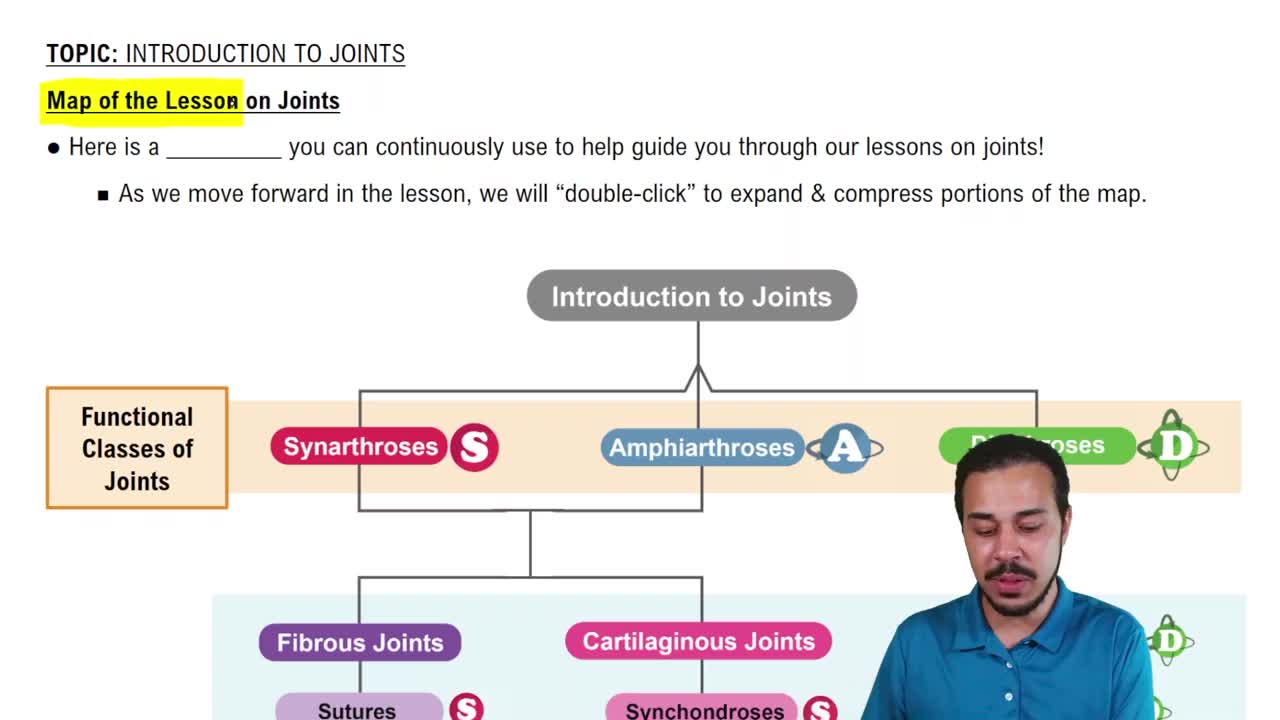
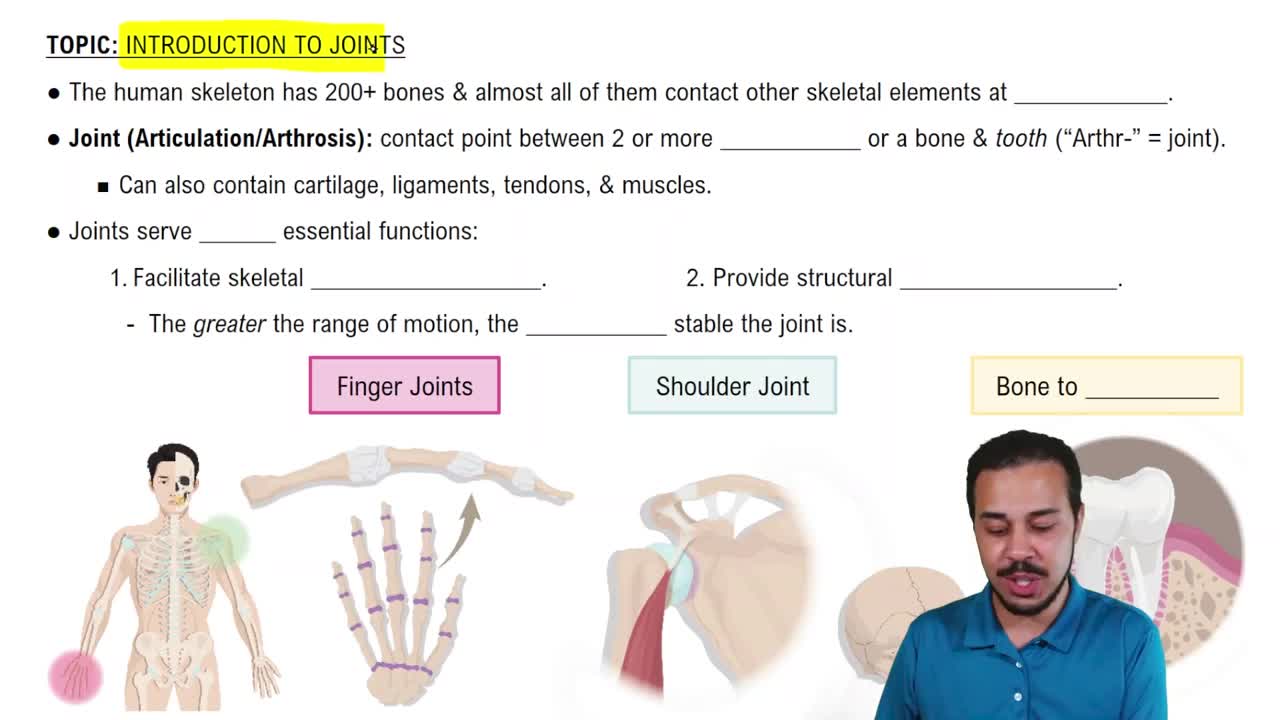
An immovable joint that is very strong; examples include sutures, gomphosis, synchondrosis, and synostosis.
What is a gomphosis joint?
A fibrous joint that binds teeth to bony sockets using the periodontal ligament.
Describe the structure of a synovial joint.
A freely movable joint with a joint capsule containing synovial membrane and fluid, articular cartilage covering bone surfaces, and accessory structures like ligaments and bursae.
What are the primary functions of synovial fluid?
Lubrication, nutrient distribution, and shock absorption within the joint cavity.
Name three accessory structures that stabilize synovial joints.
Cartilages (menisci), ligaments, and tendons.
What is the difference between a meniscus and a fat pad in synovial joints?
Meniscus is fibrocartilage between bones; fat pads are adipose tissue covered by synovial membrane that protect articular cartilages.
Define monaxial, biaxial, and triaxial joints with examples.
Monaxial joints move in one plane (elbow), biaxial in two planes (wrist), triaxial in three planes (shoulder).
What is gliding movement in synovial joints?
When two flat surfaces slide past each other, such as between carpal bones.
Explain flexion and extension movements.
Flexion decreases the angle between bones; extension increases the angle, both occurring in the anterior-posterior plane.
What is circumduction?
A circular movement of a limb or finger without rotation, combining flexion, extension, abduction, and adduction.
Describe medial and lateral rotation.
Medial rotation turns a limb toward the body's long axis; lateral rotation turns it away.
What are pronation and supination of the forearm?
Pronation rotates the forearm so the palm faces posteriorly; supination turns the palm anteriorly.
Define inversion and eversion of the foot.
Inversion twists the sole medially; eversion twists the sole laterally.
What special movements involve the thumb?
Opposition (thumb moves toward fingers) and reposition (thumb returns to anatomical position).
Name the six types of synovial joints.
Plane, hinge, condylar, saddle, pivot, and ball-and-socket joints.
What is the function of the intervertebral disc?
Separates vertebral bodies, absorbs shocks, and allows flexibility; composed of anulus fibrosus and nucleus pulposus.
What causes a herniated disc?
Nucleus pulposus breaks through the anulus fibrosus, compressing spinal nerves.
List the major ligaments stabilizing the knee joint.
 뒤로
 04:06