 뒤로
Anatomy & Physiology: Key Concepts from Lectures 1-6
 01:59

이 집합의 용어 (30)
Anatomy is the study of the structure of an organism, including gross anatomy (visible to the naked eye) and microscopic anatomy (requires a microscope).
Physiology is the study of the function of an organism and its parts, focusing on how biological systems work.
Cellular composition, metabolism, growth, excretion, responsiveness, movement, and reproduction.
Catabolism breaks down molecules releasing energy; anabolism builds complex molecules using energy.
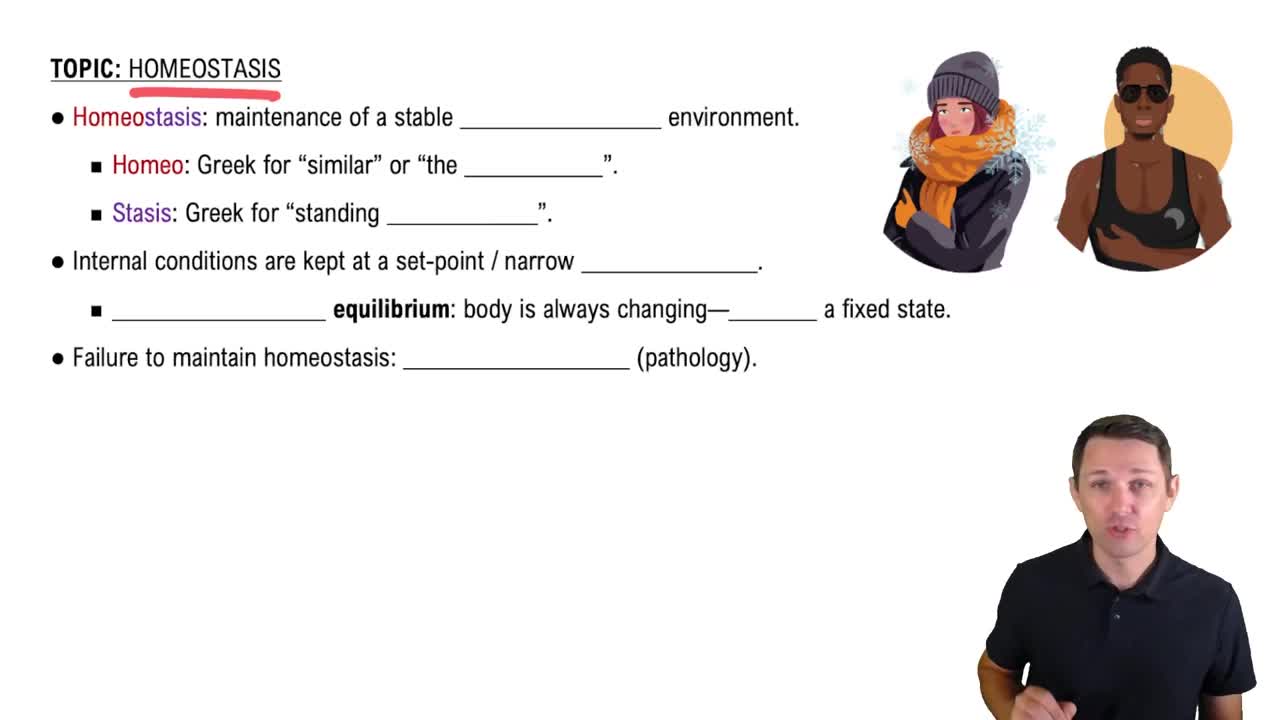
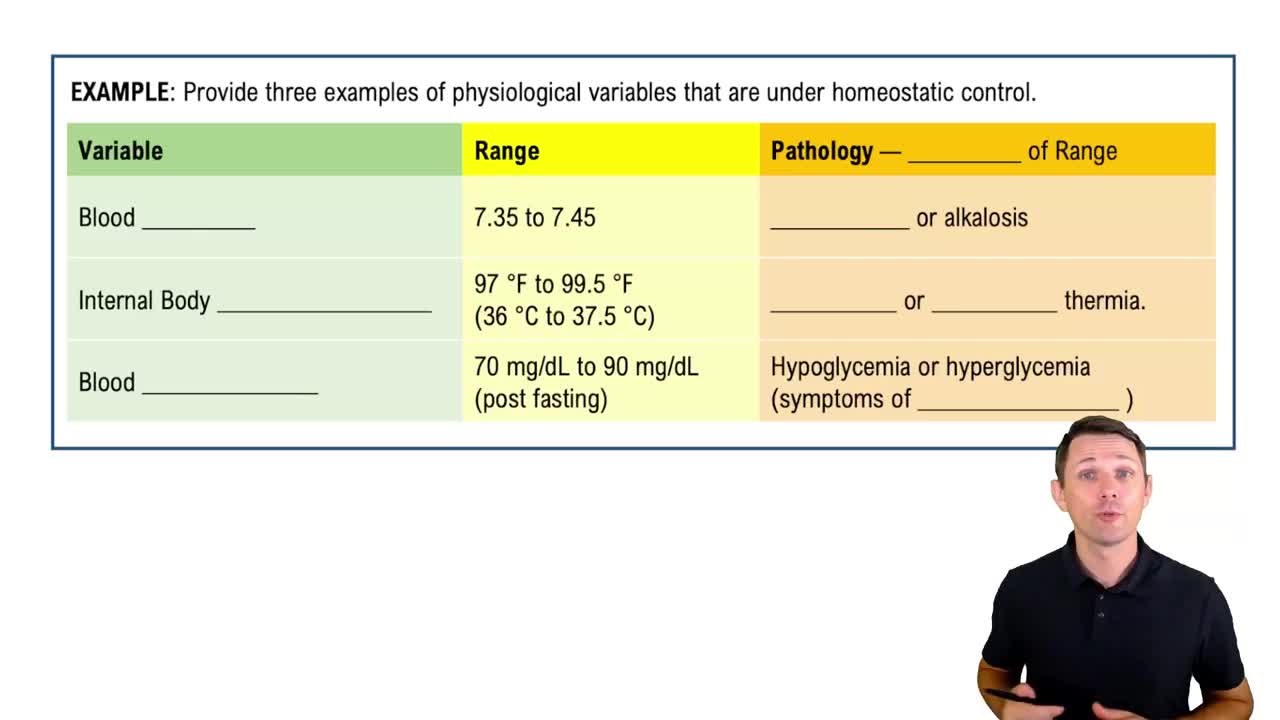
Homeostasis is the maintenance of a stable internal environment within the body despite external changes.
Negative feedback opposes an initial change to return a variable to its set point, maintaining balance.
Blood clotting where activated platelets stimulate more platelets to form a clot, amplifying the response.
Structure and function are related; the form of a body part suits its function.
Feedback loops, structure and function, gradients, and cell-to-cell communication.
Protons (positive), neutrons (neutral), and electrons (negative).
The number of protons in the nucleus of an atom.
Atoms of the same element with the same number of protons but different numbers of neutrons.
Suspensions (particles visible, settle out), colloids (particles not visible, do not settle), and solutions (solute dissolved in solvent, particles not visible).
A group of two or more atoms chemically bonded; can be same or different elements.
A molecule made of atoms from different elements.
Formed when electrons are transferred between atoms, creating charged ions that attract.
Formed when atoms share electrons to fill their outer shells; strongest chemical bonds.
Polar bonds share electrons unequally causing partial charges; nonpolar bonds share electrons equally.
Hydrogen bonds between water molecules create surface tension and contribute to water's unique properties.
The minimum energy required to start a chemical reaction by overcoming electron repulsion.
Enzymes lower activation energy, speeding up reactions without being consumed.
Concentration, temperature, presence of catalysts, and reactant properties.
A chemical reaction that links monomers into polymers by removing water.
A chemical reaction that breaks polymers into monomers by adding water.
Organic molecules composed of carbon, hydrogen, and oxygen, usually with a 1:2:1 ratio, serving as energy sources and structural components.
Hydrophobic organic molecules including fats, oils, phospholipids, and steroids, important for energy storage and cell membranes.
Polymers of amino acids linked by peptide bonds, folded into specific structures for diverse functions.
Monomers of nucleic acids composed of a nitrogenous base, pentose sugar, and phosphate group.
Adenosine triphosphate, the primary energy carrier in cells, releasing energy when its phosphate bonds are broken.
Double helix of nucleotides with complementary base pairing: A-T and G-C, storing genetic information.