 뒤로
Anatomy & Physiology: Membrane Transport and Epithelial Tissue
 02:44

이 집합의 용어 (20)
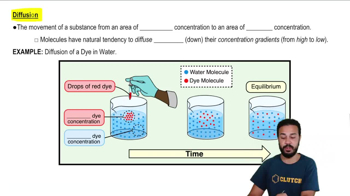
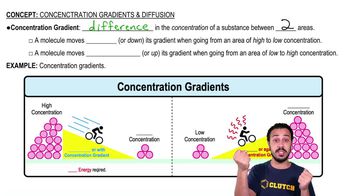
Diffusion is the movement of solutes from an area of higher concentration to an area of lower concentration until equilibrium is reached.
Increased temperature, increased concentration gradient, and decreased molecular weight increase diffusion rate.
Osmosis is the movement of water across a selectively permeable membrane from an area of lower solute concentration to higher solute concentration.
Water moves out of the cell causing it to shrink, a process called crenation.
Water moves into the cell causing it to swell and possibly burst, a process called lysis.
A solution with equal solute concentration inside and outside the cell, causing no net water movement and no change in cell volume.
Simple sugars (glucose), water, and salt (NaCl) can pass through; larger sugars and proteins cannot.
Benedict's solution tests for the presence of glucose, changing from blue to orange/green when positive after heating.
A positive test shows a cloudy or white precipitate indicating the presence of NaCl (salt).
Epithelial, connective, muscle, and nerve tissues.
Consists mostly of cells, covers body surfaces, lines cavities and organs, avascular, regenerates, and has free, basal, and lateral surfaces.
Simple epithelium has one cell layer; stratified epithelium has multiple layers.
Shapes include squamous (flat), cuboidal (cube-shaped), and columnar (tall and column-shaped).
Single layer of flat cells allowing diffusion and filtration; found in alveoli, blood vessels, and serous membranes.
Found in kidney tubules and glands; functions in secretion and absorption.
Single layer of tall cells, often with cilia or microvilli; functions in absorption, secretion, and movement of particles.
Single layer of cells with nuclei at different levels, appearing stratified; usually ciliated and contains goblet cells; lines respiratory tract.
Stratified epithelium with cells that change shape when stretched; lines urinary bladder and protects against urine's caustic effects.
Multiple layers with flat surface cells; protects against abrasion, infection, and water loss; found in skin and moist body linings.
A thin extracellular layer that anchors epithelial cells to underlying connective tissue.