뒤로

Anatomy & Physiology: Movement of Materials and Membrane Transport
컨트롤 버튼이 '내비게이션' 모드로 변경되었습니다.
1/50
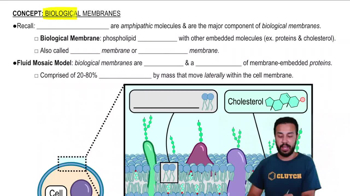
  • Two primary components of a phospholipid

    Hydrophilic phosphate head and hydrophobic fatty acid tails.

  • Type of chemical bonds linking phospholipids in the membrane

    Hydrophobic interactions hold phospholipids together, not covalent bonds.

  • Primary biological function of the lipid bilayer

    To act as a selective barrier controlling what enters and exits the cell.

  • Cellular structure maintaining homeostasis by controlling entry and exit

    The cell membrane (plasma membrane).

  • 1935 membrane model proposing proteins form distinct layers like a sandwich

    The Davson-Danielli model.

  • 1972 membrane model describing the membrane as a fluid mosaic

    The Fluid Mosaic Model by Singer and Nicolson.

  • Difference between integral and peripheral membrane proteins

    Integral proteins span or embed within the bilayer; peripheral proteins attach loosely to the membrane surface.

  • Collective term for membrane-bound carbohydrates like glycoproteins and glycolipids

    Glycocalyx.

  • Carbohydrate attached specifically to a phospholipid

    Glycolipid.

  • Four functions of membrane proteins

    Transport, enzymatic activity, cell recognition, and signal transduction.

  • Membrane controlling movement between blood and body tissues

    Capillary endothelium (capillary membrane).

  • Primary function of the alveolar membrane in lungs

    Facilitates gas exchange between air and blood.

  • Three organelles with internal membranes

    Mitochondria, nucleus, and endoplasmic reticulum.

  • Direction of molecule movement in passive transport

    Down their concentration gradient (high to low).

  • Fundamental difference between passive and active transport

    Passive transport does not use ATP; active transport requires ATP.

  • Definition of diffusion

    Movement of molecules from high to low concentration without ATP.

  • Five factors affecting diffusion rate

    Concentration gradient, temperature, surface area, distance, and molecule size.

  • Direction of O2 diffusion in lungs

    From alveoli into the blood.

  • Metabolic waste diffusing from blood into lungs

    Carbon dioxide (CO2).

  • Transport process caused by pressure pushing water and solutes

    Filtration.

  • Kidney structure where blood pressure forces water to form filtrate

    Bowman's capsule.

  • Clinical condition from excessive fluid pushed into tissues

    Edema.

  • Movement of water across a semipermeable membrane

    Osmosis.

  • Direction of water movement during osmosis

    Water moves toward the area of higher solute concentration.

  • Effect on cell volume in isotonic solution

    Cell volume remains unchanged.

  • Term for solution with lower solute concentration than inside the cell

    Hypotonic solution.

  • Cell behavior in hypotonic environment

    Cell swells due to water intake.

  • Water movement in hypertonic environment

    Water moves out of the cell, causing shrinkage.

  • Reason 0.9% saline is used in IV bags instead of distilled water

    It is isotonic to prevent cell swelling or shrinking.

  • Effect of IV with pure distilled water on red blood cells

    Cells burst (lyse) due to water influx.

  • Why drinking seawater worsens dehydration

    Seawater is hypertonic, causing water loss from cells.

  • Passive transport mechanism using transport proteins for glucose

    Facilitated diffusion.

  • Transporters facilitating glucose uptake into cells

    GLUT transporters.

  • Effect of insulin on blood glucose levels

    Insulin lowers blood glucose by promoting cellular uptake.

  • Medical term for high blood sugar due to lack of insulin

    Hyperglycemia.

  • Difference between ion leakage and voltage-gated ion channels

    Leakage channels are always open; voltage-gated channels open in response to membrane potential changes.

  • Direction of molecule movement in active transport

    Against the concentration gradient (low to high).

  • Na+/K+ pump ion exchange ratio

    3 Na+ ions out for every 2 K+ ions in.

  • Three tissue types relying on Na+/K+ pump for action potentials

    Nervous, muscular, and cardiac tissues.

  • Role of calcium pumps (SERCA) in muscle function

    Transport Ca2+ into the sarcoplasmic reticulum for muscle relaxation.

  • Transport mechanism using vesicles to absorb large materials

    Endocytosis.

  • Form of endocytosis called 'cell drinking'

    Pinocytosis.

  • Process immune cells use to engulf pathogens

    Phagocytosis.

  • Process by which pancreas releases insulin or neurons release neurotransmitters

    Exocytosis.

  • How Cholera toxin causes severe dehydration and diarrhea

    It causes excessive chloride and water secretion into intestines.

  • Neurotransmitter blocked by Botulinum toxin causing paralysis

    Acetylcholine.

  • How ionophore antibiotics kill bacteria

    By disrupting ion gradients across bacterial membranes.

  • Transport mechanism impaired by fluid-filled alveoli in pneumonia

    Diffusion of gases is impaired.

  • In osmosis activity analogy, where do 'water' students move?

    To areas with fewer 'seats' (lower solute concentration).

  • Function of the mitochondrial membrane

    Site of ATP production and controls metabolite movement.