Sensory input: gathering information about changes; Integration: processing and interpreting sensory input; Motor output: activating effectors to produce a response.
Two principal parts of the nervous system
Central nervous system (CNS): brain and spinal cord; Peripheral nervous system (PNS): nerves outside CNS including spinal and cranial nerves.
Functional divisions of the Peripheral Nervous System (PNS)
Sensory (afferent) division: transmits impulses to CNS; Motor (efferent) division: transmits impulses from CNS to muscles and glands.
Two subdivisions of the motor (efferent) division
Somatic nervous system: voluntary control of skeletal muscles; Autonomic nervous system (ANS): involuntary control of smooth muscle, cardiac muscle, and glands.
Four main types of neuroglia in the CNS
Astrocytes, Microglial cells, Ependymal cells, and Oligodendrocytes.
Functions of astrocytes
Support neurons, regulate chemical environment, guide neuron migration, recycle neurotransmitters, and maintain blood-brain barrier.
Role of Schwann cells in the PNS
Surround peripheral nerve fibers, form myelin sheaths, and aid regeneration of damaged nerves.
Structure of a neuron
Consists of a cell body (soma), dendrites (input), and an axon (conducting region) ending in axon terminals.
Difference between nuclei and ganglia
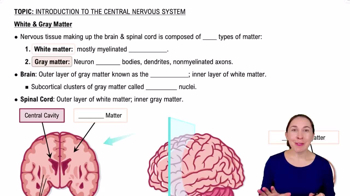
Nuclei: clusters of neuron cell bodies in CNS; Ganglia: clusters of neuron cell bodies in PNS.
Function of myelin sheath
Protects and electrically insulates axons, increasing speed of nerve impulse transmission.
Types of neurons by function
Sensory (afferent): transmit impulses to CNS; Motor (efferent): carry impulses from CNS; Interneurons: connect sensory and motor neurons within CNS.
Resting membrane potential of neurons
Approximately −70 mV; inside of cell is negative relative to outside; membrane is polarized.
Types of ion channels in neuron membranes
Leakage (nongated): always open; Gated channels: open/close in response to stimuli (chemical, voltage, mechanical).
Events causing an action potential in muscle fibers
1. End plate potential from ACh binding; 2. Depolarization via voltage-gated Na+ channels; 3. Repolarization via voltage-gated K+ channels.
Sliding filament model of muscle contraction
Thin filaments slide past thick filaments, increasing overlap; sarcomeres shorten without filaments changing length.
Four steps of the cross bridge cycle
1. Cross bridge formation; 2. Power stroke; 3. Cross bridge detachment; 4. Cocking of myosin head using ATP.
Cause of rigor mortis
Lack of ATP after death prevents detachment of myosin heads from actin, causing muscle stiffness.
Motor unit definition
One motor neuron and all the muscle fibers it innervates; smaller units allow finer control.
Phases of a muscle twitch
Latent period (excitation-contraction coupling), contraction period (cross bridge formation), relaxation period (Ca2+ reentry into SR).
Graded muscle contractions
Varying strength of contraction by changing stimulus frequency (temporal summation) and stimulus strength (recruitment).
Isotonic vs. isometric contractions
Isotonic: muscle shortens and moves load; Isometric: muscle tension increases but length does not change.
Three pathways for ATP regeneration in muscle
1. Direct phosphorylation by creatine phosphate; 2. Anaerobic glycolysis; 3. Aerobic respiration in mitochondria.
Causes of muscle fatigue
Ionic imbalances, increased inorganic phosphate, decreased ATP, and decreased glycogen.
Characteristics of smooth muscle fibers
Thin, spindle-shaped, uninucleate, no striations, less developed SR, no T tubules, connected by gap junctions.
Mechanism of smooth muscle contraction
Ca2+ binds calmodulin, activating myosin kinase which phosphorylates myosin heads to form cross bridges.
Differences between smooth and skeletal muscle contraction
Smooth muscle uses calmodulin instead of troponin, slower contraction, and can maintain tone with less energy.
Functions of muscle tissue
Produce movement, maintain posture, stabilize joints, and generate heat.
Four main characteristics of muscle tissue
Excitability, contractility, extensibility, and elasticity.
 뒤로
 0:50