 뒤로
Anatomy & Physiology: Skeletal and Muscular System Fundamentals
 3:56

이 집합의 용어 (29)
Foramen is a natural opening or hole in a bone that allows the passage of nerves and blood vessels.
Meatus is a canal or tube-like passageway within a bone.
Spinous process is a bony projection off the posterior (back) of each vertebra that muscles and ligaments attach to.
Joints are classified structurally as fibrous, cartilaginous, or synovial based on the material binding bones and presence of a joint cavity.
Joints are functionally classified as synarthrosis (immovable), amphiarthrosis (slightly movable), or diarthrosis (freely movable).
Key components include articular cartilage, synovial membrane, synovial fluid, joint capsule, and ligaments.
A muscle fiber contains myofibrils made of repeating units called sarcomeres, which are the functional contractile units.
The two types are actin (thin filaments) and myosin (thick filaments), which interact for muscle contraction.
The sarcomere includes Z-discs, A bands, I bands, and the M line, organizing actin and myosin filaments.
A triad consists of a T-tubule flanked by two terminal cisternae of the sarcoplasmic reticulum, crucial for excitation-contraction coupling.
The NMJ is the synapse where a motor neuron communicates with a muscle fiber using neurotransmitters to trigger contraction.
Acetylcholine (ACh) is the neurotransmitter released at the NMJ to initiate muscle contraction.
Contraction occurs when myosin heads bind to actin, pulling filaments past each other powered by ATP, triggered by calcium release.
Rigor mortis is the stiffening of muscles after death due to lack of ATP preventing detachment of myosin from actin.
Action potentials are all-or-none signals that trigger contraction, while local potentials are graded and can summate to trigger action potentials.
The refractory period is the time after an action potential during which the muscle fiber cannot be stimulated again; it is shorter in skeletal muscle than cardiac muscle.
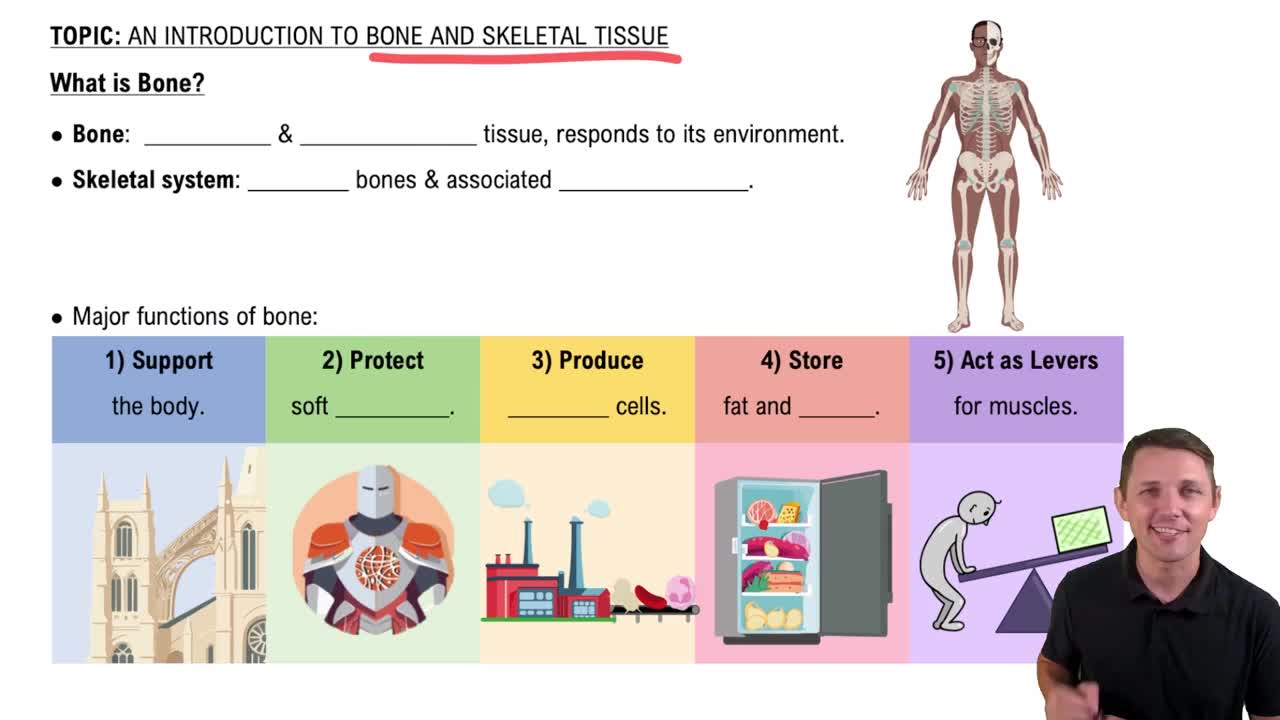
The axial skeleton includes the skull, vertebral column, and rib cage.
The appendicular skeleton includes the bones of the limbs and girdles (pectoral and pelvic).
The spinous process serves as an attachment point for muscles and ligaments that move and stabilize the spine.
Synovial fluid lubricates the joint, reduces friction, and supplies nutrients to the articular cartilage.
The storage and release of calcium ions is the key function of the:
sarcoplasmic reticulum
If actin filaments were incapable of sliding past the myosin filaments...
Contraction would not occur, and tension would not be generated.
Which type of contraction causes a skeletal muscle to shorten?
isotonic concentric contraction
If oxygen is not available, the muscle fiber will produce ATP by
anaerobic catabolism
The main immediate source of ATP (lasting about 10 seconds) as muscle contractions begin comes from:
creatine phosphate.
When the sarcomere contracts and shortens, __________.
the A band stays the same
What is accomplished by the power stroke?
The power stroke results in myosin heads pulling actin toward the center of the sarcomere.
The type of contraction that causes a skeletal muscle to lengthen is called
________isotonic eccentric contraction
Which type of contraction causes a skeletal muscle to shorten?
isotonic concentric contraction