뒤로

Anatomy & Physiology: Skeletal, Muscular, Nervous, and Special Senses Systems

컨트롤 버튼이 '내비게이션' 모드로 변경되었습니다.
1/20
  • What are the two main divisions of the human skeleton?

    Axial skeleton and appendicular skeleton.
  • What bones make up the axial skeleton?

    The skull, vertebral column, and rib cage.
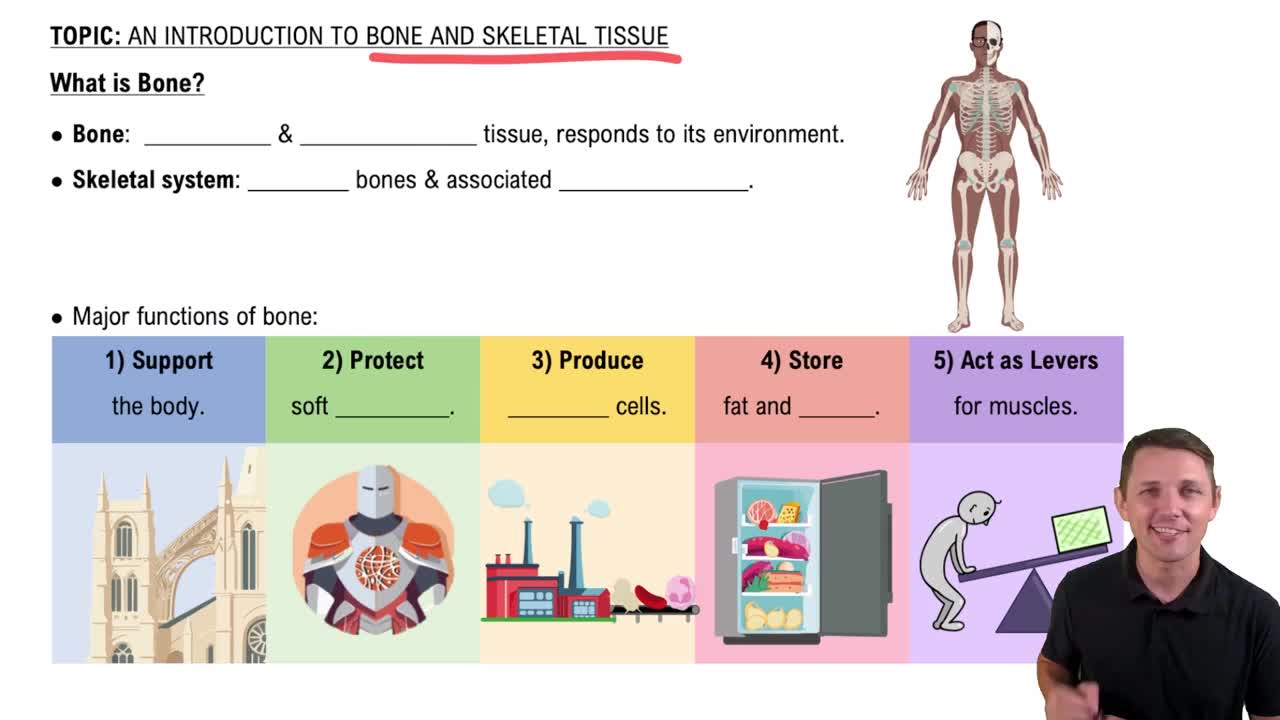
  • What is the primary function of the skeletal system?

    To provide support, protection, movement, mineral storage, and blood cell production.
  • What are the three types of muscle tissue?

    Skeletal, cardiac, and smooth muscle.
  • What distinguishes skeletal muscle from other muscle types?

    It is voluntary, striated, and attached to bones for movement.
  • What is the role of the muscular system?

    To produce movement, maintain posture, and generate heat.
  • What are joints and their function?

    Joints are connections between bones that allow for movement and flexibility.
  • Name the three types of joints based on movement.

    Fibrous (immovable), cartilaginous (slightly movable), and synovial (freely movable).
  • What is the central nervous system (CNS) composed of?

    The brain and spinal cord.
  • What is the peripheral nervous system (PNS)?

    All nerves outside the CNS that connect it to limbs and organs.
  • What are the main functions of the nervous system?

    Sensory input, integration, and motor output.
  • What are cranial nerves?

    Twelve pairs of nerves that emerge directly from the brain to control head and neck functions.
  • What is the function of the spinal cord?

    To transmit nerve signals between the brain and the rest of the body and coordinate reflexes.
  • What are the special senses?

    Vision, hearing, taste, smell, and balance.
  • Which organ is responsible for vision?

    The eye.
  • What structure in the ear is responsible for balance?

    The vestibular apparatus in the inner ear.
  • What is the role of sensory receptors in special senses?

    To detect specific stimuli like light, sound, chemicals, or movement and send signals to the brain.
  • What is the difference between axial and appendicular skeleton?

    Axial skeleton supports the central axis; appendicular skeleton includes limbs and girdles.
  • What is the significance of lab exercises on axial and appendicular skeleton?

    They help identify and understand the structure and function of different bones.
  • Why are muscular system lab exercises important?

    They provide practical knowledge of muscle anatomy and movement mechanics.