뒤로

Anatomy & Physiology: Skeletal System and Bone Structure

컨트롤 버튼이 '내비게이션' 모드로 변경되었습니다.
1/30
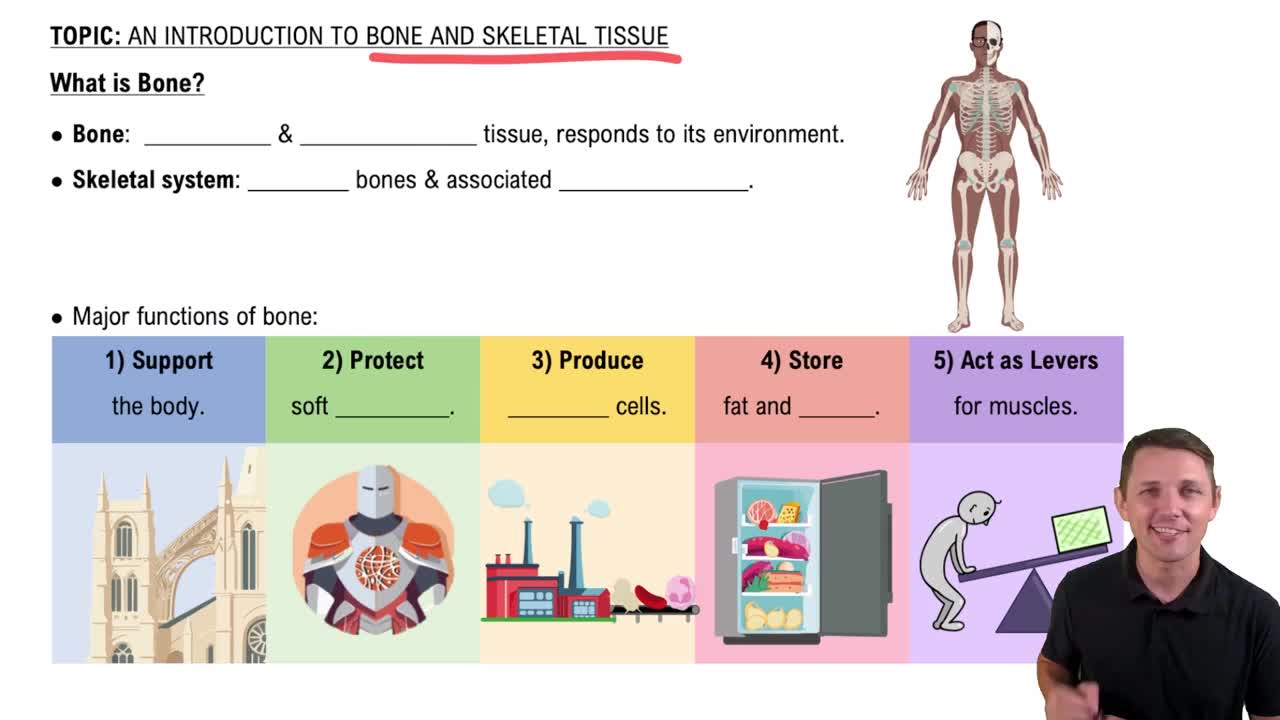
  • Major functions of the skeletal system

    Support, Protection, Movement, Mineral storage:, Blood cell production, Fat storage

  • Diaphysis

    The long, central shaft of a long bone.
  • Epiphyses

    The enlarged ends of a long bone.
  • Metaphysis

    Region between diaphysis and epiphysis containing the growth plate in growing bones.
  • Articular cartilage

    Smooth cartilage covering bone ends at joints; reduces friction and absorbs shock.
  • Periosteum

    Tough connective tissue covering outer bone surface except where articular cartilage is present; aids growth and repair.
  • Compact bone

    Dense, hard bone that provides strength.
  • Spongy bone

    Porous bone with a network of bony struts and spaces, often containing red bone marrow.
  • Medullary cavity

    Hollow space inside the diaphysis that contains bone marrow.
  • Endosteum

    Thin membrane lining the medullary cavity and internal bone surfaces.
  • Red bone marrow

    Bone marrow that produces red blood cells, white blood cells, and platelets.
  • Yellow bone marrow

    Bone marrow that stores fat as an energy reserve.
  • Osteoprogenitor cells

    Stem-like cells that develop into osteoblasts and help replace bone-forming cells during growth and repair.
  • Osteoblasts

    Cells that build bone by producing organic bone matrix and mineralizing it.
  • Osteocytes

    Mature bone cells that maintain bone tissue and detect mechanical stress.
  • Osteoclasts

    Large cells that break down bone tissue in a process called bone resorption.
  • Effect when osteoclast activity exceeds osteoblast activity

    Leads to decreased bone mass and density, weaker bones, increased fracture risk, and possible osteoporosis.
  • Osteon

    Basic structural unit of compact bone; consists of lamellae arranged around a central canal containing blood vessels and nerves.
  • Endochondral ossification

    Bone forms by replacing a hyaline cartilage model; occurs in most long bones like femur and humerus.
  • Intramembranous ossification

    Bone develops directly from mesenchymal tissue without a cartilage model; forms flat skull bones and clavicles.
  • Epiphyseal plate (growth plate)

    Layer of hyaline cartilage between epiphysis and diaphysis where bone lengthens during growth.
  • Closure of epiphyseal plates

    Occurs with maturation due to sex hormones; cartilage is replaced by bone, stopping lengthwise growth.
  • Marfan syndrome

    Genetic disorder affecting connective tissue causing long limbs, joint laxity, and skeletal abnormalities.
  • Gigantism

    Excess growth hormone before growth plate closure causing excessive height.
  • Acromegaly

    Excess growth hormone in adults causing enlargement of hands, feet, and facial bones.
  • Pituitary dwarfism

    Too little growth hormone during childhood causing reduced height.
  • Parathyroid hormone (PTH)

    Released when blood calcium is low; increases blood calcium by stimulating bone resorption.
  • Calcitonin

    Released when blood calcium is high; limits bone resorption to lower blood calcium.
  • Calcitriol

    Active vitamin D form that increases calcium absorption from the digestive tract.
  • Four stages of fracture healing

    Hematoma formation → Soft callus formation → Hard callus formation → Bone remodeling.