뒤로

Anatomy & Physiology: Skeletal System and Joints
컨트롤 버튼이 '내비게이션' 모드로 변경되었습니다.
1/44
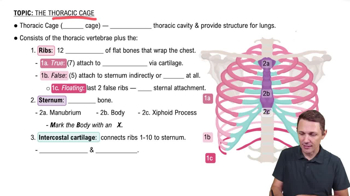
  • Most superior part of the sternum

    Manubrium

  • Most inferior part of the sternum

    Xiphoid process

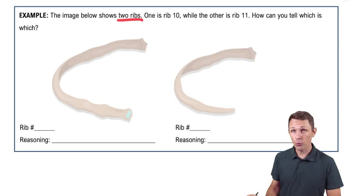
  • Total number of ribs

    24 ribs, or 12 pairs

  • True ribs

    Ribs 1–7; they attach directly to the sternum

  • False ribs

    Ribs 8–12; they attach indirectly or do not attach to the sternum

  • Floating ribs

    Ribs 11–12; they do not attach to the sternum

  • Number of cervical vertebrae

    7

  • Number of thoracic vertebrae

    12

  • Number of lumbar vertebrae

    5

  • Vertebra with no vertebral body

    C1 (atlas)

  • Movement allowed by C1

    Nodding the head

  • Special feature of C2

    The dens

  • Movement allowed by C2

    Rotation of the head

  • Unique feature of cervical vertebrae

    They have transverse foramina

  • Sacrum

    5 fused vertebrae

  • Bones forming the tailbone

    Sacrum joins with the coccyx

  • Primary spinal curves

    Thoracic and sacral; develop before birth

  • Secondary spinal curves

    Cervical and lumbar; develop after birth

  • Only direct upper-limb connection to axial skeleton

    Clavicle

  • Joint connecting clavicle to manubrium

    Sternoclavicular joint

  • Bones of the pectoral girdle

    Clavicle and scapula

  • Part of scapula articulating with clavicle

    Acromion

  • Lateral forearm bone in anatomical position

    Radius

  • Medial forearm bone in anatomical position

    Ulna

  • Bone articulating with the humerus capitulum

    Radius

  • Bone articulating with the humerus trochlea

    Ulna

  • Movement at proximal radioulnar joint

    Pronation and supination

  • Pronation

    Turning the palm to face posteriorly/downward

  • Supination

    Turning the palm to face anteriorly/upward

  • Bones forming the os coxa

    Ilium, ischium, and pubis

  • Acetabulum

    Socket where the femur articulates with the hip

  • Bone forming the kneecap

    Patella, a sesamoid bone

  • Medial bone of the lower leg

    Tibia

  • Lateral bone of the lower leg

    Fibula

  • Bone forming the heel

    Calcaneus

  • Bone articulating with tibia and fibula to form ankle

    Talus

  • Functional classification of synovial joint

    Diarthrosis (freely movable)

  • Functional classification of suture

    Synarthrosis (immovable joint)

  • Functional classification of symphysis

    Amphiarthrosis (limited movement)

  • Key difference between ligament and tendon

    Ligament connects bone to bone; tendon connects muscle to bone

  • Purpose of menisci in the knee

    Fibrocartilage pads that help distribute forces and improve joint fit

  • Cruciate ligaments of the knee

    ACL (anterior cruciate ligament) and PCL (posterior cruciate ligament); limit excessive anterior/posterior movement

  • Purpose of bursae

    Small fluid-filled pockets that reduce friction around joints

  • Synovial fluid functions

    Lubrication, shock absorption, and nourishing cartilage cells