 뒤로
Anatomy & Physiology: Skeletal System Exam Review
 4:50

이 집합의 용어 (19)
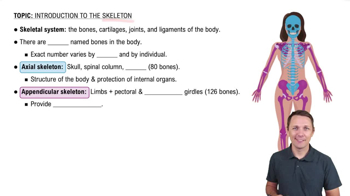
The axial skeleton includes the skull, vertebral column, and rib cage. The appendicular skeleton includes the limbs and girdles (pectoral and pelvic) that attach them to the axial skeleton.
Single cranial bones include the frontal, occipital, sphenoid, and ethmoid bones. Paired cranial bones include the parietal and temporal bones.
Single facial bones include the mandible and vomer. Paired facial bones include the maxillae, zygomatic, nasal, lacrimal, palatine, and inferior nasal conchae bones.
Cervical curve is the neck region curve, thoracic curve is the upper back curve, lumbar curve is the lower back curve, and sacral curve is the curve of the sacrum and coccyx.
Common malformations include scoliosis (lateral curvature), kyphosis (excessive thoracic curve), and lordosis (excessive lumbar curve).
The pectoral girdle consists of the clavicles and scapulae, attaching upper limbs to the axial skeleton. The pelvic girdle consists of the hip bones, attaching lower limbs to the axial skeleton.
Both have 14 phalanges per limb: 3 per finger/toe except 2 in the thumb/big toe. The hand has 5 digits (thumb to little finger), the foot has 5 digits (big toe to little toe).
Includes the skull (cranial and facial bones), vertebral column (cervical, thoracic, lumbar, sacrum, coccyx), and rib cage (ribs and sternum).
Includes the pectoral girdle (clavicles and scapulae), upper limbs (humerus, radius, ulna, carpals, metacarpals, phalanges), pelvic girdle (hip bones), and lower limbs (femur, tibia, fibula, tarsals, metatarsals, phalanges).
Sagittal suture runs between parietal bones, coronal suture between frontal and parietal bones, lambdoidal suture between occipital and parietal bones, squamous suture between temporal and parietal bones.
Include the anterior (frontal), posterior (occipital), sphenoidal (anterolateral), and mastoid (posterolateral) fontanelles.
Frontal sinuses are in the frontal bone above the eyes, maxillary sinuses in the maxillae below the eyes, and sphenoidal sinuses in the sphenoid bone behind the nasal cavity.
Cervical (7 vertebrae), thoracic (12), lumbar (5), sacral (5 fused), and coccygeal (4 fused) regions.
Female skeletons have a wider pelvic inlet, broader sciatic notch, and less pronounced muscle attachments. Male skeletons are generally larger with more robust features.
Pedicles are short projections from the vertebral body connecting to the laminae. Laminae are flat plates that form the vertebral arch roof.
The centrum is the thick, disc-shaped anterior portion of a vertebra that bears weight and forms the vertebral body.
Costal refers to anything related to the ribs.
Longitudinal arches run lengthwise along the foot; transverse arch runs across the foot widthwise, both providing support and shock absorption.
Transverse foramina are openings in cervical vertebrae that allow passage of the vertebral arteries.