 뒤로
Anatomy & Physiology: Skeletal System, Joints, and Muscles
 3:56

이 집합의 용어 (30)
Axial Skeleton is the central core (skull, spine, ribs) protecting organs. Appendicular Skeleton includes arms, legs, shoulders, and hips for movement.
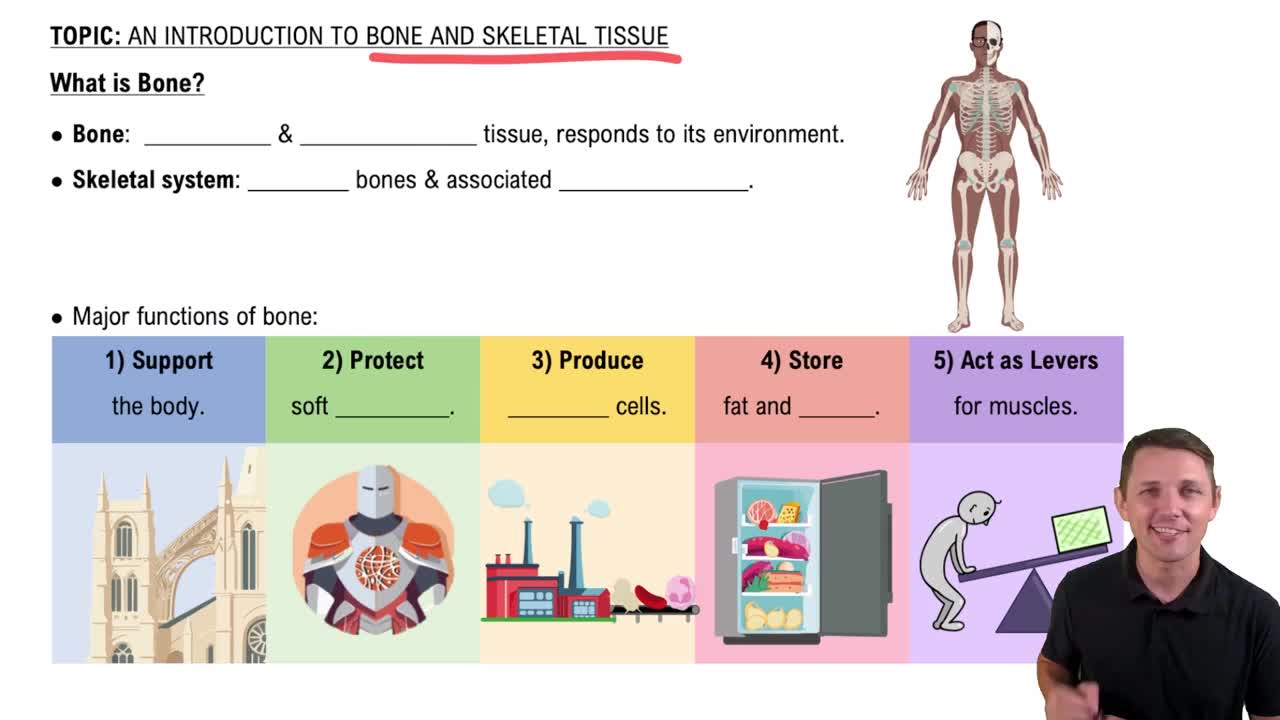
Support, Protection, Movement, Mineral Storage, and Blood Cell Production inside bone marrow.
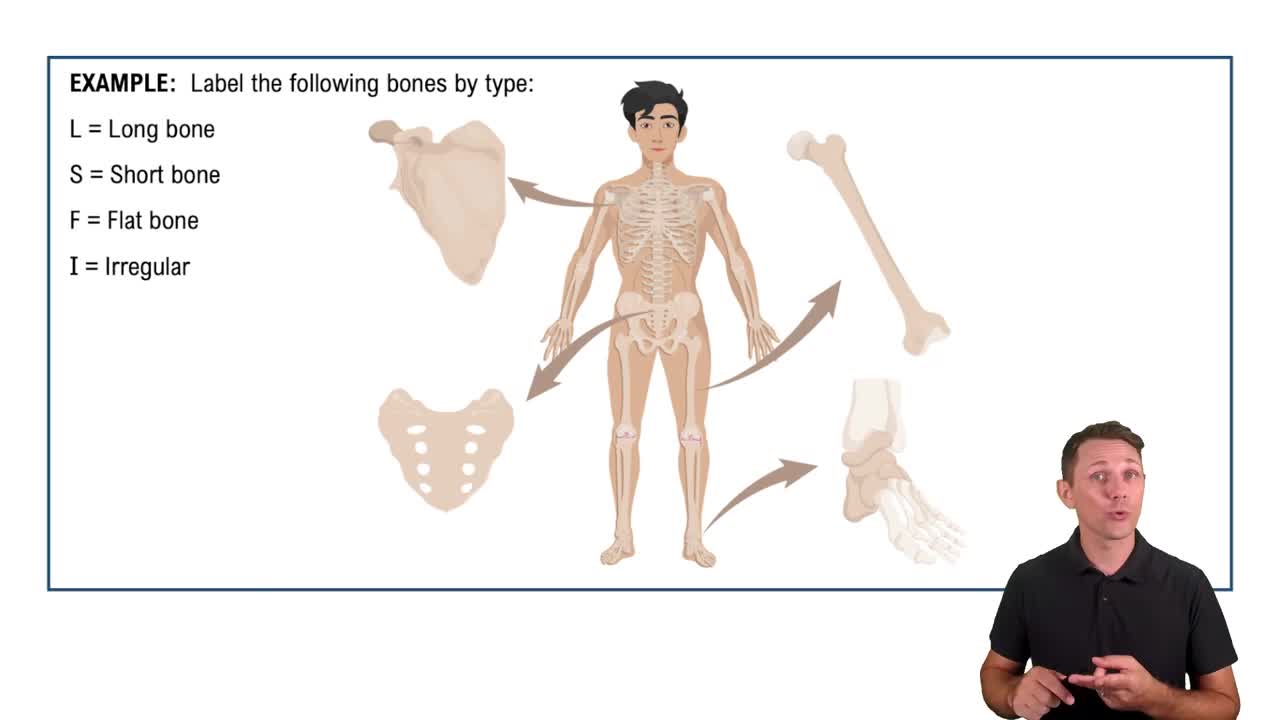
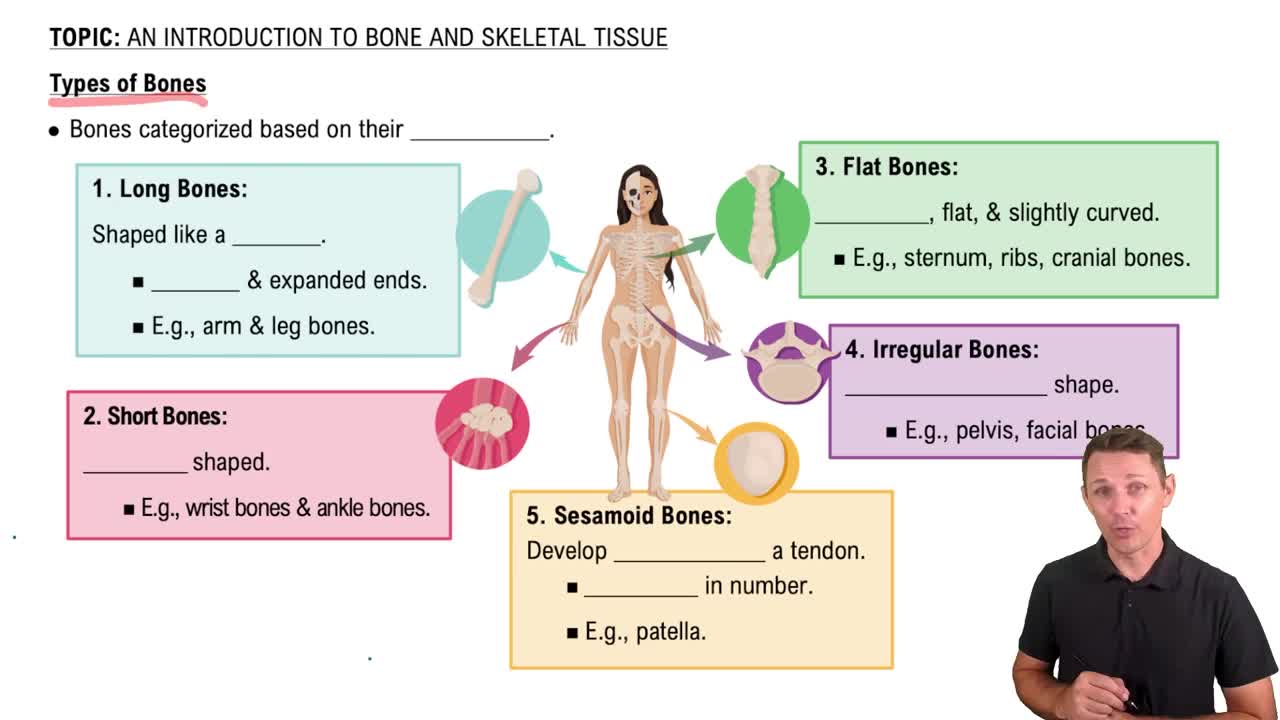
Long bones (arms/legs), short bones (wrists/ankles), flat bones (ribs), and irregular bones (vertebrae).
Diaphysis is the long central shaft; epiphyses are the rounded ends of a long bone.
Periosteum is the tough outer covering of bone; endosteum is the inner lining inside the bone.
Compact bone is dense and solid outside; spongy bone is light with a honeycomb structure inside.
Osteogenic (stem cells), Osteoblasts (build bone), Osteocytes (maintain bone), Osteoclasts (break down bone).
Flat bones form by intramembranous ossification; long bones form by endochondral ossification from cartilage models.
PTH raises blood calcium by activating osteoclasts; Calcitonin lowers blood calcium by promoting calcium storage in bones.
Hematoma formation, soft callus (cartilage), hard callus (spongy bone), and remodeling by osteoclasts and osteoblasts.
Fibrous (no movement), Cartilaginous (slight movement), Synovial (free movement).
Synarthrosis (immovable), Amphiarthrosis (slightly movable), Diarthrosis (freely movable).
Articular cartilage, joint cavity, joint capsule, synovial fluid, and ligaments.
Ligaments connect bone to bone; tendons connect muscle to bone.
Plane (sliding), Hinge (door-like), Pivot (rotation), Condylar (back-and-forth & side-to-side), Saddle (wide movement), Ball-and-Socket (full rotation).
Flexion/Extension, Abduction/Adduction, Circumduction, Rotation, Pronation/Supination, Dorsiflexion/Plantar flexion, Inversion/Eversion.
Skeletal (voluntary, striated), Cardiac (involuntary, striated), Smooth (involuntary, non-striated).
Whole muscle → Fascicle → Muscle fiber → Myofibril → Sarcomere → Myofilaments.
Actin (thin filament), Myosin (thick filament), Troponin & Tropomyosin (regulatory proteins), Z discs (sarcomere boundaries), M line (center of sarcomere).
Myosin heads pull actin filaments inward, shortening the sarcomere by reducing the H zone and I band; A band length stays the same.
Nerve signal triggers acetylcholine release, which binds muscle receptors, causing an electrical impulse; acetylcholinesterase breaks down ACh to relax muscle.
Signal travels down T-tubules, calcium is released, binds troponin, moves tropomyosin, exposing actin for myosin binding.
Myosin binds actin, performs power stroke, detaches using ATP, and resets for next pull.
Isometric (tension without length change), Isotonic Concentric (muscle shortens), Isotonic Eccentric (muscle lengthens).
Phosphocreatine (instant), Anaerobic Glycolysis (fast without oxygen), Aerobic Metabolism (slow with oxygen).
Fast-twitch: quick, strong, fatigue fast; Slow-twitch: endurance, fatigue resistant.
Parallel, convergent (fan-shaped), pennate (feather-shaped), circular.
First class: fulcrum in middle (head nodding); Second class: load in middle (tiptoes); Third class: effort in middle (biceps curl).
Origin: fixed bone; Insertion: moving bone.
Agonist: prime mover; Antagonist: opposes action; Synergist & Fixator: assist and stabilize joints.