What are the two main subdivisions of the skeleton?
Axial skeleton and appendicular skeleton.
List three functions of the skeletal system.
Support the body, protect soft organs, allow movement, store minerals and fats, and blood cell formation (hematopoiesis).
Name the four main classifications of bones.
Long bones, short bones, flat bones, and irregular bones.
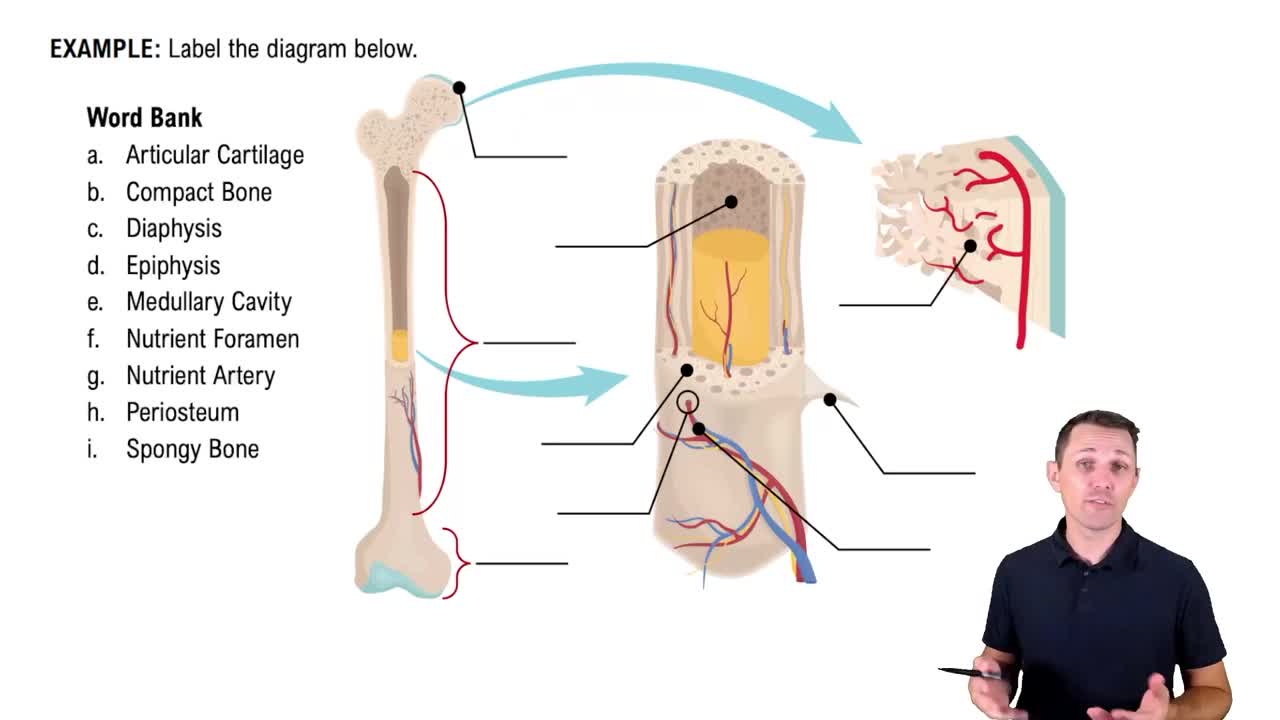
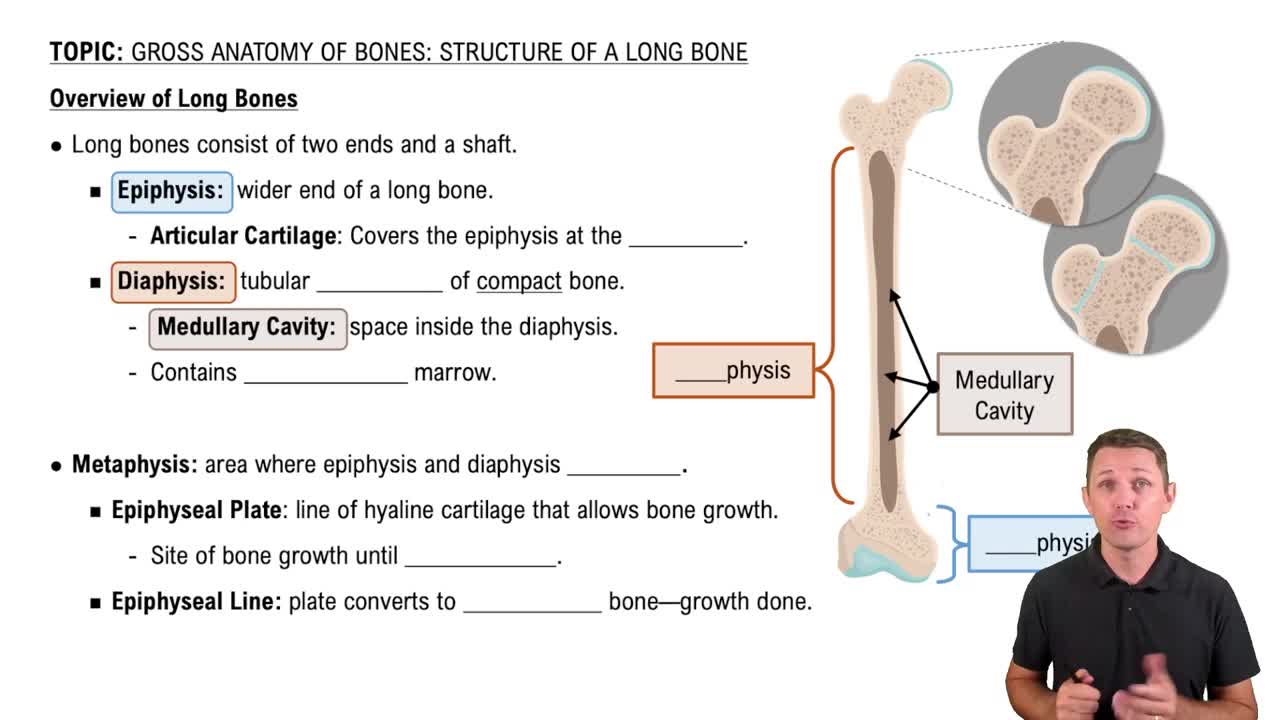
What is the diaphysis of a long bone?
The shaft of the bone, composed mainly of compact bone, making up most of the bone's length.
What is the periosteum?
A fibrous connective tissue membrane covering the outside of the diaphysis, secured by perforating (Sharpey’s) fibers.
What is contained in the marrow (medullary) cavity of a long bone?
Yellow marrow (mostly fat) in adults; red marrow for blood cell formation in infants.
What are bone markings and their categories?
Surface features of bones for muscle, tendon, ligament attachment or nerve/blood vessel passage. Categories: projections/processes (start with 'T') and depressions/cavities (start with 'F').
What are osteocytes and where are they located?
Mature bone cells situated within cavities called lacunae in the bone matrix.
What makes bone hard and flexible?
Calcium salts deposited in the matrix make bone hard; organic parts of the matrix make bone flexible.
What is ossification?
The process of bone formation, occurring on hyaline cartilage models or fibrous membranes.
What are the two major phases of ossification in long bones?
Osteoblasts cover the hyaline cartilage model and enclosed cartilage is digested away, forming a medullary cavity.
Where does bone growth in length occur in long bones?
At the epiphyseal plates, which are converted to bone during adolescence, ending growth in length.
What factors influence bone remodeling throughout life?
Blood calcium levels and the pull of gravity and muscles on the skeleton.
What hormone is released when blood calcium levels are low and what does it do?
Parathyroid hormone (PTH) activates osteoclasts to break down bone and release calcium into the blood.
What bones make up the axial skeleton?
Skull, vertebral column, and bony thorax (ribs and sternum).
How many bones are in the adult human skeleton?
206 bones.
What are the two sets of bones in the skull?
Cranium bones (enclose the brain) and facial bones (hold eyes and allow facial expression).
What is the difference between the atlas (C1) and axis (C2) vertebrae?
Atlas supports the head and allows nodding; axis has the dens that acts as a pivot for head rotation.
What are the three parts of the bony thorax?
Sternum, ribs (true, false, floating), and thoracic vertebrae.
What bones compose the pectoral girdle?
Scapula and clavicle.
What bones form the pelvic girdle?
Two coxal (ossa coxae) bones, each composed of ilium, ischium, and pubis.
Name two major differences between a male and female pelvis.
Female pelvis is larger, more circular inlet, shallower, bones lighter and thinner, and pubic arch is more rounded.
What bones form the upper limb?
Humerus (arm), radius and ulna (forearm), carpals (wrist), metacarpals (palm), and phalanges (fingers).
What bones form the lower limb?
Femur (thigh), tibia and fibula (lower leg), tarsals (ankle), metatarsals (foot), and phalanges (toes).
What are the three arches of the foot?
Two longitudinal arches and one transverse arch.
What are the three major categories of joints based on movement?
Synarthroses (immovable), amphiarthroses (slightly movable), and diarthroses (freely movable).
What are the four distinguishing features of synovial joints?
Articular cartilage, articular capsule, joint cavity, and reinforcing ligaments.
 뒤로
 6:19