 뒤로
Anatomy & Physiology: Special Senses
 5:05

이 집합의 용어 (20)
Transduction is the process by which sensory receptors convert an adequate stimulus into a change in membrane potential, generating electrical signals.
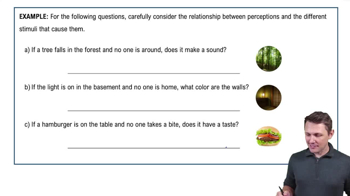
Adequate stimulus is the specific form of energy a sensory receptor cell is specialized to respond to.
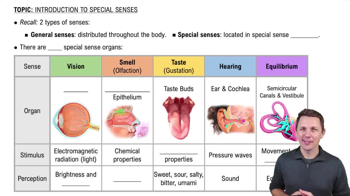
Chemoreceptors detect chemical stimuli and are found in smell, taste, and tissue damage receptors.
Thermoreceptors respond to changes in temperature.
Mechanoreceptors detect mechanical stimuli such as touch, hearing, and equilibrium.
Photoreceptors are specialized cells that detect light energy in the eye.
Ligand-gated ion channels open in response to a ligand binding, allowing ions like Ca2+ to enter and generate receptor potentials.
Olfactory receptors are G protein-coupled receptors that activate adenylyl cyclase to produce cAMP, opening cation channels and depolarizing the cell.
Sweet (sugars), Salty (Na+), Sour (H+), Bitter (toxic molecules), Umami (glutamate and nucleotides).
They use G protein-coupled receptors called gustducin to initiate signal transduction.
They directly depolarize taste receptor cells causing release of serotonin.
The tympanic membrane vibrates in response to sound waves, transmitting vibrations to the middle ear bones.
Malleus, incus, and stapes amplify sound vibrations from the tympanic membrane to the oval window of the cochlea.
The oval window transmits vibrations into the cochlear fluid; the round window allows fluid displacement to relieve pressure.
Movement of stereocilia opens mechanically gated ion channels, causing depolarization or hyperpolarization of hair cells.
Bending stereocilia toward the tallest stereocilium opens ion channels, leading to depolarization.
Basilar membrane movement causes hair cells to move against the tectorial membrane, triggering ion channel opening.
The vestibular apparatus detects head position and movement to maintain balance and equilibrium.
Otoliths are calcium carbonate crystals that move with gravity, stimulating hair cells in the vestibular system to detect head position.
Sound waves enter the ear canal, vibrate the tympanic membrane, are amplified by middle ear bones, and transmitted to the cochlea via the oval window.