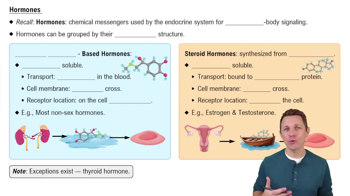
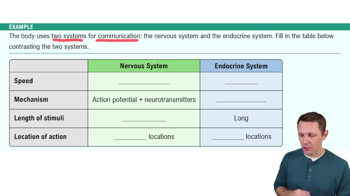
What is the primary function of the endocrine system?
To coordinate and integrate body cell activities by releasing hormones into the blood, influencing metabolic activities with slower but longer-lasting responses than the nervous system.
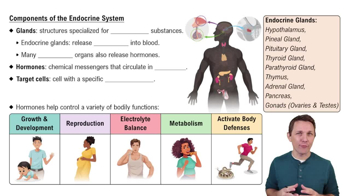
Name the main endocrine glands.
Pituitary, thyroid, parathyroid, adrenal, and pineal glands.
What are the two main classes of hormones?
Amino acid–based hormones (including peptides and proteins) and steroids synthesized from cholesterol.
How do hormones affect target cells?
By altering plasma membrane permeability, stimulating enzyme or protein synthesis, activating/deactivating enzymes, inducing secretory activity, or stimulating mitosis.
What triggers hormone release in the endocrine system?
Endocrine gland stimuli (humoral, neural, hormonal) and nervous system modulation.
Define humoral stimuli in hormone release.
Changing blood levels of ions and nutrients directly stimulate hormone secretion, e.g., low blood Ca2+ triggers parathyroid hormone release.
What is neural stimuli in hormone release?
Nerve fibers stimulate hormone release, such as sympathetic fibers triggering adrenal medulla to secrete catecholamines.
Explain hormonal stimuli in hormone release.
Hormones stimulate other endocrine glands to release hormones, e.g., hypothalamic hormones stimulate anterior pituitary hormones.
What determines target cell specificity for hormones?
Presence of specific receptors, blood hormone levels, receptor number, and receptor-hormone binding affinity.
What is up-regulation and down-regulation of hormone receptors?
Up-regulation: target cells increase receptors in response to low hormone levels. Down-regulation: target cells decrease receptors due to high hormone levels.
What is the half-life of a hormone?
The time required for the blood level of a hormone to decrease by half, varying from minutes to days depending on the hormone.
Describe permissiveness in hormone interaction.
One hormone cannot exert its full effect without another hormone being present.
What is synergism in hormone action?
Multiple hormones produce the same effect on a target cell, amplifying the response.
Define antagonism in hormone interaction.
One hormone opposes the action of another, e.g., insulin and glucagon.
What hormones are secreted by the posterior pituitary?
Oxytocin and antidiuretic hormone (ADH), both produced by hypothalamic neurons and stored in the posterior pituitary.
What are the main functions of oxytocin?
Stimulates uterine contractions during childbirth and triggers milk ejection during breastfeeding.
How does antidiuretic hormone (ADH) regulate water balance?
ADH targets kidney tubules to reabsorb water, reducing urine output; high concentrations cause vasoconstriction.
What are the direct metabolic effects of growth hormone (GH)?
Decreases glucose uptake, triggers glycogen breakdown, increases fatty acid levels, and promotes protein synthesis.
How is growth hormone (GH) secretion regulated?
Stimulated by growth hormone-releasing hormone (GHRH) and inhibited by growth hormone-inhibiting hormone (GHIH or somatostatin).
What is the role of thyroid-stimulating hormone (TSH)?
Stimulates thyroid gland development and secretion of thyroid hormones.
How is adrenocorticotropic hormone (ACTH) regulated?
Released in response to corticotropin-releasing hormone (CRH) from the hypothalamus, with feedback inhibition by cortisol.
What are the functions of follicle-stimulating hormone (FSH) and luteinizing hormone (LH)?
FSH stimulates gamete production; LH promotes gonadal hormone production and triggers ovulation in females.
What hormone does prolactin (PRL) regulate and how is it controlled?
Stimulates milk production; regulated mainly by prolactin-inhibiting hormone (dopamine) and stimulated by estrogen and suckling.
What are the two main thyroid hormones and their effects?
T4 (thyroxine) and T3 (triiodothyronine); they increase basal metabolic rate, regulate growth, development, and maintain blood pressure.
What is the role of parathyroid hormone (PTH)?
Maintains calcium homeostasis by stimulating bone resorption, increasing kidney reabsorption of Ca2+, and activating vitamin D for intestinal absorption.
What hormones are produced by the adrenal cortex?
Mineralocorticoids (e.g., aldosterone), glucocorticoids (e.g., cortisol), and gonadocorticoids (weak androgens).
Describe the renin-angiotensin-aldosterone mechanism.
Low blood pressure triggers renin release, leading to angiotensin II formation, which stimulates aldosterone release to increase blood volume and pressure.
What are the main effects of cortisol?
Increases blood glucose via gluconeogenesis, promotes fat and protein metabolism, enhances vasoconstriction, and suppresses inflammation and immune response.
What hormones are secreted by the adrenal medulla?
Catecholamines: epinephrine (80%) and norepinephrine (20%), which increase heart rate, blood glucose, and cause vasoconstriction.
What hormone does the pineal gland secrete and its function?
Melatonin, which regulates circadian rhythms, sexual maturation timing, and physiological processes with rhythmic variations.
What are the endocrine functions of the pancreas?
Alpha cells produce glucagon to raise blood glucose; beta cells produce insulin to lower blood glucose.
How does insulin lower blood glucose levels?
Enhances glucose uptake by cells, inhibits glycogen breakdown, and prevents conversion of amino acids/fats to glucose.
What are the primary sex hormones produced by the gonads?
Ovaries produce estrogens and progesterone; testes produce testosterone.
 뒤로
 7:06