 뒤로
Anatomy & Physiology: The Skeletal System
 3:56

이 집합의 용어 (29)
Axial skeleton and Appendicular skeleton.
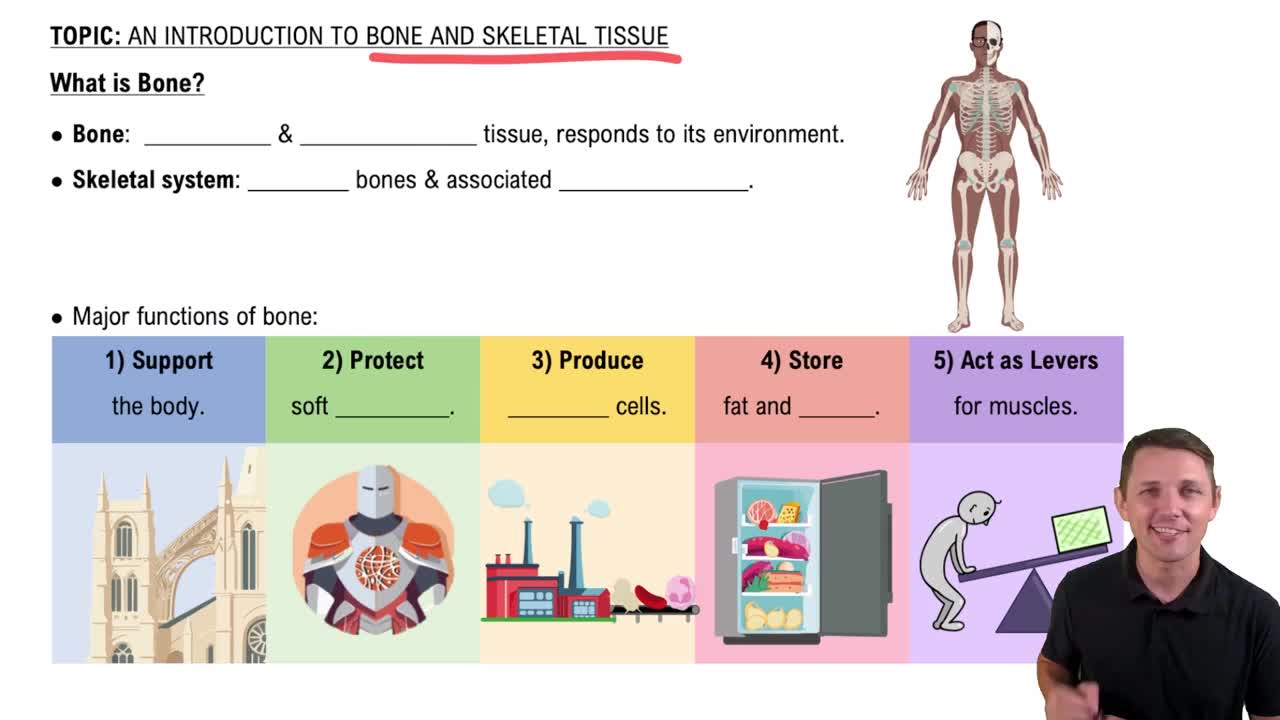
Support the body, protect soft organs, allow movement, store minerals and fats, and blood cell formation (hematopoiesis).
Compact bone: dense and smooth; Spongy bone: needlelike pieces with many open spaces.
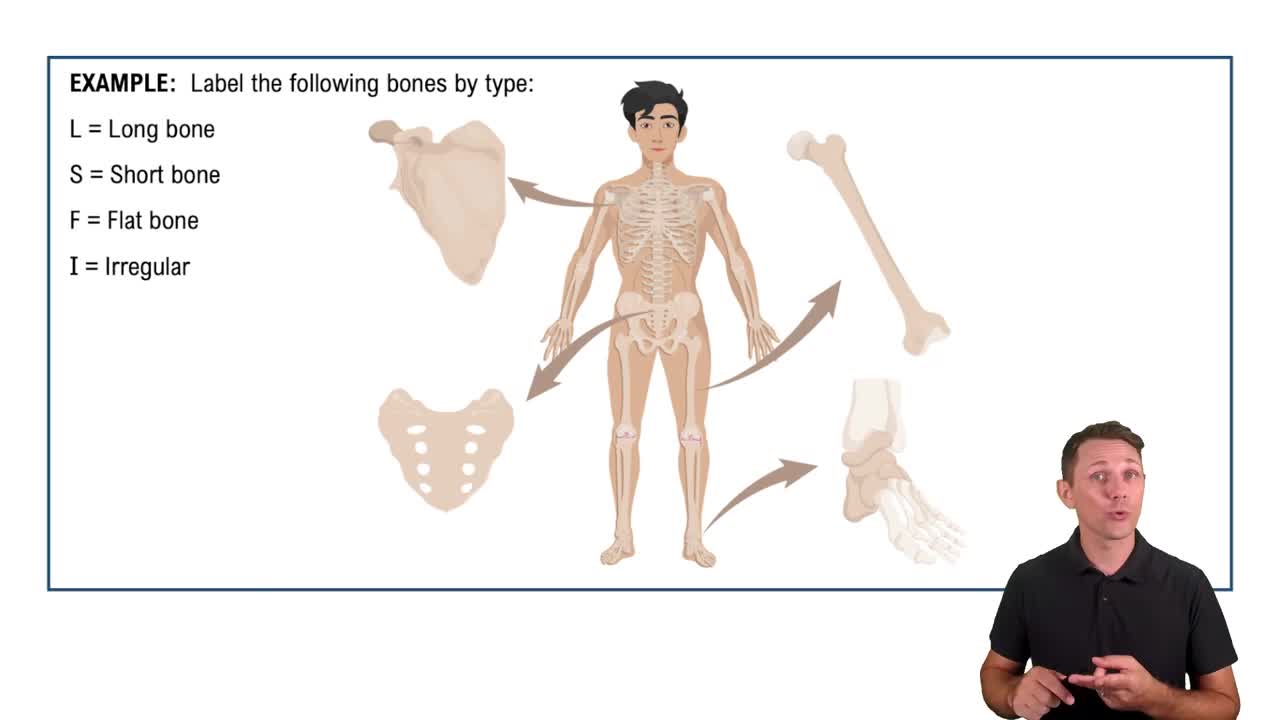
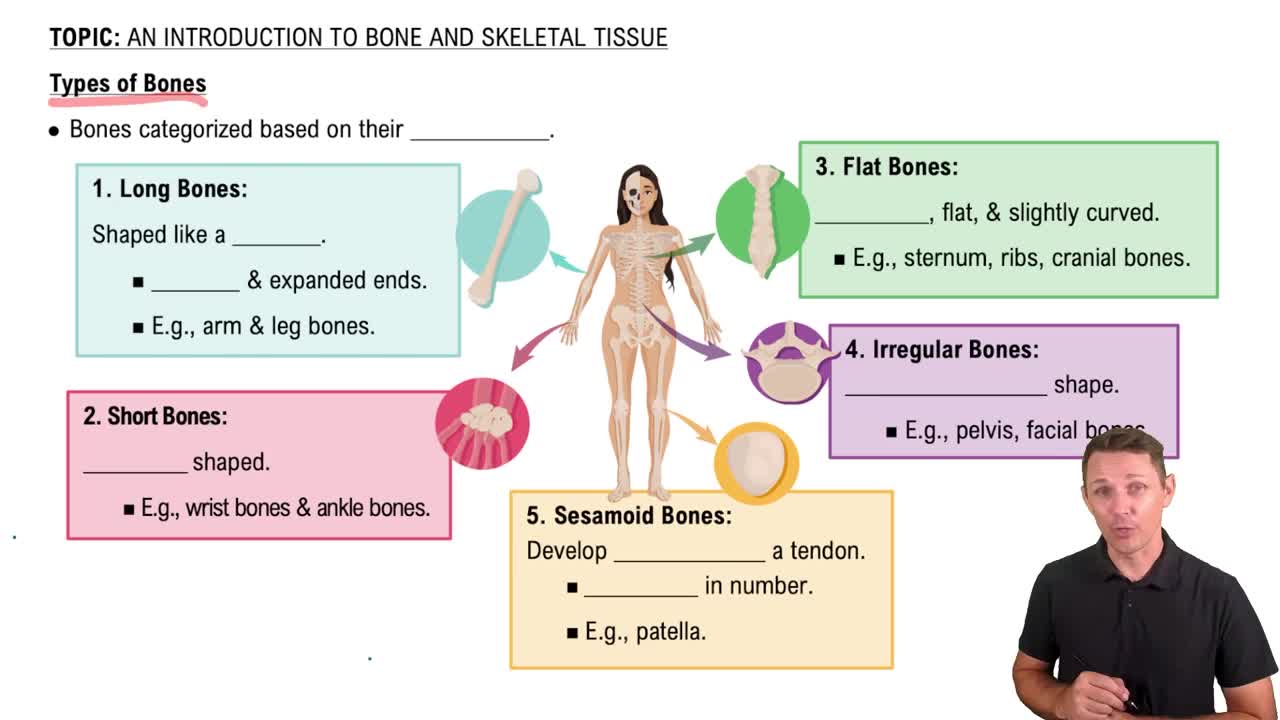
Long, flat, short, and irregular bones.
Longer than wide, shaft with enlarged ends, mostly compact bone with spongy bone at ends; examples: femur, humerus.
The shaft, composed of compact bone, covered by periosteum (fibrous connective tissue membrane).
Ends of the bone, mostly spongy bone enclosed by thin compact bone, covered with articular cartilage to reduce friction.
Epiphyseal plate is hyaline cartilage in growing bones causing lengthwise growth; epiphyseal line is its remnant in adults.
Contains yellow marrow (fat) in adults and red marrow (blood cell formation) in infants.
Projections/processes (often start with 'T') for muscle attachment and depressions/fossae (often start with 'F') for nerves and vessels.
Structural and functional unit of compact bone, consisting of a central canal surrounded by concentric lamellae.
Tiny canals that connect osteocytes to the central canal, forming a nutrient transport system.
Collagen fibers provide flexibility and tensile strength; calcium salts provide hardness to resist compression.
The process of bone formation, occurring on hyaline cartilage models or fibrous membranes.
1) Osteoblasts cover cartilage with bone matrix; 2) Cartilage is digested to form medullary cavity.
Bone growth in width by osteoblasts adding matrix outside and osteoclasts removing bone inside the diaphysis.
Growth hormone and sex hormones regulate bone growth.
Released when blood calcium is low; activates osteoclasts to break down bone and release calcium.
Closed (simple) fracture does not penetrate skin; open (compound) fracture penetrates skin.
Hematoma formation, fibrocartilage callus formation, bony callus replaces fibrocartilage, bone remodeling.
Skull, vertebral column, and bony thorax.
8 bones that enclose and protect the brain.
14 bones that hold eyes anteriorly and allow facial expression.
Lighten the skull and amplify sounds during speech.
Does not articulate with any other bone; supports the tongue and aids in swallowing and speech.
Primary curvatures (thoracic, sacral) present at birth; secondary curvatures (cervical, lumbar) develop after birth.
Synarthroses (immovable), amphiarthroses (slightly movable), diarthroses (freely movable).
Fibrous (immovable), cartilaginous (immovable or slightly movable), synovial (freely movable).
Articular cartilage, articular capsule, joint cavity with synovial fluid, and reinforcing ligaments.