 뒤로
Anatomy & Physiology Unit 1-3 Key Concepts
 01:59

이 집합의 용어 (26)
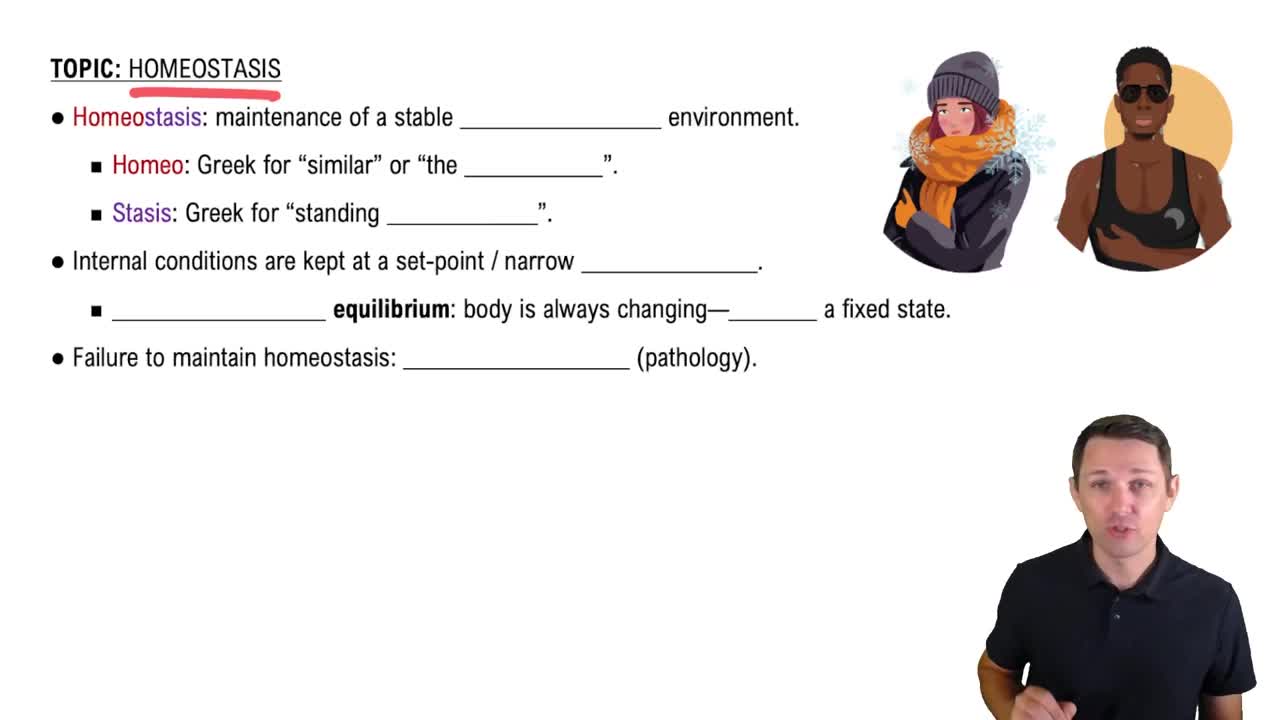
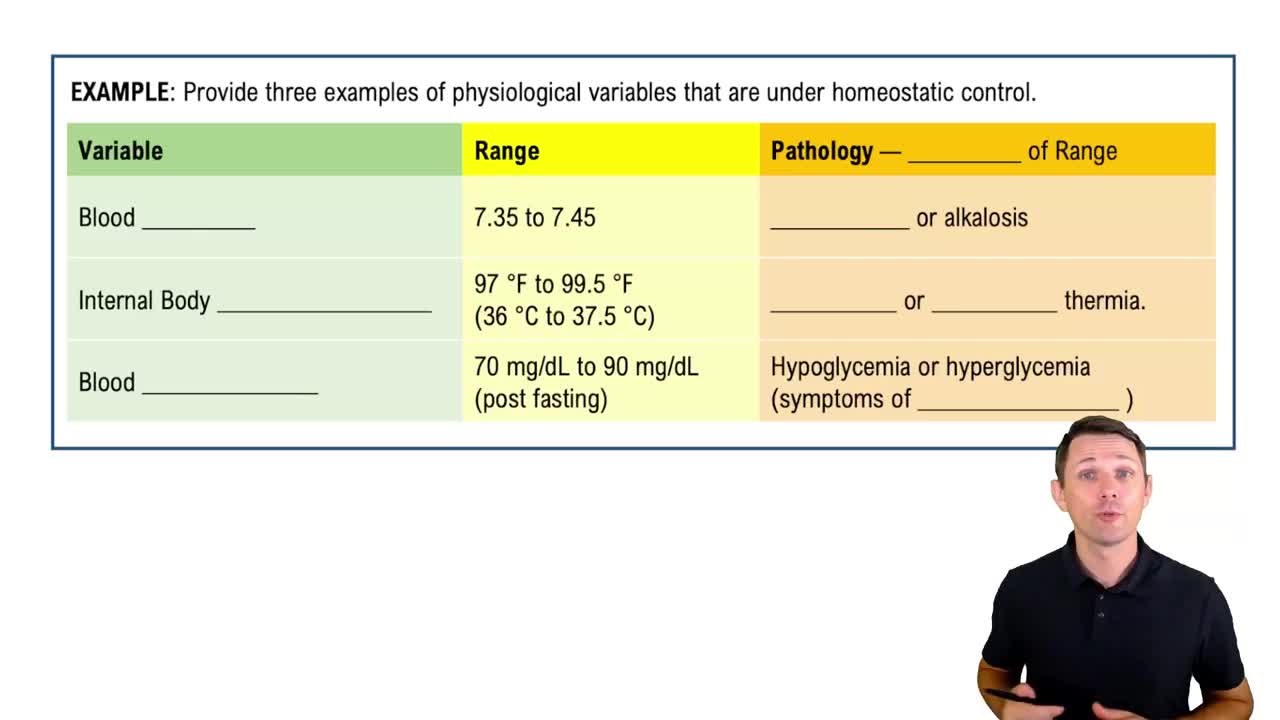
Homeostasis is the body's ability to maintain a stable internal environment despite external changes.
Stimulus, Receptor, Afferent Pathway, Control Center, Efferent Pathway, Effector.
Electrical signals (nervous system) and chemical signals (endocrine system).
Examples include the spinal cord, pancreas, and endocrine glands.
Muscles, glands, organs, and cells that respond to control center signals.
The response performed by the effector to adjust the internal condition.
A change in the internal or external environment that is detected by receptors.
The stimulus is the increased body temperature because it is the detected change triggering the response.
Thermoreceptors detect changes in temperature.
Sweating is the body's response (action), not the initial detected change.
Because it is a physiological response, not the original detected change triggering the loop.
The stimulus is reduced or eliminated, restoring balance.
Negative feedback reverses a change to maintain homeostasis; positive feedback amplifies a change to complete a process.
System: Blood clotting; Stimulus: Blood vessel injury; Receptor: Platelets; Control center: Platelet activation; Instructions: Release chemicals; Effector: Platelets; Action: Clot formation.
System: Body temperature regulation; Stimulus: Increased body temperature; Receptor: Thermoreceptors; Control center: Hypothalamus; Instructions: Signal sweat glands; Effector: Sweat glands; Action: Sweating to cool body.
Negative feedback loops are more common.
Atoms consist of protons and neutrons in the nucleus, with electrons orbiting in shells around it.
Electrons occupy orbital shells; the valence shell is the outermost. The octet rule states atoms are most stable with 8 electrons in their valence shell.
Atoms with incomplete valence shells are reactive; they form bonds by gaining, losing (forming cations/anions), or sharing electrons.
Covalent bonds share electrons between atoms; ionic bonds transfer electrons, creating charged ions attracted to each other.
Electronegativity is an atom's ability to attract electrons in a bond.
Fluorine, oxygen, and nitrogen.
H2O has polar covalent bonds and a bent shape causing uneven charge; O2 and CO2 have nonpolar bonds or symmetrical shapes, so charges balance out.
Water's polarity allows it to surround and separate charged ions, dissolving ionic compounds.
A weak attraction between a hydrogen atom covalently bonded to an electronegative atom and another electronegative atom.
Polar covalent bonds create partial charges needed for hydrogen bonds to form between molecules.