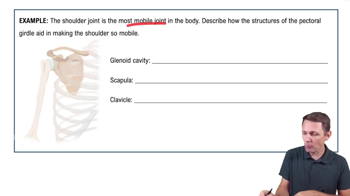
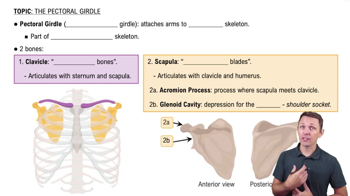
The pectoral girdle consists of the clavicle (collarbone) and the scapula (shoulder blade).
What is the only direct connection between the axial skeleton and the pectoral girdle?
The clavicle articulates with the manubrium of the sternum and is the only direct connection between the axial skeleton and the pectoral girdle.
How is the scapula attached to the axial skeleton?
The scapula is attached to the clavicle anteriorly but has no direct connection to the axial skeleton; it is supported by skeletal muscles and ligaments.
Name the major parts of the scapula.
The scapula includes the acromion, coracoid process, spine, glenoid cavity, superior border, medial border, and inferior angle.
What are the movements of the pectoral girdle?
The pectoral girdle can perform elevation, depression, protraction, and retraction.
What bones compose the upper limb?
The upper limb consists of the brachium (humerus), antebrachium (radius and ulna), wrist (carpals), and hand (metacarpals and phalanges).
Identify the proximal features of the humerus.
The proximal humerus includes the head, anatomical neck, greater tubercle, lesser tubercle, and intertubercular sulcus.
What are the distal features of the humerus?
The distal humerus has the capitulum, trochlea, medial epicondyle, lateral epicondyle, and fossae such as the olecranon fossa.
What bones form the forearm?
The forearm is formed by the radius and ulna.
What is the function of the interosseous membrane between the radius and ulna?
The interosseous membrane connects the radius and ulna, providing surface area for muscle attachment and stabilizing the two bones.
Name the bones of the wrist.
The wrist contains 8 carpal bones: scaphoid, lunate, triquetrum, pisiform, trapezium, trapezoid, capitate, and hamate.
How many metacarpal bones are in the hand and what do they form?
There are 5 metacarpal bones that articulate with the distal carpal bones and form the palm of the hand.
How many phalanges are in the hand and how are they arranged?
The hand has 14 phalanges: each finger has proximal, middle, and distal phalanges except the thumb, which has only proximal and distal.
What bones make up the pelvic girdle?
The pelvic girdle consists of two ossa coxae (hip bones), which support and protect lower viscera and the developing fetus in females.
List the main differences between the male and female pelvis.
The female pelvis has a wider pelvic outlet, less curvature of sacrum and coccyx, wider pelvic inlet, broader and lower pelvis, widely fanning ilia, and a pubic angle greater than 100 degrees.
What bones compose the lower limb?
The lower limb includes the femur (thigh), patella (kneecap), tibia and fibula (leg), tarsal bones (ankle), metatarsals, and phalanges (foot).
What is the function of the lower limb?
The lower limb is responsible for transferring body weight to the ground during standing and movement.
Name the bones of the ankle.
The ankle contains 7 tarsal bones: talus, calcaneus, navicular, medial cuneiform, intermediate cuneiform, lateral cuneiform, and cuboid.
How many phalanges are in the foot and how are they arranged?
The foot has 14 phalanges: each toe has proximal, middle, and distal phalanges except the big toe, which has only proximal and distal.
What information can the skeleton reveal about an individual?
The skeleton can reveal information about race, medical history, gender, body size, muscle mass, and age.
 뒤로
 6:23