What is dual innervation in the autonomic nervous system?
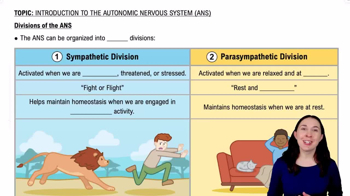
Dual innervation means most organs receive input from both the sympathetic and parasympathetic divisions, allowing balanced regulation of organ function.
What are the primary functions of the parasympathetic and sympathetic nervous systems?
The parasympathetic nervous system promotes rest and digest activities, while the sympathetic nervous system initiates fight-or-flight responses.
What types of neurons transmit signals in the autonomic nervous system?
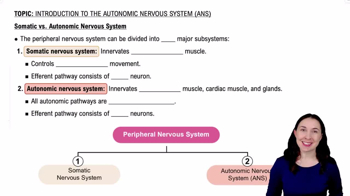
The ANS uses preganglionic neurons from the CNS that synapse in autonomic ganglia, and postganglionic neurons that extend to effector organs.
Which cranial nerves are involved in the parasympathetic nervous system?
Cranial nerves III (oculomotor), VII (facial), IX (glossopharyngeal), and X (vagus) are involved in parasympathetic innervation.
What types of fibers are found in autonomic nerves?
Autonomic nerves contain both efferent fibers (motor, controlling organs) and afferent fibers (sensory, relaying information from visceral receptors).
What are the two main types of cholinergic receptors in the ANS?
Cholinergic receptors include nicotinic (ionotropic) and muscarinic (metabotropic) receptors that bind acetylcholine.
What are the main classes of adrenergic receptors and their general effects?
Alpha (α) receptors are usually excitatory with higher affinity for norepinephrine; Beta (β) receptors activate cAMP with subtypes β1 (excitatory) and β2 (inhibitory).
What is a neuroeffector junction in the autonomic nervous system?
A neuroeffector junction is a synapse between postganglionic neurons and effector organs where neurotransmitters are released from varicosities.
How is neurotransmitter release triggered at neuroeffector junctions?
An action potential opens voltage-gated Ca2+ channels, causing exocytosis of neurotransmitter stored in varicosities.
What is tonic activity in autonomic regulation?
Both sympathetic and parasympathetic branches are active at rest, with parasympathetic dominance maintaining homeostasis.
How does the autonomic nervous system regulate blood pressure when standing?
Visceral receptors detect change, afferent pathways send signals to the medulla, which adjusts sympathetic and parasympathetic output to maintain blood pressure.
Which brain areas regulate autonomic function?
The hypothalamus, pons, and medulla oblongata are key centers for autonomic regulation.
What is a motor unit in the somatic nervous system?
A motor unit consists of one motor neuron and all the skeletal muscle fibers it innervates.
What neurotransmitter is released at the neuromuscular junction?
Acetylcholine is released and binds to nicotinic cholinergic receptors on the motor end plate.
What happens during the end-plate potential (EPP) at the neuromuscular junction?
ACh binding opens Na+ and K+ channels, causing depolarization that triggers a muscle action potential and contraction.
Compare the origin of neurons in the parasympathetic, sympathetic, and somatic nervous systems.
Parasympathetic neurons originate in brainstem or sacral spinal cord; sympathetic neurons in thoracic and lumbar spinal cord; somatic neurons in ventral horns of spinal cord.
What neurotransmitters act at neuroeffector junctions in the autonomic and somatic systems?
What receptor types are found at effector organs in the autonomic and somatic systems?
Parasympathetic uses muscarinic cholinergic receptors; sympathetic uses adrenergic and some muscarinic; somatic uses nicotinic cholinergic receptors.
Name a muscarinic agonist drug and its clinical use.
Pilocarpine is a muscarinic agonist used to treat dry mouth and glaucoma.
What is the mechanism of action of atropine and its clinical application?
Atropine blocks muscarinic cholinergic receptors and is used to induce mydriasis, reduce salivation, and treat motion sickness.
How does propranolol affect the autonomic nervous system?
Propranolol is a β1 and β2 antagonist used to treat hypertension and arrhythmias by blocking adrenergic receptors.
Describe the process of synaptic transmission in the nervous system.
An action potential triggers neurotransmitter release from presynaptic vesicles, which bind postsynaptic receptors to elicit a response; neurotransmitters are then degraded or reabsorbed.
What enzyme hydrolyzes acetylcholine at the synapse?
Acetylcholinesterase hydrolyzes acetylcholine into choline and acetate, terminating its action.
 뒤로
 1:10