 뒤로
Autonomic Nervous System and Neurophysiology
 1:10

이 집합의 용어 (21)
A ganglion is a cluster of neuron cell bodies located in the peripheral nervous system.
A preganglionic neuron is a neuron that originates in the central nervous system and projects to a ganglion in the autonomic nervous system.
A postganglionic neuron is a neuron that originates in an autonomic ganglion and projects to the target effector organ.
The sympathetic chain is a series of interconnected ganglia located alongside the vertebral column involved in sympathetic nervous system signaling.
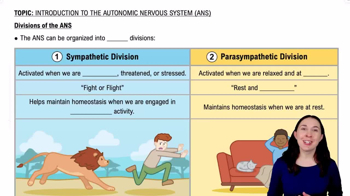
The sympathetic nervous system prepares the body for 'fight or flight' responses, increasing heart rate, dilating pupils, and diverting blood to muscles.
Collateral ganglia are autonomic ganglia located anterior to the vertebral column that provide sympathetic innervation to abdominal and pelvic organs.
The parasympathetic nervous system promotes 'rest and digest' activities, conserving energy and maintaining homeostasis.
Terminal ganglia are parasympathetic ganglia located near or within the target organs.
Cholinergic neurotransmitters release acetylcholine; cholinergic receptors include nicotinic and muscarinic receptors that bind acetylcholine.
Adrenergic neurotransmitters release norepinephrine; adrenergic receptors include alpha (α) and beta (β) receptors that bind norepinephrine or epinephrine.
α receptors typically cause excitatory effects via calcium signaling; β receptors often cause inhibitory or excitatory effects via cyclic AMP pathways.
Binding of acetylcholine to nicotinic receptors opens ion channels causing depolarization and excitation of the postganglionic neuron or muscle cell.
Binding of acetylcholine to muscarinic receptors activates G-protein coupled pathways leading to varied effects depending on the target cell.
A neuroeffector junction is the synapse between a postganglionic autonomic neuron and its target effector cell.
A varicosity is a swollen region along the axon of a postganglionic neuron that releases neurotransmitters over a wide area of the target tissue.
A neuromuscular junction is the synapse between a somatic motor neuron and a skeletal muscle fiber.
Preganglionic neurons in both sympathetic and parasympathetic systems release acetylcholine; postganglionic neurons in parasympathetic also release acetylcholine.
Postganglionic neurons in the sympathetic nervous system typically release norepinephrine as their neurotransmitter.
They often have opposing effects on the same organ to maintain homeostasis, such as heart rate modulation by increasing or decreasing activity.
The central nervous system (CNS) and the peripheral nervous system (PNS).
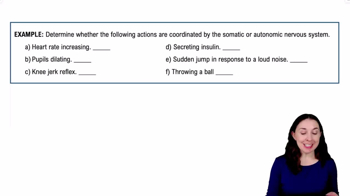
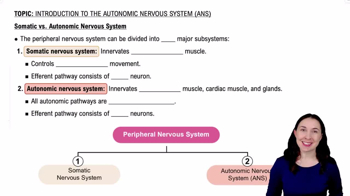
The somatic nervous system and the autonomic nervous system, which includes sympathetic and parasympathetic divisions.