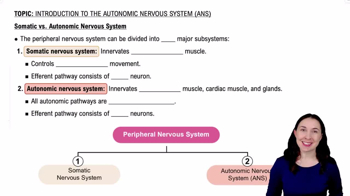
The autonomic nervous system is the involuntary or general visceral motor system controlling internal organs and glands.
What neurotransmitter is released by cholinergic neurons?
Cholinergic neurons release acetylcholine (ACh) as their neurotransmitter.
What neurotransmitters are associated with adrenergic neurons?
Adrenergic neurons release norepinephrine (NE) or epinephrine (EPI) as neurotransmitters.
What is the role of the adrenal medulla in the autonomic nervous system?
The adrenal medulla releases epinephrine (EPI) and norepinephrine into the bloodstream during sympathetic activation.
Define dual innervation.
Dual innervation means an organ receives nerve fibers from both the sympathetic and parasympathetic divisions.
What are effectors in the autonomic nervous system?
Effectors are muscles or glands that respond to autonomic nerve signals.
What is a ganglion in the autonomic nervous system?
A ganglion is a cluster of neuron cell bodies located outside the central nervous system.
What type of receptor binds acetylcholine at the neuromuscular junction?
The nicotinic receptor binds acetylcholine at the neuromuscular junction and autonomic ganglia.
What receptor type mediates parasympathetic effects on target organs?
The muscarinic receptor mediates parasympathetic effects on target organs.
What are alpha receptors?
Alpha receptors are adrenergic receptors that generally cause excitatory responses to norepinephrine.
What are beta receptors?
Beta receptors are adrenergic receptors that can cause excitatory or inhibitory effects depending on the subtype.
What is the parasympathetic division?
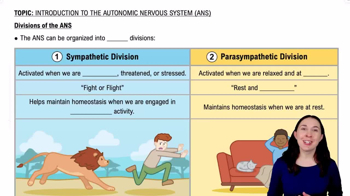
The parasympathetic division promotes rest-and-digest activities, conserving energy and maintaining homeostasis.
What is the general function of adrenergic nerve fibers?
Adrenergic nerve fibers release norepinephrine to stimulate sympathetic responses.
What is the general function of cholinergic nerve fibers?
Cholinergic nerve fibers release acetylcholine to stimulate parasympathetic or sympathetic preganglionic neurons.
How does norepinephrine affect target organs?
Norepinephrine binds to alpha and beta adrenergic receptors to modulate sympathetic responses.
What is the difference between nicotinic and muscarinic receptors?
Nicotinic receptors are ion channels at ganglia and neuromuscular junctions; muscarinic receptors are G-protein coupled receptors on target organs.
What is the role of neurotransmitters in the autonomic nervous system?
Neurotransmitters transmit signals from neurons to effectors, regulating organ function.
What is the significance of ganglia in autonomic pathways?
Ganglia serve as relay points where preganglionic neurons synapse with postganglionic neurons.
How does epinephrine differ from norepinephrine in autonomic function?
Epinephrine is mainly released by the adrenal medulla into the blood, amplifying sympathetic effects; norepinephrine acts locally as a neurotransmitter.
What is the general effect of alpha receptor activation?
Alpha receptor activation typically causes vasoconstriction and increased blood pressure.
 뒤로
 1:10